
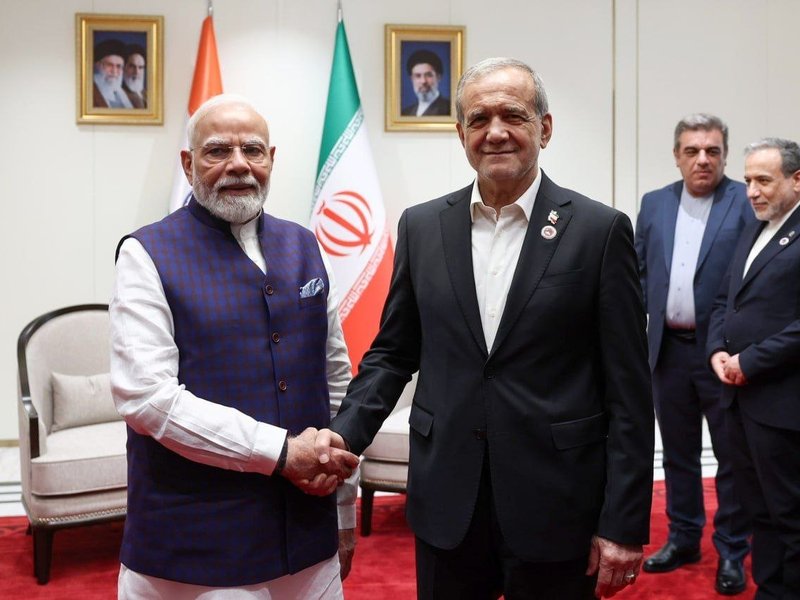
New Delhi, Sep 1 (IANS) Noted journalist and former Minister of State for External Affairs, M J Akbar, on Tuesday said that the bilateral meeting between Prime Minister Narendra Modi and Iran President Masoud Pezeshkian on the sidelines of the SCO Summit in Bishkek has sent a "very powerful message" as it took place against the background of the recent Mecca Pact signed between Saudi Arabia, Turkey and Pakistan.
Prime Minister Modi and Pezeshkian held extensive discussions in the Kyrgyzstan capital on Monday, discussing bilateral ties and also the recent developments in the West Asia conflict while sharing their perspectives on the evolving situation.
"The most important meeting on the agenda of Prime Minister Modi on his visit to the SCO at Kyrgyzstan was, in fact, his first meeting which was with the Iran President. By the very meeting, they sent a very powerful message because the meeting itself was against the background of the Mecca Pact. The meeting itself actually sent the message that war and war alliances are not the solution to problems. The solution to problems lies in negotiation and what Prime Minister Modi has identified as the nub of his policy, which is peace, is the answer to the future, particularly to the generations which are at this moment struggling to find an economic future," Akbar told IANS in an interview.
During the meeting, PM Modi had expressed concern at the escalation of tensions in the region and reiterated India’s consistent position that all issues must be resolved through dialogue and diplomacy.
"Iran and India have used what in diplomacy is known as flexible realism in order to find a new rapport. A very important element of the negotiations was the discussion of trade. And this must also be seen in the context of the American effort to impose what they call outcast sanctions and tariffs on Iran," said Akbar.
Highlighting that both countries are civilizational states which understand that the bilateral bonds that they can build are "far more important than pacts which are designed for war", the former minister highlighted that Prime Minister Modi has insisted that it is very important to keep the Hormuz Strait safe for passage of ships.
"In my view, the most important bilateral element was the discussion over Chabahar port. That port has taken on an extremely critical importance in the present crisis. This port has been part of the Indo-Iran agenda for a long while, but really came to fruition in the first five years of Prime Minister Modi's tenure in office. The fact that it has revived is extremely good news for both countries," Akbar emphasised.
He also reckoned that National Security Advisor (NSA) Ajit Doval's recent visit to Beijing has had an "extraordinarily salutary effect" on India-China equations.
"The border management has been the source of our problem for the last five decades and more. The '62 war itself became a very major watershed in our relations which were harmonious by and large till then. Since then, the border has been the point of conflict and the point of challenge for both our militaries as well as our diplomats and our foreign policies. But, by and large, the agreement on the border which was fashioned in 1988 has helped in which both sides came to a very fundamental understanding that the resolution lies in non-resolution.
"That means you accept reality as it is and then find other methods and other avenues of cooperation. This is a message that has been reinforced by Mr. Doval's visit and I think there is enough evidence that China has understood that hawks within the Chinese system, hawks within the Chinese military are not conducive to good relations with India. There is, I can only call it speculation, that a very prominent military hawk in the Chinese, in the supreme command of the Chinese army, has been suddenly dropped recently. We do not know the full truth of this because the Chinese system remains opaque," Akbar added.
He also mentioned the significance of Chinese President Xi Jinping's scheduled visit to New Delhi next week to attend the BRICS Summit.
"President Xi is going to be in Delhi for the BRICS Summit and both sides are making every effort to see that, this visit - although it will be under the umbrella of BRICS, but there will be a very strong bilateral element to it - this meeting, substantive meeting between Prime Minister Modi and President Xi will settle existing turbulence and pave the way for cooperation within the foreseeable future."
--IANS
/as