
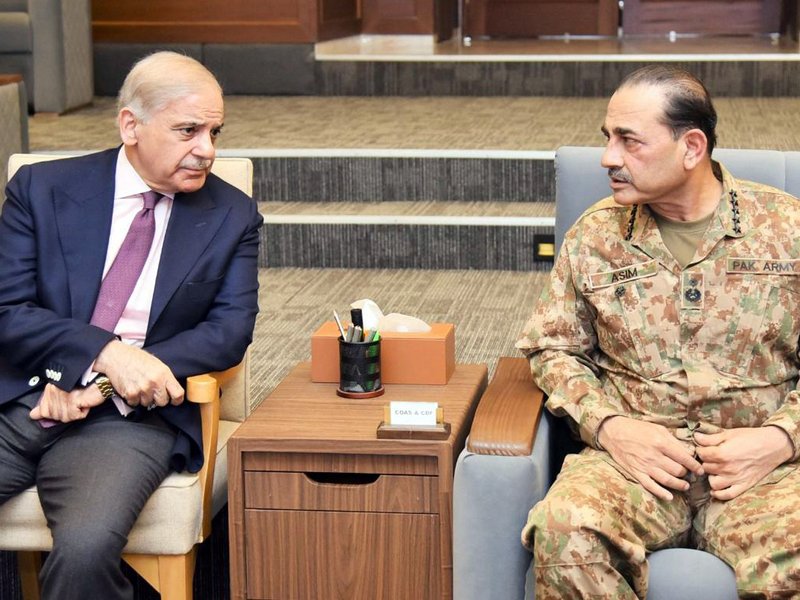
Jerusalem, Nov 29 (IANS) Under the pretext of administrative reform, Pakistan's army chief, Field Marshal Asim Munir, appears to be preparing a fundamental reorganisation of the country's political geography that could dismantle the political structures standing between him and absolute power, and even weaken the foundations holding Pakistan together, according to a report.
"Pakistan has already lost one half of its territory because its rulers failed to distinguish between controlling a country and governing its people. The tragedy would be for its military leadership to repeat that mistake while claiming to be saving the nation," wrote Sergio Restelli, an Italian political advisor, author and geopolitical expert, in The Times of Israel.
According to Restelli, the proposal to divide Pakistan's four provinces into as many as 12 to 15 smaller administrative units, presented as an attempt to improve governance, could fundamentally alter the country's federal structure.
"For Munir, weakening these centres could achieve what decades of military interference have failed to accomplish permanently. It could create a political system in which no civilian institution possesses sufficient territorial, financial or electoral strength to challenge the army," he stated.
Restelli noted that breaking up the provinces could diminish the influence of established political parties, such as the Sharif family's Pakistan Muslim League-Nawaz in Punjab and the Bhutto-Zardari dynasty's Pakistan Peoples Party in Sindh, while multiplying the number of provincial governments dependent on the federal establishment.
"Pakistan would remain a federation on paper while becoming increasingly centralised in practice," he wrote.
Highlighting that the greatest danger lies in Balochistan, which has experienced decades of separatist violence and political alienation, the report said that any attempt to divide the province without political consent could be interpreted as another attempt to dilute regional identity and weaken demands for autonomy.
"In Balochistan, where distrust of Islamabad is already deeply entrenched, imposing a new political geography without broad consent could strengthen precisely those forces the military seeks to contain," Restelli stated.
The report also flagged the economic cost of the plan, citing an October estimate by the Islamabad-based Policy Research Institute of Market Economy that dividing Punjab into three provinces alone could cost between 46.9 billion and 56.2 billion Pakistani rupees annually.
"Pakistan could end up with more governments, more politicians, more bureaucrats and greater expenditure without any corresponding improvement in public services," it mentioned.
--IANS
ksk/vd