
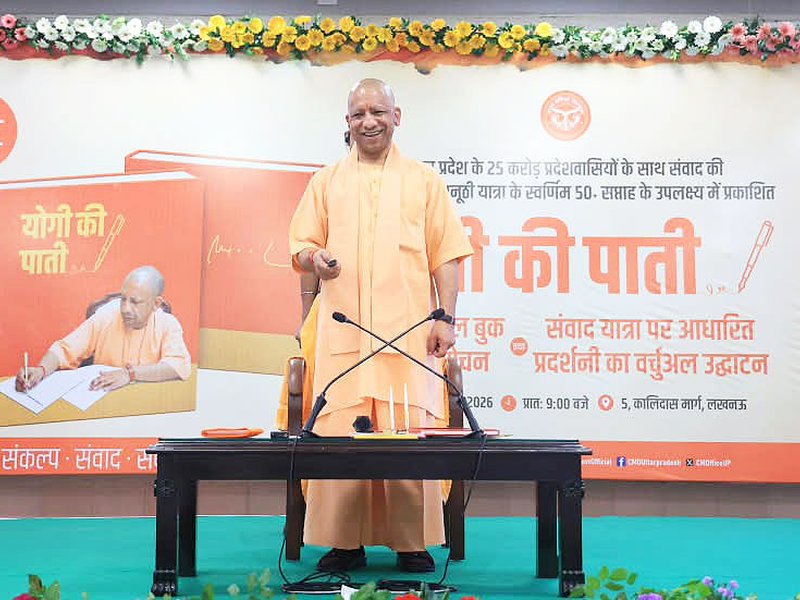
Lucknow, Nov 16 (IANS) Uttar Pradesh Chief Minister Yogi Adityanath on Monday unveiled the coffee table book 'Yogi Ki Paati' at his official residence to mark the golden milestone of more than 50 weeks of unique dialogue with the 25 crore people of the state.
He also virtually inaugurated an exhibition based on the dialogue journey.
The Chief Minister said that old previous government-led system had left innocent children to suffer and die due to insensitivity, while the present system has given those children and common people a better life and improved quality of life.
This, he added, is the true example of a government's sensitivity and responsibility.
"The state government has not bestowed any favour or grace; it has only discharged its duties."
Ensuring that the benefits of government schemes reach the person standing at the last rung of society is the government's responsibility, the Chief Minister said.
"'Yogi Ki Paati' is a medium of this sensitivity, concern and intimate dialogue," the Chief Minister said.
Chief Minister Yogi Adityanath recalled that amid official engagements, the thought often crossed his mind of how to share those untouched aspects of public life with ordinary citizens that remain unknown to large sections of society.
In nearly three decades of public life, the Chief Minister realised that many communities, classes and subjects lack adequate public awareness.
"Through 'Yogi Ki Paati', an effort has been made to bring these aspects to the forefront and connect every section of society through dialogue."
Citing the Vantangia community as an example, the Chief Minister said that nearly 120 years ago, the British had cut vast forests to lay railway lines and later settled people in those areas to regenerate the forests, promising them land in return for planting trees and protecting them.
"As the forests grew, these families were progressively neglected. Even after Independence in 1947, they remained without permanent houses, electricity, water, ration cards or the right to elect a village head. Generations lived in neglect and deprivation inside the forests. In 2005-06, while in Maharajganj, he saw a long procession of Vantangia families walking barefoot in tattered clothes."
Upon inquiry, CM Adityanath learnt they were going to the district headquarters to protest. Some people from Bihar had also joined them and were trying to use their movement.
He immediately arranged food and night stay for them through local workers, helped prepare a memorandum and later called them to Gorakhpur, assuring them that their fight would be taken up.
Their settlements existed in Maharajganj (18), Gorakhpur (5) and several other districts, including Siddharthnagar, Balrampur, Gonda, Lakhimpur Kheri and Pilibhit.
He met the then Prime Minister Manmohan Singh and explained the need to amend the forest rights law, also presenting evidence of their long residence before the Environment Minister Jairam Ramesh.
He distinguished between natural forests (random growth) and artificially planted ones (in orderly rows).
"Forest experts can assess the age of trees; those 75–100 years or older prove that the ancestors of these families had planted them. The Centre amended the law in 2007-08, but it was not effectively implemented in Uttar Pradesh until 2017. After becoming Chief Minister, he prioritised securing the rights of Vantangia families. Today, thousands of families in 54 Vantangia settlements enjoy basic facilities and civic rights. These efforts also drew his attention to the problems of other tribes and deprived communities such as the Musahar, Tharu, Chero, Gond, Kol, Buksa and Sahariya."
Referring to the Musahar community, the Chief Minister recalled that during Mulayam Singh Yadav's tenure, nearly a dozen people had died of hunger in Kushinagar even as a foodgrain scam was underway.
He had protested and submitted a memorandum to the then Governor.
"Today, Musahar families have been given land pattas, houses and linked to various government schemes."
In Chitrakoot, he noted, Lord Ram had first interacted with Nishadraj and later stayed among the Kol community thousands of years ago.
Yet even after more than seven decades of Independence, many Kol families were forced to live in thatched huts with mud walls.
"Under the Chief Minister Awas Yojana they have now been provided pucca houses and linked to other schemes."
He asked whether those whose voices are not heard can be kept deprived of government schemes.
"Every individual has the right to a life of dignity and to the benefits of government programmes."
As another example of sensitivity, the Chief Minister recalled the long struggle against encephalitis in eastern Uttar Pradesh. Every year from mid-July to mid-November, thousands of children fell ill and hundreds died. Hospitals lacked basic facilities. When he visited the BRD Medical College in Gorakhpur, as an MP, a 100-bed ward was packed with 1,000–1,200 patients.
"In the July heat there were no fans or electricity; four children and five-six relatives shared each bed. He (Yogi Adityanath) returned to Gorakhnath Temple, arranged 100 beds, mattresses, ACs, fans and bedsheets the following week and sent them to the medical college.
In Balrampur, children's deaths were being reported as due to an "unknown disease".
The Chief Minister insisted that with medical science so advanced, treatment for encephalitis must be ensured on the basis of symptoms.
Today, he said with satisfaction that continuous government efforts have completely eliminated encephalitis and no child dies from it anymore.
Changes in the Basic Education Council were also cited as an example of sensitive governance, he added.
"Before 2017, a large number of schools were without teachers, buildings were dilapidated and children lacked basic resources. Sixty to 70 per cent of children, especially girls, were forced to go to school barefoot. Initially shoes, socks and uniforms were provided to girls; later the same facilities were extended to boys. Today nearly 1.60 crore children receive two uniforms, school bags, books, and shoes and socks. Funds are transferred directly to parents' accounts through Direct Benefit Transfer (DBT)."
"Through Operation Kayakalp, basic facilities have been developed in schools with public participation, achieving nearly 96 per cent saturation in Basic Education Council schools. Atal Residential Schools for children of labourers and modern CM Composite Schools are emerging as new centres of quality education."
Yogi Ki Paati, the Chief Minister said, gives space to the concerns of youth, students, women's dignity, farmers (the annadatas), labourers and every section of society.
It also highlights the efforts of heritage and development that constitute the real strength of Uttar Pradesh. Even when schemes exist, eligible people often cannot avail them due to lack of information. Therefore, repeated dissemination of information about schemes such as Ayushman cards, ration cards and destitute women pension is necessary.
The purpose of 'Yogi Ki Paati' is to ensure that information about government schemes and achievements reaches the last person in society.
--IANS
sktr/khz