
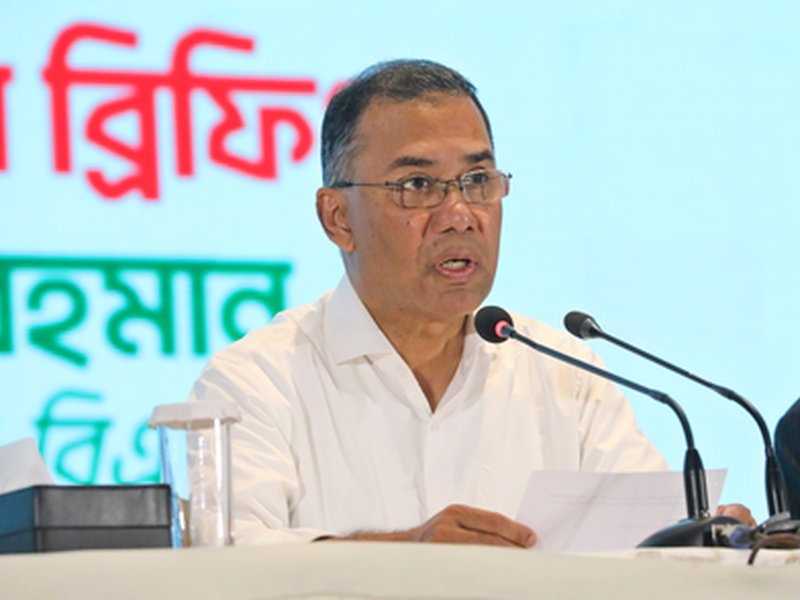
Colombo, Feb 22 (IANS) Zillur Rahman, a leading Bangladeshi journalist and President of the Centre for Governance Studies in Dhaka, in an exclusive interview with a leading think-tank, asserted that India and Bangladesh share long-standing historical, economic, and strategic connections.
He emphasised that although policy priorities may evolve under the Bangladesh Nationalist Party (BNP)-led government, the long-term relationship between India and Bangladesh is expected to remain constructive.
In an interview with Sri Lanka-based think-tank Trinco Centre for Strategic Studies (TCSS), Zillur Rahman said, "India and Bangladesh share deep historical, economic, and strategic ties. While policy priorities may shift under the BNP, the long-term relationship is likely to remain constructive. Bangladesh Prime Minister Tarique Rahman's leadership will require balancing domestic nationalist expectations with the practical benefits of strong regional cooperation."
"Potential friction may arise on border management, trade, or infrastructure projects, but both countries have strong institutional and people-to-people connections that provide a framework for dialogue. I expect Dhaka will seek a pragmatic approach: maintaining cooperation on trade, energy, and connectivity while asserting Bangladesh's sovereignty and domestic priorities," he added.
Responding to a question on Islamabad's potential renewed engagement, particularly with Jamaat-e-Islami, whose ideology aligns more closely with Pakistan, the Bangladeshi journalist stressed that while "historical and ideological links may create space for engagement between Pakistan and certain political actors in Bangladesh", the country's foreign policy is ultimately shaped by strategic and economic considerations.
On whether such engagement could steer Dhaka away from its long-standing partnership with India, he said, "Pakistan's engagement is unlikely to fundamentally redirect Dhaka's long-standing cooperation with India, given the deep interdependence in trade, energy, and regional security."
"What is more plausible is selective engagement on specific issues, without altering Bangladesh's broader regional alignment. Dhaka's leadership is likely to maintain pragmatic diplomacy: balancing relationships with multiple partners while protecting national interests and sovereignty," Rahman added.
When asked about growing concerns regarding China's growing influence in South Asia and geopolitical challenges ahead for Bangladesh, he said that the South Asian nation is increasingly navigating a multipolar world order, where maintaining strategic autonomy is crucial.
"China's economic and infrastructure engagement offers opportunities, particularly in connectivity and investment, but requires careful management to avoid over-dependence. Simultaneously, relationships with the US, Europe, and regional neighbours remain important. The new government will need to balance these partnerships thoughtfully, maintaining sovereignty while leveraging foreign investment and diplomatic support," Rahman told TCSS.
--IANS
scor/khz