
New Delhi, Nov 29 (IANS) Prime Minister Narendra Modi is expected in Canada's Toronto and Ottawa on December 11–12, and negotiators are racing to finish a Comprehensive Economic Partnership Agreement (CEPA) between the two countries, which is broader than a conventional free-trade pact, according to a report.
Global Affairs Canada says it will span goods and services trade, investment, agriculture, digital trade, mobility and sustainable development. Officials are working through 16 policy areas, and three services chapters are closed, with another round planned for December, as per the One World Outlook report.
The bilateral trade in goods and services has already reached $21.3 billion in 2025 as the two countries aim to more than double that to roughly $49 billion by 2030.
The logic is as much strategic as commercial. The US took 71.7 per cent of Canada’s merchandise exports in 2025, down from 75.9 per cent a year earlier, according to Statistics Canada, and Canadian Prime Minister Mark Carney has made reducing that dependence a centrepiece of policy. India, which is the fastest-growing major economy, wants secure supplies of fuel, food and minerals from a stable partner, states the report by Olivia Marie Gagnon.
"The fit is unusually good. Canada has uranium, natural gas, potash, pulses, minerals and deep pools of pension capital. India has 1.4 billion consumers, a vast engineering workforce, a world-class generic drug industry and a diaspora of 1.8 million Canadians of Indian origin," the report stated.
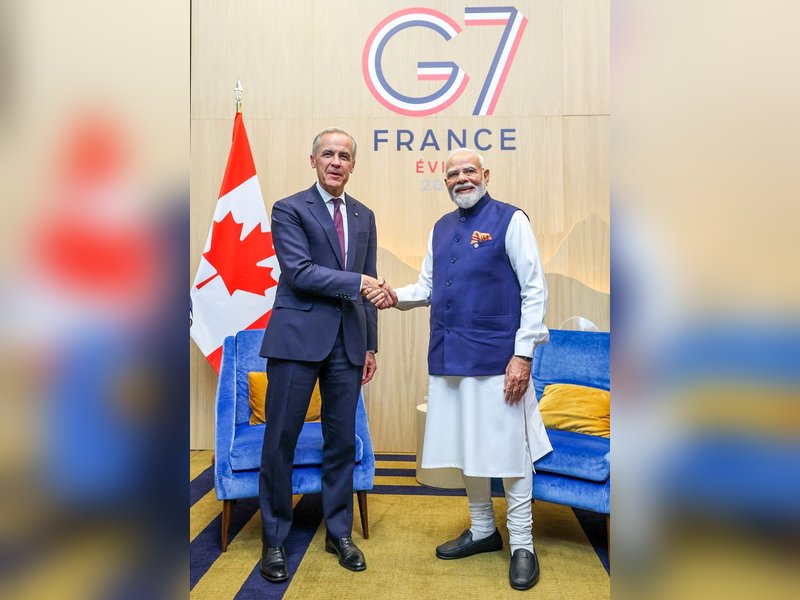
The ball was set rolling for stronger ties between the two countries with Prime Ministers Modi and Carney meeting at the G7 summit in Kananaskis.
Carney’s visit to India, from February 27 to March 2, was the first by a Canadian Prime Minister in eight years, and built around deliverables rather than ceremony. In Mumbai and New Delhi, he and PM Modi signed the terms of reference for CEPA, launched a strategic energy partnership and welcomed memoranda on critical minerals, renewable energy and education. Cameco signed a $1.8 billion uranium contract, and Canadian officials counted more than 10 commercial agreements worth about $3.9 billion.
The momentum has continued with Trade Minister Maninder Sidhu leading nearly 300 businesses to New Delhi, Bengaluru and Mumbai, producing 34 commercial agreements worth almost $210 million in October. Sidhu and his Indian counterpart Piyush Goyal have met 10 times since May 2025, the report stated.
--IANS
sps/vd