

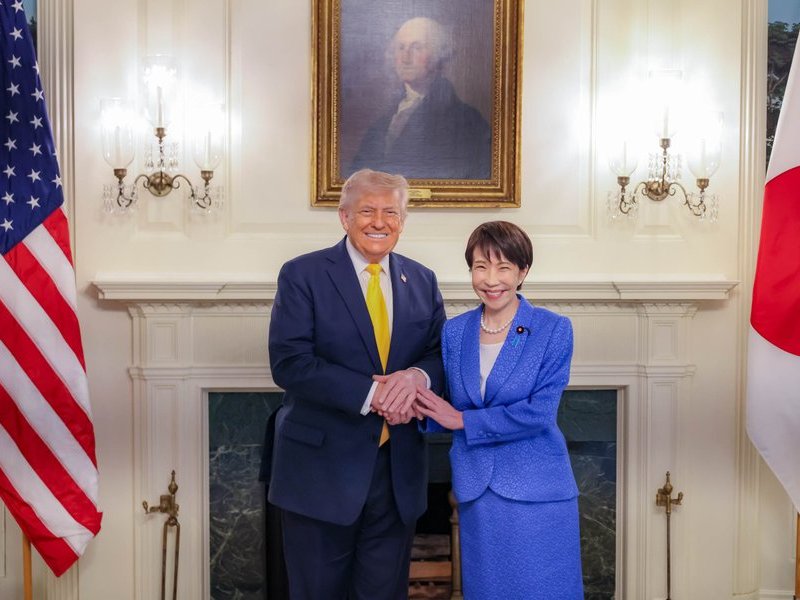
Washington, March 20 (IANS) The United States and Japan announced over $100 billion in energy and infrastructure investments, alongside new defence and supply chain measures, signalling a sharper strategic alignment in the Indo-Pacific.
President Donald Trump and Prime Minister Sanae Takaichi met at the White House and outlined a broad set of initiatives to strengthen the US-Japan alliance, boost economic security, and reinforce deterrence in the region.
A key pillar of the announcement was a major expansion of Japanese investment in the United States. In addition to an earlier $36 billion tranche, a second round includes up to $40 billion for small modular reactor projects in Tennessee and Alabama and up to $33 billion for natural gas generation facilities in Pennsylvania and Texas.
The joint statement said the deployment of advanced reactors would serve as a “next-generation stable power source, stabilizing electricity prices for the American people and strengthening the Japan-US leadership in global technological competition.”
The two sides also agreed to deepen cooperation on supply chains, particularly in critical minerals. A new action plan aims to expand production and diversify sources of key inputs for strategic industries.
Ambassador Jamieson Greer said the plan would “expand the production and diversity of critical minerals, laying the foundation for a binding plurilateral agreement supported by price floors and other measures.”
Both countries will accelerate joint research on deep-sea mineral resources, including rare-earth deposits near Japan’s Minamitorishima Island, which could support long-term industrial demand.
On the economic front, the United States said it would improve market access for agricultural exports to Japan. It will also prioritise visa processing for business travellers who “make significant investments, train American workers, or transfer critical skills, techniques, or know-how.”
Technology and innovation featured prominently in the discussions. Agreements were reached to expand cooperation in artificial intelligence, quantum technologies, and high-performance computing, involving government agencies and private sector partners.
In space, Japan will support NASA’s Artemis programme with a crewed lunar rover. The two sides also plan to expand their collaboration in low Earth orbit and future Moon missions.
Defence cooperation was another major focus. The United States welcomed Japan’s commitment to increase defence spending and strengthen its military capabilities. Both sides will expand missile defence cooperation and increase production of key systems.
They will also build on the deployment of advanced capabilities in Japan to support what they described as a “strong denial defense posture.” Plans include increasing production of Standard Missile-3 systems and exploring co-production of advanced air-to-air missiles.
On regional security, the leaders reaffirmed their commitment to “peace and stability across the Taiwan Strait” and opposed unilateral attempts to change the status quo. They also reiterated their commitment to the “complete denuclearization of North Korea.”
Separately, a bipartisan group of US senators introduced a resolution welcoming Takaichi’s visit. Senator Jeanne Shaheen said the alliance remains “a cornerstone of peace, stability and economic prosperity in the Indo-Pacific,” while Senator Bill Hagerty described the partnership as entering a “new ‘golden age’… in terms of national security, economic security, and energy security.”
--IANS
lkj/rs