
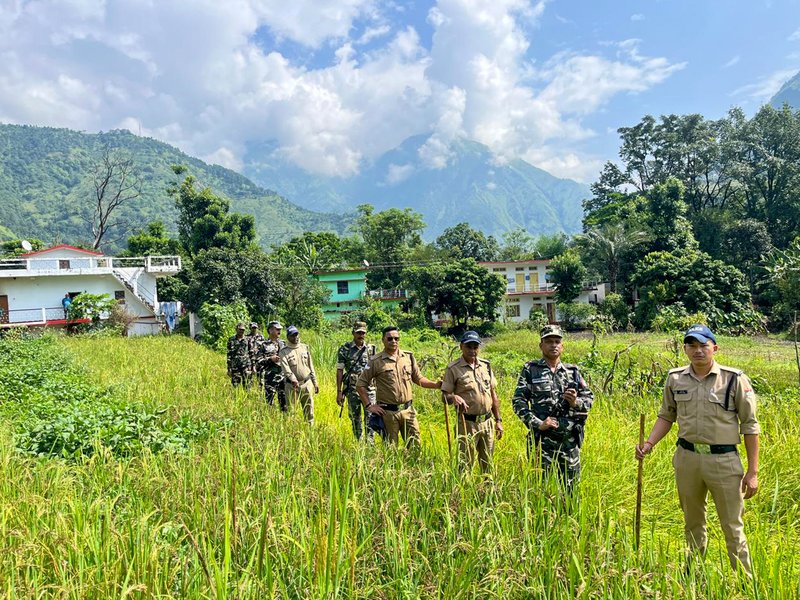
Kathmandu, Aug 21 (IANS) Nepal and India have agreed to enhance security surveillance at sensitive locations along their border through the use of modern and advanced technologies, including CCTV cameras and other equipment, during a meeting of a high-level joint mechanism between the two countries.
The two countries face the risk of cross-border crime because of the porous border between them, although the open border has also strengthened people-to-people ties across the two countries.
Relations between Nepal and India are often characterized as those of “Roti and Beti” (bread and daughter), reflecting long-standing traditions of cross-border livelihoods and marriages.
During the two-day 14th meeting of the Nepal-India Joint Working Group (JWG) on Border Management, which concluded in Dehradun on Friday, discussions focused on strengthening effective coordination and real-time information exchange between relevant agencies of the two countries to curb cross-border crimes and illegal activities, Nepal’s Home Ministry said in a statement.
Cross-border crimes and illegal activities, including drug trafficking, trafficking of psychotropic substances and prohibited and controlled medicines, wildlife and human trafficking, economic crimes involving counterfeit currency, and the illegal trade in arms and ammunition, were among the issues discussed during the meeting.
“The Nepali side also raised emerging security challenges, including cybercrime and cross-border digital fraud,” the ministry said.
India's Ministry of Home Affairs said in a statement that both sides reviewed the entire spectrum of bilateral cooperation on border management and security and reaffirmed their commitment to strengthening cooperation in these areas.
“Discussions covered addressing trans-border crime and criminal activities; the strengthening and effective utilization of border infrastructure, particularly Integrated Check Posts (ICPs), roads and railway networks; and the removal of encroachments and maintenance of boundary pillars,” it said. “The two sides also exchanged views on strengthening institutional coordination and capacity building across various sectors, and agreed to sustain engagement in these areas.”
According to Nepal’s Home Ministry, the meeting also held extensive discussions on key border management issues, including preventing encroachment and unauthorized use of the No Man’s Land (Dasgaja) area.
When Nepal’s Prime Minister Balendra Shah remarked in the House of Representatives in late May that Nepal had also encroached on Indian territory, drawing strong criticism from opposition parties, Nepal’s Foreign Ministry later clarified that the PM's remarks primarily referred to encroachments in the no-man’s-land area along the border and what he described as “cross-border occupation.”
“The issue mentioned by the Prime Minister in Parliament is essentially related to encroachment in the Dasgaja area [no-man’s land] and cross-border occupation,” the ministry had said.
According to the ministry, as the Fixed Boundary Principle was adopted in demarcating the Nepal-India border in riverine areas, situations of “cross-border occupation” have arisen in which citizens of one country cultivate land or reside on territory that falls within the other country.
The two sides also discussed facilitating the cross-border movement of citizens of both countries, strengthening mechanisms for facilitating and monitoring third-country nationals traveling through Nepal-India border points, improving disaster management, and making Nepal-India district-level coordination meetings (BDCCs) more effective, according to Nepal’s Home Ministry.
The Nepali delegation at the joint-secretary-level mechanism was led by Anand Kafle, Joint Secretary at Nepal’s Ministry of Home Affairs, while the Indian delegation was led by Pausumi Basu, Joint Secretary at India’s Ministry of Home Affairs.
The two sides also agreed to hold the next meeting of the Joint Working Group in Nepal on a mutually convenient date.
--IANS
scor/as