

New Delhi, July 24 (IANS) While a brilliant spell of 2-18 in the first T20I against Zimbabwe provided immense joy for Mayank Yadav on his return to international cricket, the bigger picture stretches far beyond it for the Delhi-based tearaway pacer.
A 21-month injury layoff due to a stress fracture in the back needing surgery in Christchurch, New Zealand in July 2025, Mayank picking Player of the Match award on successful return to international cricket at the Harare Sports Club is merely step one in taking the world by storm again – like how he did in a breakthrough IPL 2024 season.
For Devendra Sharma, Mayank’s childhood coach at the Sonnet Club in the national capital, watching the speedster hit his strides and trouble the Zimbabwe batters with some serious heat again brought equal parts relief and satisfaction after a grueling spell on the sidelines.
“He bowled exceedingly well. It was a treat to the eyes to see him perform very well. As his coach, it felt very joyful and I was really happy to see it because all the hard work done by him, including during the rehab phase, has paid off. I remember of the time he was very worried because things weren’t going well for him after picking the back injury in IPL 2025 and continuously was at the NCA (now the BCCI Centre of Excellence) in Bengaluru).
“Before he left for Zimbabwe on July 20, I advised him to not stick much to bowling short balls all the time. I told him, ‘Just see the footwork of the batter and bowl as per that,’ and that advice worked really well. It was also wonderful to see him get the backing from the likes of VVS Laxman,” an elated Sharma told IANS in an exclusive conversation on Friday.
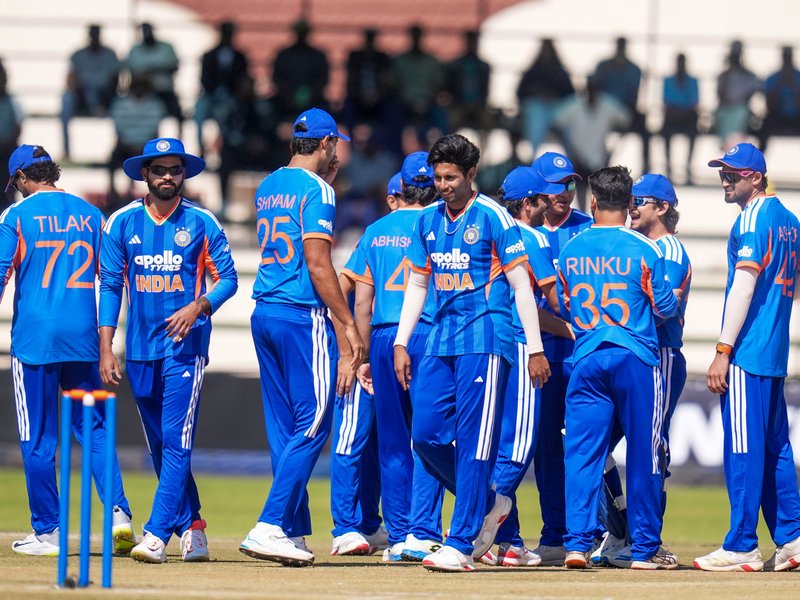
Mayank was right on the money when on a pitch with spongy bounce, he produced a steep delivery that squared Brian Bennett up and a faint edge was caught behind by wicketkeeper Ishan Kishan. The early breakthrough set the tone for Mayank, leaving Dion Myers tentative in his footwork as he struggled to cope with the pacer's raw pace and eventually fell to him.
Ten of Mayank's first 12 deliveries were clocked in the mid-to-high 140kmph range, with his fastest ball touching 149kmph. With 21 of his 24 deliveries pitched either short-of-a-length or in the good-length area, Mayank extracted sharp zip and bounce off the deck, repeatedly squaring up the batters and hitting them high on the handle. In all, seeing Mayank bowl fast and hurry Zimbabwe’s batters for pace was a purist’s delight.
Having spent an extended period recovering at the Centre of Excellence (CoE), for injuries ranging from back to elbow, side strain and toe infection before stress fracture came into picture, the primary focus for Mayank was ensuring that he capitalized immediately upon his return to the international setup. It also helped that he was constantly kept in the scheme of things – like his selection for India A team in the T20 World Cup warm-up games and having a net bowling stint during the one-off Test against Afghanistan in New Chandigarh in June.
“Whenever you get a chance or opportunity to play, you have to grab it with both hands. For Mayank, getting that first game and then doing well in it was super important as he has to maintain himself to be in the reckoning for future T20I assignments and he literally did what was asked of him,” added Sharma, also the childhood coach of India wicketkeeper-batter Rishabh Pant.
The road back from the serious back injury is rarely straightforward for a express pacer, and Sharma was candid in explaining psychological hurdles Mayank had to overcome in that phase full of turbulence.
“When a player goes through an injury and has to do rehab, there are lots of ups and downs in the mind. Like whether I will play or not and even if I play, will it be the same as before? Credit to him – he did his rehab with a lot of shiddat (dedication). He did his daily exercises and then graduated to bowling 15-20 overs daily at CoE.
“In times like that, a player just needs motivation to keep going. Like ‘Yes, you can do it. You have the capability.’ The chats I always had with him were centered around motivating him.
“Before he left for Zimbabwe, I called him to say, ‘You have got a very good opportunity. Make the most of it and don’t let it go to waste because if you do well here, then the path of cementing your place in the Indian team will be made. Credit goes to his hardwork, and the dedication he showed daily to do his rehab well,” he recalled.
Sharma also highlighted the crucial role played by the medical and training staff at the CoE, where access to top-tier facilities via a fast bowling contract accelerated Mayank's recovery and helped sharpen his skill set.
“Credit should also go to the people at the CoE for helping him to get back to the field. The machines and equipment needed for him to get better at the CoE – such facilities aren’t here in Delhi. Being at the CoE has helped him become better in all aspects and I am absolutely sure that he will continue doing well in coming matches.”
While T20Is serve as the immediate stage for Mayank's comeback after making his debut in the series against Bangladesh in 2024, Sharma revealed that the long-term roadmap includes building workload capacity to ready the fast bowler for the ultimate Test in longer formats.
“He was very elated on getting the chance to play again for India. When a player gets a call-up again to play internationally, the mind also starts to be full of joy because all the hard work done over the years is for playing cricket only, no? He practiced in Chandigarh as well in the run-up to the one-off Test against Afghanistan.
“Our next step is to improve his fitness and prepare for playing ODIs and Tests. He shouldn't get injured now considering he had the surgery which Bumrah went through. He had a good rehab and will increase his stamina gradually. After putting 15-20 overs at the CoE, he will soon aim to put 25 overs in a day and try for him to play Tests.”
Beyond physical recovery, tactical adjustments have been central to Mayank's evolution. “In cricket, if we work hard in the right way, we will definitely get success. The lines and lengths vary from batter to batter - some play well on the front foot, some on the back foot or either both ways.
“At that time, the bowler has to see where he has to bowl and employ variations accordingly. He bowled more short balls in the IPL (this time, where he took no wickets) and I told him that time not to do so as the batter is standing on the back foot and has time to hit the ball. So, you have to give less room.
“I did talk about this with him and urged him to think well before bowling as then you will get success. I just hope that he will bowl well in the coming games. He has got a good start and he will do better in the upcoming matches,” concluded Sharma.
--IANS
nr/bc