
Brussels, Jan 11 (IANS) The New Year, which is meant to mark renewal, exposed a reality that political leaders want to hide in Europe. From Brussels to Amsterdam, from Strasbourg to Berlin, from suburbs in France to cities in Italy, the transition into the New Year followed a similar pattern - fires, riots, attacks on emergency services and neighbourhoods surrendered to mobsters in their majority Muslim immigrants, a report has stated.
A report in Brussels Signal stated, "This was not at all some random occurrence of disorder. It was definitely not “youth excess”. It was not a fireworks problem by any means. Rather, it was the predictable outcome of mass immigration combined with failed integration, cultural fragmentation, and a political refusal to confront the role of Islam in shaping parallel social ethos. In Brussels, unrest erupted from districts long identified by police as high-risk during major public events -areas with immigrant and Muslim populations."
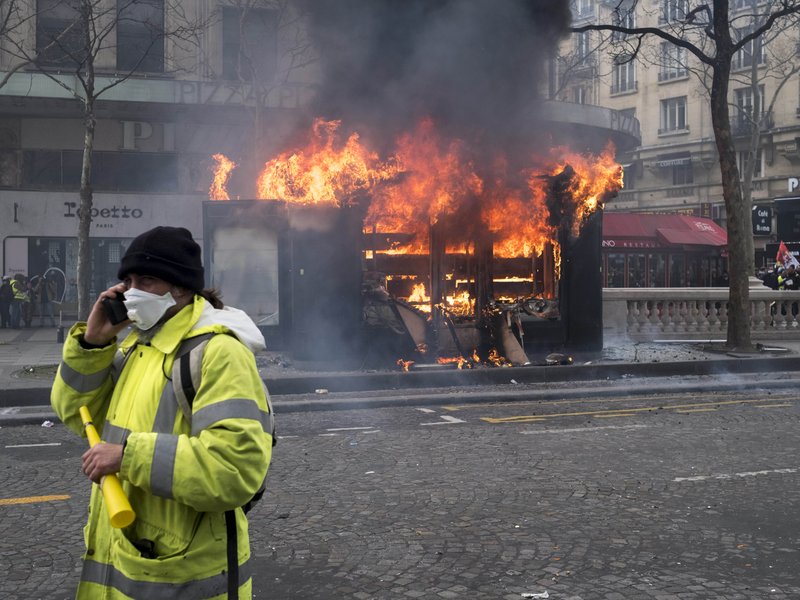
During the unrest, homes and businesses were targeted, over 150 arrests were made, dozens of cars were burned, and stones were pelted at firefighters and incendiaries while responding to arson. The unrest started after Morocco’s success in the Africa Cup of Nations. Police lost control despite deploying additional units as it expected trouble.. This issue is not about football but the absence of loyalty to the host society, the normalisation of hostility towards police, and the use of public space as a stage for showcasing identity instead of embracing citizenship and this is happening across the European Union.
"In Amsterdam, during a night marked by widespread violence and hundreds of arrests nationwide, the Vondelkerk, a 19th-century Christian landmark, was engulfed in flames and effectively destroyed. The fire broke out amid heavy illegal fireworks use and repeated assaults on police and emergency services. What was once a Christian symbol was lost during a night of lawlessness driven by groups with no attachment to Europe’s cultural inheritance," a report in Brussels Signal stated.
More than a thousand vehicles were torched across France. Police faced coordinated attacks using fireworks and projectiles in districts already linked to chronic unrest in Strasbourg. Germany faced a similar situation as police and firefighters were targeted with illegal fireworks in Berlin, Hamburg and the Ruhr.
Police unions acknowledged that neighbourhoods in Germany became no-go zones for emergency services during peak hours, according to a report in Brussels Signal. Majority of this violence occurred in regions with high levels of immigration and integration failure, especially among Muslim young men socialised outside German civic norms. Meanwhile, police broke up violent gatherings in Milan, Turin, Rome, Naples and Florence, with security personnel facing attacks using fireworks.
A report in Brussels Signal stated, "The common denominator across Europe is not poverty, nor fireworks, nor celebration. It is a parallel society shaped by immigration and reinforced by Islamic cultural distance from European norms. In these environments, the state is viewed as the enemy, police are seen as adversaries and public space is treated as contested territory rather than shared inheritance."
It is not a phenomenon that began by accident. However, Europe has been importing aggressors by the millions without demanding assimilation and is encouraging multiculturalism without safeguarding the dominant culture and traditions.
The report said, "Fireworks bans, curfews, and emergency deployments are mere bandages in the face of a strategic failure. They do nothing to address the deeper problem: Europe is now a continent that has lost confidence in its right to impose its own rules, defend its symbols, and demand that any newcomers must adapt to Western values and practices."
--IANS
akl/dan