
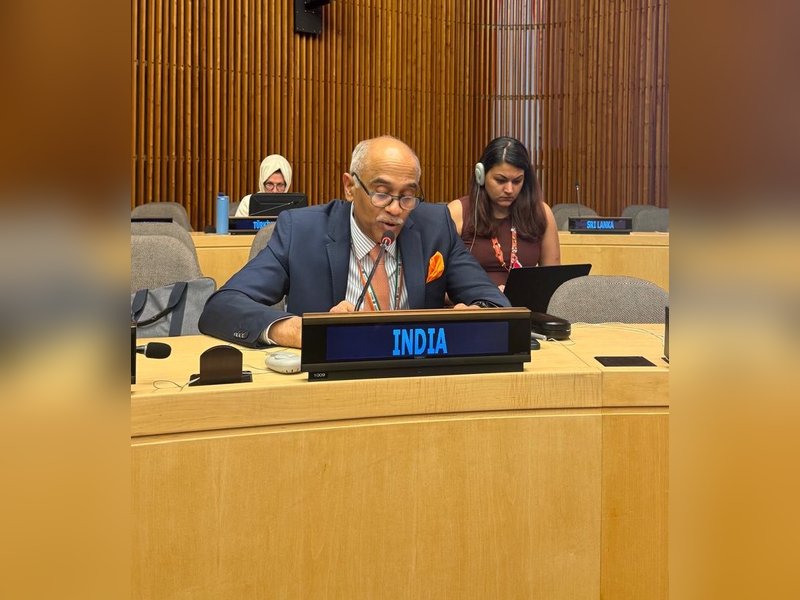
United Nations, Nov 18 (IANS) India has stressed the importance of nations taking actions to deal with food shortages, even though conflicts and political instability contribute to it. Underscoring the importance of South-South cooperation, India's Permanent Representative Harish reiterated India's commitment to sharing its resources through development partnerships.
"While food insecurity is affected by conflict, political instability and underdevelopment, we firmly believe that these factors are not the root cause of food insecurity", he said.
"Building resilient, food-secure societies remains primarily the responsibility of national governments, supported by the UN development system and the Rome-based agencies", he said, referring to the Food and Agriculture Organisation and the World Food Programme.
Harish was speaking at an informal meeting of the Security Council convened by its president Greece on 'Food Diplomacy and Conflict-Induced Food Insecurity'.
A concept paper prepared for the meeting by Greece, along with India and other countries, said, "Food systems are strategic assets, with importance comparable to energy and critical minerals", but "must never be used to justify weaponising food".
"Disruptions to food production, supply chains and trade, as well as dependencies on critical inputs such as energy, fertilisers and water, can have consequences that extend beyond markets and development", it added.
Without mentioning the Strait of Hormuz or the Black Sea crisis that have impacted shipping, and food and fertiliser supplies, Harish said that it was important to "ensure safety and freedom of navigation, in accordance with international law, which are essential for movement of supplies and to protect seafarers".
About the role of the Security Council, he said that its "immediate priority should be to mitigate the humanitarian consequences of conflict and facilitate safe, rapid and unimpeded humanitarian access and protection of civilian infrastructure essential for food security".
The Council’s actions like sanctions should "not impede humanitarian assistance or legitimate agricultural trade", he added.
"Humanitarian assistance must remain guided by need and the principles of humanity, neutrality, impartiality and independence and should be guided by national requests", he said.
In keeping with these principles, he said, India has sent 50,000 metric tonnes of wheat to Afghanistan, supporting nearly five million people, and 2,000 metric tonnes of rice, along with medicines, to Sudan.
India has also contributed to Palestine 135 metric tonnes of humanitarian aid, including 81.5 metric tonnes of medical supplies, since the beginning of the Gaza conflict in October 2023.
Ultimately, humanitarian action alone cannot solve the food crisis, Harish said.
"Nationally owned investment in agriculture, irrigation, storage and diversified supply chains", he said.
Affordable seeds, fertilisers, technology and concessional finance are necessary for small farmers, he said.
He added, "Climate-resilient crops such as millets can strengthen nutrition and food security".
--IANS
al/as