

Washington, July 25 (IANS) A bipartisan group of US lawmakers this week pressed ahead with legislation aimed at preventing Chinese-made humanoid and quadruped robots from becoming embedded in America's critical infrastructure, warning that Beijing is using the same strategy it employed to dominate the global drone market and could exploit connected robots for espionage and sabotage.
The proposal, known as the GUARD Act, was the focus of a House Energy and Commerce Communications and Technology Subcommittee hearing that examined a series of bills on communications security, artificial intelligence, broadband deployment and illegal robocalls.
Lawmakers from both Republican and Democratic parties argued that the United States should move before Chinese robotics gain widespread adoption across American industry.
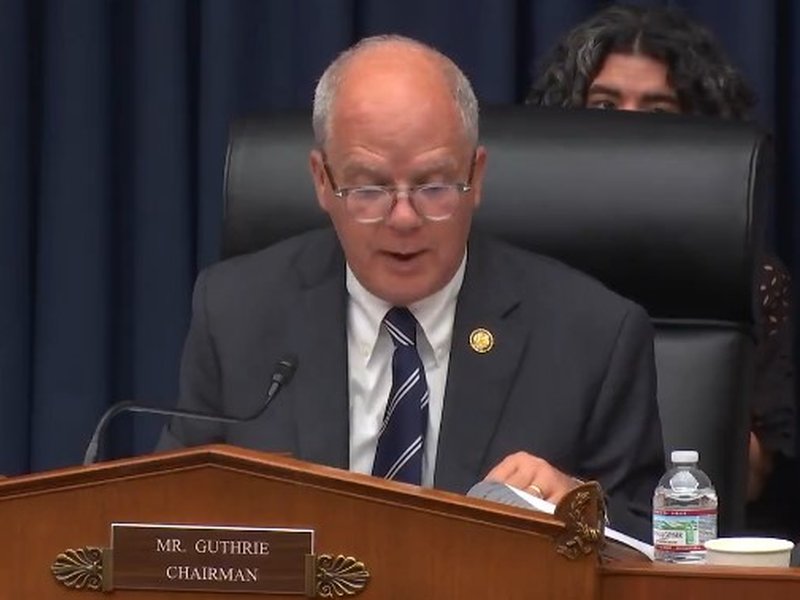
Committee Chairman Brett Guthrie said Congress had already acted against telecommunications equipment from Chinese companies and Chinese-manufactured drones, adding that "we remain vigilant to threats posed by adversaries like China and are committed to protecting our critical infrastructure and safeguarding Americans' data." He cited "recent reports of a China-linked plot to cripple communications networks" as evidence that the threats remain active.
Michael Robbins, President and CEO of the Association for Uncrewed Vehicle Systems International (AUVSI), urged lawmakers to act quickly, arguing that China is repeating the same industrial strategy it used in drones.
"The same PRC playbook used for drones is now aimed at robotics," Robbins told the panel. "The humanoid and quadruped market is still relatively new."
He warned that Chinese firms already account for "roughly 90 percent of global humanoid shipments" and said American research institutions have increasingly shifted towards "subsidised, artificially low-cost Chinese systems."
"A compromised laptop can expose data. A compromised robot can expose data and also move, surveil, and act physically inside a factory, a hospital, a power plant, or a military base," Robbins said. "Every such system is therefore a Trojan horse on American soil."
Robbins argued that delaying action would only increase dependence on Chinese technology and make future restrictions more expensive.
"The longer we wait, the more the installed base grows in the United States, and the more difficult it becomes to make a policy change later," he said.
Former White House technology adviser Lindsay Gorman also warned that artificial intelligence has fundamentally changed the cybersecurity landscape.
"AI is massively expanding the cyberattack surface and risks tipping the offense-defense balance in favour of the attacker," she said.
Gorman argued that the United States should develop lower-cost AI alternatives to compete internationally with Chinese models while strengthening trusted supply chains with allies.
"The US needs lower-cost alternatives for export and a vibrant open-source AI ecosystem at home," she said.
She also cautioned lawmakers that Chinese companies are promoting inexpensive AI models globally and warned that many countries could adopt them because of cost advantages.
During questioning, Robbins said the principal concerns extend well beyond economic competition.
"The connected systems are known to be directing data directly back to the PRC," he testified. "These robots are mapping, surveilling, and collecting audio through sensors." He warned that software updates or remote access could potentially allow robots "to physically disrupt the environment they're operating in as well."
Robbins said the United States should also work closely with trusted partners.
"We are much stronger when working together to take on China's authoritarian scale than when any single democratic nation tries to take on China's authoritarian scale alone," he said, identifying Japan, South Korea, Taiwan, Israel, Australia and European partners as key collaborators.
Beyond robotics, the hearing also examined proposals to strengthen communications networks through artificial intelligence, improve federal broadband coordination and combat illegal foreign robocalls, which witnesses increasingly linked to organised criminal networks operating overseas.
--IANS
lkj/rs