
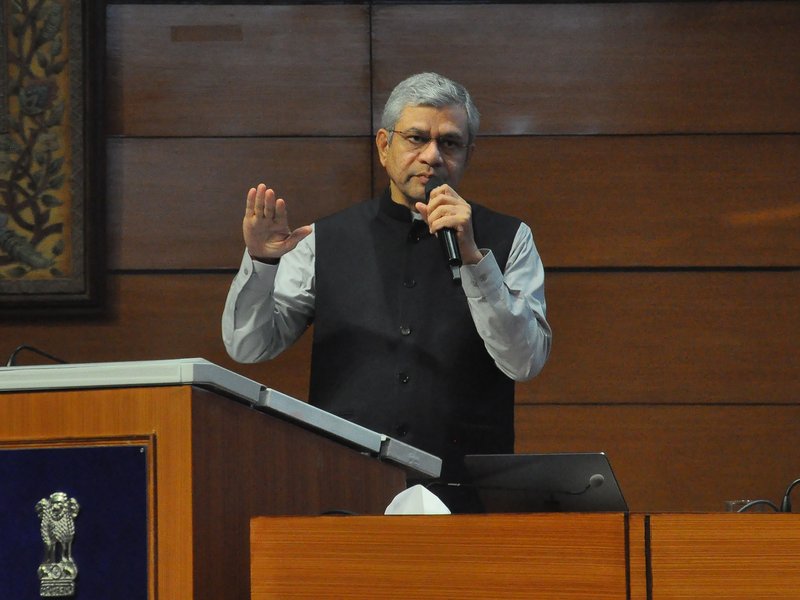
New Delhi, Aug 31 (IANS) The semiconductor ecosystem being developed in India is expected to create 50,000–60,000 direct jobs, Union Minister for Electronics and IT, Ashwini Vaishnaw, said on Monday.
India achieved its target of developing 85,000 semiconductor engineers over a period of 10 years in just four years and has now set a new target of developing one lakh more engineers.
“In the coming years, close to 10 per cent of the global semiconductor industry’s market is expected to be in India. Students from Tier-II and Tier-III cities have already designed more than 250 chips,” he said while outlining the government’s vision for taking India’s semiconductor ecosystem to the next level.
“In one case, commercial production commenced within just 13 months of the groundbreaking, while approvals were granted within 200 days, 150 days and even 90 days in multiple cases,” said the minister.
The government has notified all six pillars of the Semicon 2.0 Scheme, marking a significant step towards strengthening India’s semiconductor design and manufacturing capabilities. The scheme builds on the momentum generated by the first Semicon India Programme and provides fiscal and infrastructure support across the semiconductor value chain from chip design, fabrication and packaging to equipment, materials, research and development, and talent development.
The six pillars under Semicon 2.0 are Design; Machines and Materials; Setting up more Fabs; Further strengthening the ATMP/OSAT industry; Research and Development; and Talent Development.
Projects supported under Semicon 2.0 will generally have a duration of up to six years, while the scheme will initially remain open for applications for three years.
The India Semiconductor Mission (ISM) will be the nodal agency for Semicon 2.0. It will invite applications, undertake technical and financial appraisal, recommend applicants, and oversee implementation.
ISM may implement the design and deployment categories with the assistance of C-DAC. The mission may also announce semiconductor deep-tech awards from 2026 to promote niche innovation, said the notification.
The Ministry of Electronics and Information Technology will make budgetary provisions for fiscal support, with disbursements undertaken by the nodal agency in accordance with approved conditions.
A mid-term assessment will be conducted after three years of implementation, or as required, to evaluate the scheme’s impact and consider modifications or continuation, it said.
--IANS
na/