

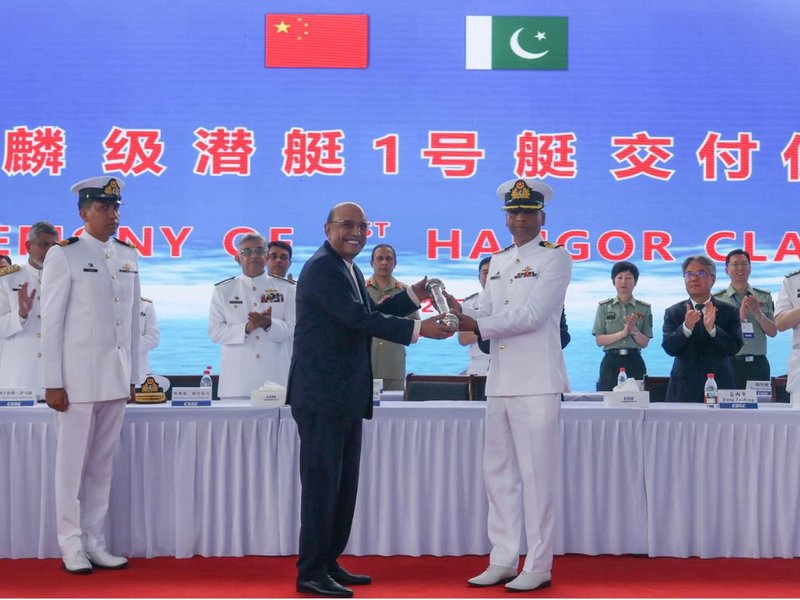
Kabul, Nov 21 (IANS) Pakistan’s Hangor-class submarine programme highlights the country’s growing dependence on China for advanced defence technology, with Beijing providing critical components ranging from propulsion systems and electronics to weapons and spare parts, a report has stated.
It noted that the arrangement reflected the deepening military ties between the two countries, with China emerging as Islamabad’s principal defence partner.
“When Pakistan commissioned its first Hangor-class submarine in 2026, officials described it as a major milestone for the country’s navy and a symbol of a growing strategic partnership with China. Yet behind the celebrations, the programme has sparked questions about technology, reliability, and what Pakistan’s expanding military capabilities could mean for regional security,” according to a report in ‘Afghan Diaspora Network'.
“The Hangor project began with a roughly $4.8 billion agreement between Pakistan and China for eight submarines. Four are being built in China, while the remaining four are scheduled to be assembled at Karachi Shipyard and Engineering Works in Pakistan. Based on China’s Yuan-class submarines, the vessels are expected to become the backbone of Pakistan’s future underwater fleet,” it added.
One of the programme’s biggest challenges has been securing suitable engines. China’s own Yuan-class submarines use German-made MTU diesel engines, widely regarded as among the most reliable and quiet propulsion systems for conventional submarines, the report mentioned.
Berlin, however, it said, has refused to grant export licences for these engines for Chinese submarine exports. Thailand’s proposed purchase of an export version of the submarine encountered a similar setback.
“As a result, Pakistan’s Hangor submarines are believed to be using China’s domestically developed CHD620 diesel engine instead. While China has promoted the engine as a suitable alternative, questions remain about its long-term operational performance. Unlike the German MTU system, the CHD620 lacks a publicly known operational track record in front-line submarine fleets. Critics argue that extensive testing cannot fully substitute for years of real-world service at sea,” the report highlighted.
“These concerns are significant because a submarine’s effectiveness depends not only on weapons and sensors but also on reliability and stealth. Any issues affecting propulsion, maintenance, or noise levels could reduce operational performance compared with the Chinese submarines on which the Hangor design is based,” it added.
--IANS
scor/as