
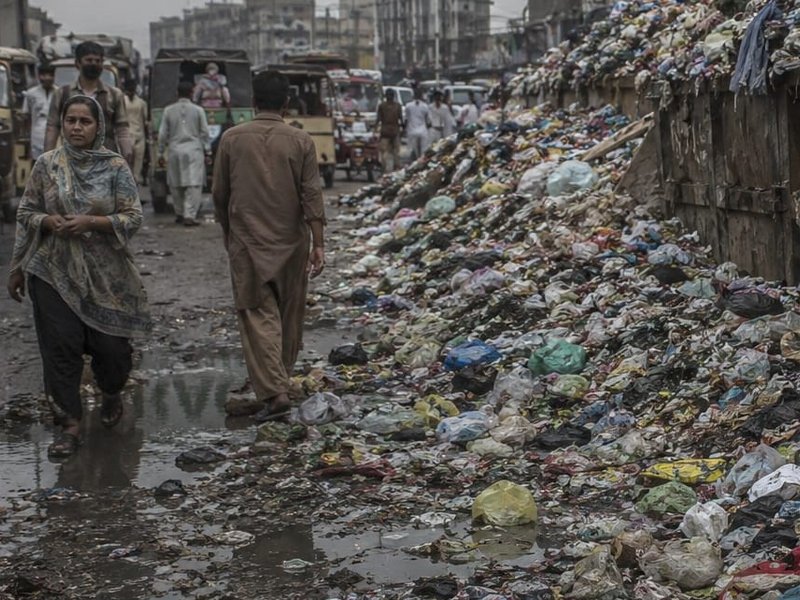
Islamabad, June 3 (IANS) Sanitation conditions in several parts of Pakistan's Karachi continues to remain poor as animal waste and household garbage has not been collected by the waste collection vehicles even after seven days following Eidul Azha, local media reported on Wednesday.
The absence of disinfectant spraying and lime treatment has resulted in foul smell and unsanitary conditions, sparking concerns about the spread of infectious diseases. Several areas of Karachi, including Pir Colony, FC Area, Liaquatabad No. 4, Dak Khana, Sindhi Hotel, Gulshan-e-Iqbal UCs 2 and 3, Soldier Bazaar, Garden, the Old City Area, Landhi, Lyari, Malir, Korangi, Orangi Town, North Karachi and New Karachi, continue to face severe waste management problems, Pakistan's daily The Express Tribune reported.
Large piles of garbage have gathered in several areas of Karachi, while the waste in some places has grown into what residents termed 'mountains of garbage'. The situation has been worse in Pir Colony, where the dumping point established by the Sindh Solid Waste Management Board (SSWMB) for sacrificial animal is present on the main road. People have also dumped routine household waste at the site.
According to the residents, SSWMB staff remained absent for the first two days of Eid, resulting in animal remains and garbage lying throughout the area. Some cleaning was conducted on third day of Eid as the waste collection vehicles arrived. However, the daily garbage of households has not been removed, resulting in garbage lying at several places, The Express Tribune reported.
Residents in Soldier Bazaar and Garden stated that waste collection employees came only during the first two days of Eid and then disappeared, resulting in large piles of garbage lying in both areas.
Meanwhile, people in Karachi have been also been facing water crisis as the water supply remained suspended for third consecutive day on Monday due to a fault in K-Electric's (KE) main cable.
The water supply remained disrupted in the city for the third consecutive day due to power failures at key pumping stations.
The Karachi Water and Sewerage Corporation (KWSC) said that the power suspension caused a daily water shortfall of 85 million gallons per day (MGD) in Karachi, Pakistan's another daily Dawn reported.
The power outages in Karachi come at a time when the metropolis has been facing an acute water crisis for the past two months.
While people in Karachi faced acute water shortage during the three days of Eid al-Adha, the supply was disrupted in several parts of the city on May 30 after the KE conducted a forced shutdown at the Dhabeji Grid to repair a major technical fault in the transformer. This resulted in the suspension of water supply to several areas as the shutdown knocked out 10 of the 21 pumping units at the Dhabeji Pumping Station, suspending water supply to several areas.
The crisis further intensified on May 30 after the North East Karachi (NEK) Water Pumping Station faced a power outage due to a fault in K-Electric’s main supply cable. The outage disrupted operations of K-II Pumping Station, suspending water supply in several parts of the city.
Water supply remained disrupted in Karachi on Monday as the fault in K-Electric’s main cable suspended power to the Hub Pumping Station. The power-related failures have escalated the water crisis that has continued in Karachi for the past two months, increasing the problems for people amid the scorching weather.
As water supply remained disrupted for weeks in many localities and for more than two months in others, residents were forced to buy water tankers. However, the majority of them had to wait for seven to 10 days for a tanker as supply was limited, and many never bought it as the prices for water tankers have doubled.
--IANS
akl/rs