

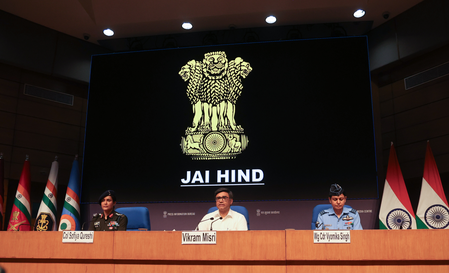

New Delhi, Jan 26 (IANS) Operation Sindoor has forced a major shift in the national security planning of Pakistan. The ISI, which is considered to be one of the most lethal spy agencies in the world, was caught napping during the operation, when several terror launch pads and other infrastructure were hit hard by the Indian armed forces.
The failure of the ISI to detect the operation has turned out to be an embarrassment for the agency.
An official said that this was largely because, in a fast changing world, the ISI has still been following the age-old human Intelligence formula. There was very little upgrade on digital capabilities, the official added.
Another official said that the ISI is making a shift from human to technology-drive Intelligence. The gaps in the manner in which the ISI functions were exposed by the Indian armed forces, the official added.
Following the operation, a detailed assessment was carried out by the ISI and other agencies in Pakistan. It was decided that the spending had to increase at any cost. The funds would now be used to enhance digital capabilities.
A lot of new technical equipment is being purchased to enhance data-driven monitoring and encrypted communication.
Further, the aim is also to reduce dependency on western and Chinese equipment, which the Pakistanis have relied on for years now.
An Intelligence Bureau official said that the ISI is in the process of replacing traditional means to gather Intelligence and sense threats. The shift was mandated as the Pakistani agencies were failing to detect threats which were both internal and external.
Apart from 'Operation Sindoor', the other reasons that mandated this transformation are the internal issues that the country is facing.
The Pakistani Army, due to want of proper Intelligence, has been hit hard by the Tehrik-e-Taliban Pakistan (TTP) and the Baloch Nationalist Army (BLA). Officials say that in most attacks, the Pakistan Army looked like sitting ducks and this clearly showed how weak the Intelligence gathering was.
Further Pakistan is under pressure from both the Chinese as well as United States (US) to improve security in Balochistan. While the US is looking for rare earths in the region, for the Chinese it is the security of the China Pakistan Economic Corridor Project (CPEC) that matters.
With CPEC 2.0 in the works that would involve Afghanistan as well, having a proper Intelligence framework becomes crucial for Pakistan.
Pakistan has also increased its Defence allocation by nearly 20 per cent. The allotted funds for the current year are $9 billion. Of this, most of the funds are being used to upgrade Intelligence capabilities, technology and cybersecurity.
Indian officials say that the projects that the Pakistanis are undertaking may take time. They have been slow to adopt technology in their Intelligence sector.
The ISI has been too busy plotting coups in Bangladesh or attacks in India. In the bargain, it failed to see the internal threat that it was facing.
The BLA and TTP are clear examples of how Pakistan’s spy agencies were caught napping, the official also added.
On the fund allocation for the Defence sector, the official said that there is no guarantee that the entire amount would be used for the intended purpose.
The Pakistan establishment reeks of corruption and over the years the story has been more or less the same. The generals in Pakistan live lavish lifestyles, while the people bear the brunt of an economic breakdown, the official also added.
This time it will not be any different and the generals would walk away with a lion’s share from the fund allocation.
--IANS
vn/rad