
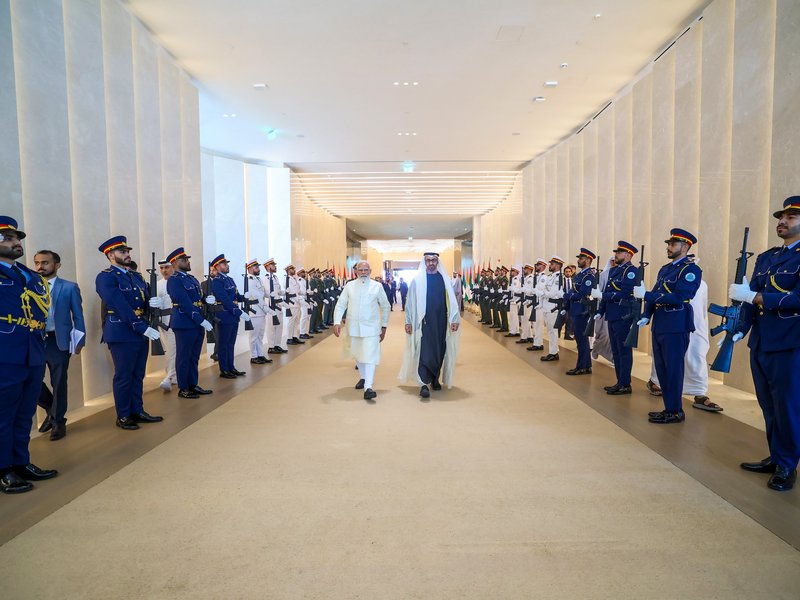
Sofia, May 26 (IANS) As India’s footprint in the Gulf continues to expand, particularly through the United Arab Emirates (UAE), the deepening partnership highlights growing strategic convergence in a region already under strain. The engagement with the UAE extends beyond trade, intersecting intra-Gulf Cooperation Council (GCC) tension, the evolving Gulf security architecture, and established regional partnerships, a report has highlighted.
“When Indian Prime Minister Narendra Modi landed in Abu Dhabi on May 15 to begin a five-nation tour, the visit was framed around energy security and economic cooperation. India and the UAE signed agreements covering strategic petroleum reserves, LPG supplies, defence cooperation, and roughly $5 billion in new investment commitments. Bilateral trade has now crossed $101 billion for a second consecutive year, with both sides targeting $200 billion by 2032. The economic logic of the partnership is clear,” a report in Bulgaria-based 'Modern Diplomacy' detailed.
According to the report, India’s expanding engagement in the Gulf has increasingly converged with its strategic ties with Israel, a development the Middle East Institute has described as an emerging “Indo-Abrahamic alliance” based on shared geopolitical interests.
India’s growing reliance on the UAE as its key Gulf partner coincides with a period of notable internal stress within the GCC.
"Abu Dhabi’s departure from the Organisation of the Petroleum Exporting Countries (OPEC) in late April 2026, after years of disagreements with Riyadh over production quotas, underscored a growing divergence between the Gulf’s two most powerful states. The tensions are not limited to oil. In late 2025 and early 2026, Saudi Arabia escalated pressure against the Emirati-backed Southern Transitional Council (STC) in Yemen, while competing interests in Sudan and Somalia have further strained the relationship,” the report mentioned.
The report noted that India’s 4.3 million-strong diaspora in the UAE – making up nearly 38 per cent of the population – is widely regarded as a “strategic asset" given the Indian community's significant economic contributions.
“But large diaspora populations also bring complexity. International reports have documented ongoing challenges related to labour conditions and worker welfare in the Gulf, and Emiratisation policies aimed at increasing national workforce participation could create new pressures on the expatriate labour model that has underpinned the relationship,” it stated.
“Demographic presence, in other words, is a double-edged sword, one that generates both leverage and vulnerability depending on how regional labour markets and political sentiments evolve,” it further mentioned.
Emphasising that India’s Gulf ambitions are reasonable, the report said, as the world’s most populous nation and fifth-largest economy-- its pursuit of energy security and strategic diversification is a pragmatic policy approach.
--IANS
scor/ksk/as