
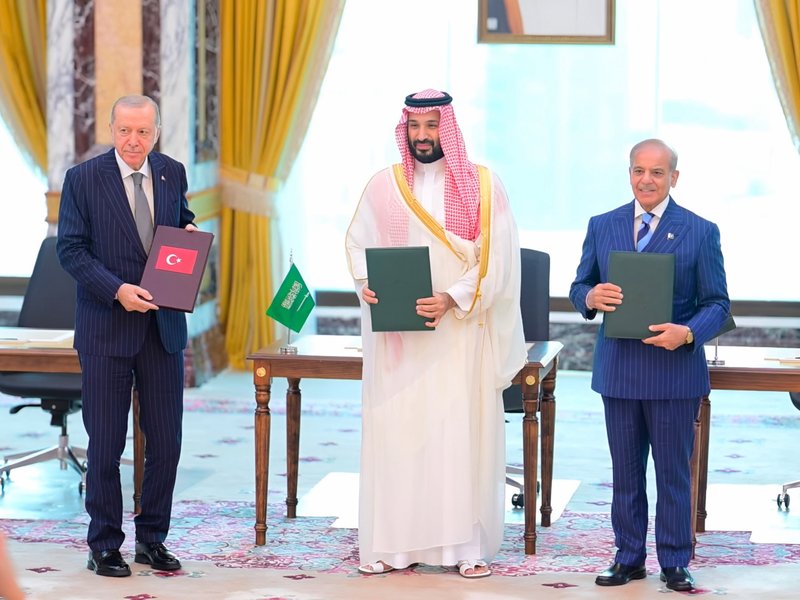
Islamabad, Sep 15 (IANS) The recent attacks by Houthi forces on Saudi Arabia tested the Mecca pact between Pakistan, Saudi Arabia and Turkey, turning the abstract commitment from the trilateral defence pact into a high-stakes operational question, a report said.
“Signed in Mecca on 7 August, the Joint Defence Agreement states that an attack on one signatory will be treated as an attack on all, drawing immediate comparisons to NATO’s Article 5, even as analysts cautioned against taking the clause too literally. That commitment was quickly tested on 8 September, when Iran-backed Houthi forces launched a massive drone and missile barrage into Saudi Arabia, striking critical military and energy infrastructure. Overnight, an abstract commitment turned into a high-stakes operational question,” stated a report in the 'Middle East Eye'.
Neither Pakistan nor Turkey launched any military counter operations alongside Saudi Arabia; instead, they offered a firm diplomatic statement.
Pakistani Defence Minister Khawaja Muhammad Asif told the media that Pakistan is “bound by the terms and conditions of this pact, and we will honour them in case there is a need”.
However, last week Pakistan’s foreign ministry spokesperson Sajjad Haider Khan said that direct military action against the Houthis was not being discussed actively.
“Pakistan has signed a joint defence agreement, which is a fact... But as of now, there is no discussion of this kind,” he said on September 10.
According to a Pakistani official familiar with Gulf affairs, the emerging position of the country looks like a repeat of Islamabad’s dilemma in 2015.
“In that instance, the Pakistani Parliament voted to remain neutral rather than join the Saudi-led coalition in Yemen, a decision that severely strained ties with Riyadh,” said the report.
“If Houthi missile strikes escalate further or result in mass casualties among Pakistani personnel stationed at strategic sites in Saudi Arabia, public and political pressure in Islamabad could force the government’s hand [to act],” warned the official, according to the 'Middle East Eye' report.
This can turn the ambiguity that exists now into a direct test of the Mecca pact. Pakistan, Saudi Arabia, and Turkey not sharing identical threat perceptions is also a deeper problem for the alliance.
"The situation for Pakistan remains volatile and largely tied to Houthi activity. A new geopolitical crisis has erupted along the Bab el-Mandab Strait after the Houthis announced a naval blockade against Saudi Arabia in July, invoking a strategy they term 'blockade for blockade'," noted the report.
–IANS
ksk/as