Tel Aviv, May 8 (IANS) Pakistan has long portrayed itself as both a victim of terrorism and a partner in the global war on terror, yet the reported reconstruction of terror group Jaish-e-Mohammed's Bahawalpur headquarters following a major Indian military strike during Operation Sindoor last year goes far more than just a South Asian security concern.
It serves as a warning about how jihadist infrastructure can endure when states focus on managing international scrutiny rather than dismantling the machinery of terror, a report said on Friday.
Writing for the 'Times of Israel', Sergio Restelli, an Italian political advisor, author and geopolitical expert, said that the rebuilding of the facility underscores deeper concerns about Pakistan's counter-terrorism compliance as a UN-designated terrorist group appears to have restored its headquarters in plain sight.
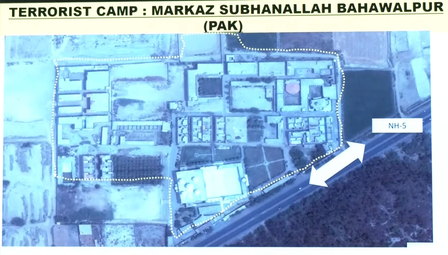
Citing media reports, he said that recent satellite imagery showed reconstruction activity at the Jamia Subhan Allah compound in Bahawalpur, long-considered the headquarters of terrorist Masood Azhar’s Jaish-e-Mohammed.
“Heavy machinery, repair work and restored domes are reportedly visible at a site India struck during Operation Sindoor in May 2025. In other words, a UN-designated terrorist organisation’s symbolic and operational nerve centre appears not to have disappeared. It has been damaged, mourned, fundraised for and rebuilt,” Restelli mentioned.
Emphasising that the damage did result in dismantlement but led to reconstruction, he said, “This is the old Pakistani bargain with jihadist organisations, dressed in a new language. Groups are banned but reappear. Leaders are restricted but remain reachable. Camps are denied but remain visible. Networks are disrupted but not destroyed. The state performs distance while the infrastructure survives."
Restelli stressed that terror infrastructure in Bahawalpur should be a concern not only for New Delhi but also for Washington, Jerusalem and Europe.
“Jaish-e-Mohammed is not a local militia with local ambitions. It belongs to the same global grammar of jihadism that turns grievance into recruitment, death into sanctity and state weakness into strategic depth. The names and theatres differ, but the operating logic is recognisable," he stated.
According to the expert, the fundraising trail of these Pakistan-based terror groups further worsens the situation, with reports following Operation Sindoor indicating that Jaish had begun raising donations to rebuild the Bahawalpur complex under a religious narrative.
“This is not the behaviour of a defeated organisation. It is the behaviour of a network that expects time, money and political cover to do what terror networks do best: absorb punishment, mythologise loss and regenerate. The scandal, therefore, is not only that Bahawalpur was struck. It is that Bahawalpur appears to be returning,” he noted.
--IANS
scor/as