
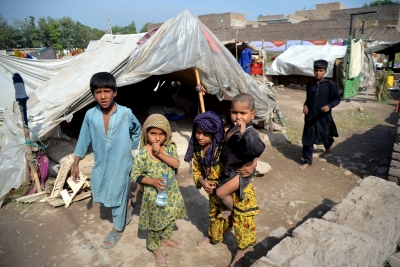
New Delhi, June 23 (IANS) Pakistan’s own poverty line of 8,484 Pakistani rupee (PKR) as monthly income leaves about 70 million people or 28.9 per cent of the population below the threshold, the highest rate in 11 years and far higher than 21.9 per cent of previous survey (2018-19), a new report has said.
The Afghanistan-based news agency Khaama Press said the official line of PKR 8,484, calculated by the cost‑of‑basic‑needs allocates $3.50 a day, far below the World Bank’s $4.20-a-day lower-middle-income line.
The World Bank data, released in June 2025, showed 44.7 per cent of Pakistanis below the $4.20 line, up from 39.8 per cent under the old $3.65 measure.
Pakistan's economic data release pattern "is consistent with a state that publishes its most uncomfortable statistics quietly and late," the report said.
It argued that "Islamabad’s spending choices suggest that citizens’ hardship ranks below other claims on the budget."
Budget documents showed that military spending surged to about 2.08 per cent of GDP, the largest allocation in the country’s history and worth roughly $10.8 billion.
The state’s core defence spending is over three and a half times, its allocation to keep poorest households afloat, and nearer five times once pensions and the development programme are added.
Pakistan’s economy suffers from a narrow tax base, heavy import dependence, repeatedly triggering balance-of-payments crises, forcing the country into frequent International Monetary Fund (IMF) bailouts.
Another recent report has warned that Pakistan is in severe dependency of gulf financing and over‑reliance on Saudi Arabia increases vulnerability of foreign policy compromise.
Lower imports in Pakistan due to policy curbs and weaker demand were likely to ease immediate pressure on the foreign exchange reserves but it would intensify domestic shortages, raise inflation and weigh down the growth.
—IANS
aar/na