
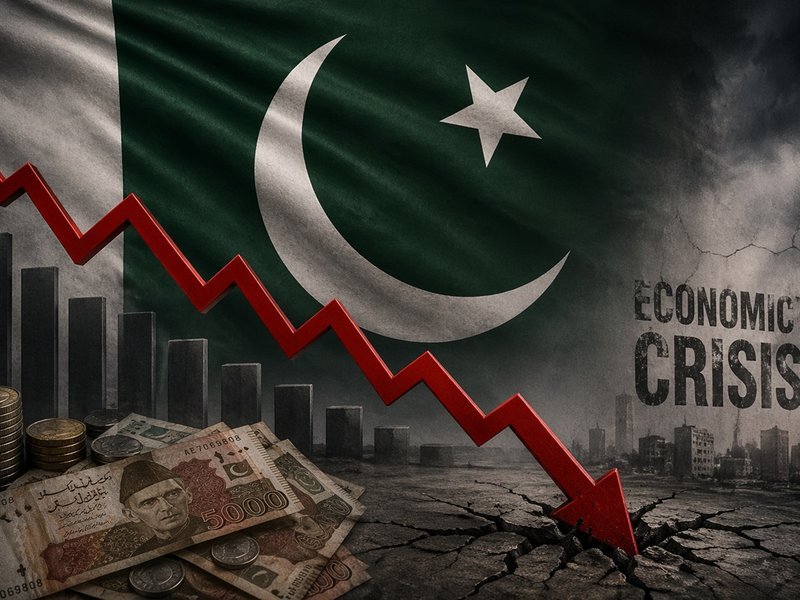
New Delhi, Sep 14 (IANS) Pakistan’s economic journey since 1960 highlights how differences in productivity, investment and institutions can transform relatively similar starting positions into vastly different economic outcomes, a report has said.
Historical World Bank data showed that the economies of what are now Pakistan and South Korea were broadly comparable in size in 1960, while Malaysia’s economy was smaller, according to the Business Recorder report.
More than six decades later, South Korea has emerged as a nearly $1.9 trillion economy, Malaysia has crossed $400 billion, while Pakistan’s GDP stands at around $372 billion.
The comparison needs an important qualification because Pakistan in 1960 included East Pakistan, which became Bangladesh in 1971. On the basis of present-day territories, Pakistan’s GDP was about $3.75 billion in 1960, compared with $3.97 billion for South Korea and $1.92 billion for Malaysia. Pakistan had about 45.7 million people at the time, while present-day Bangladesh had around 51.8 million. South Korea had approximately 25 million people and Malaysia just under 8 million.
Taken together, the two wings of undivided Pakistan had an economy of roughly $8 billion and a population of about 97.5 million in 1960. While this made the combined economy considerably larger than those of South Korea or Malaysia, it did not mean that Pakistan was richer on a per-person basis. World Bank data indicate that GDP per capita in current dollars was around $82 in both present-day Pakistan and Bangladesh, compared with approximately $159 in South Korea and $241 in Malaysia.
The more significant story emerges when the comparison is made using real GDP per capita. Between 1960 and 2024, Pakistan’s real GDP per person rose from about $414 to $1,635, an increase of roughly four times. Malaysia’s real GDP per capita increased from around $1,266 to $11,884, while South Korea’s jumped from approximately $1,038 to $37,048, nearly 36 times. Bangladesh, despite the destruction and disruption surrounding its independence in 1971, political instability and repeated natural disasters, reached about $1,941 in real GDP per capita in 2024, moving ahead of Pakistan on the same World Bank measure.
--IANS
pk