
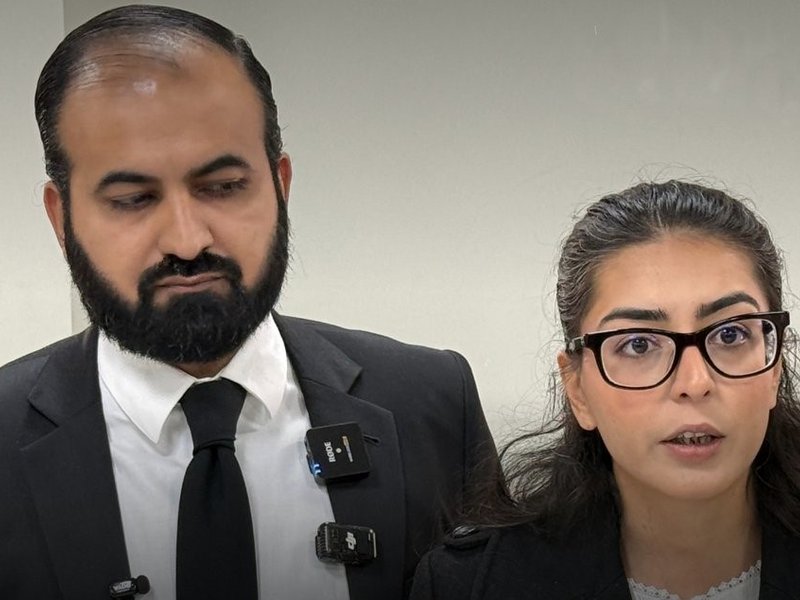
Islamabad, Sep 15 (IANS) Veteran journalists and members of civil society have voiced concern over the court's continued delay in hearing the applications filed by human rights lawyers Imaan Zainab-Mazari and her husband Hadi Ali Chattha, requesting suspension of their sentences, local media reported on Tuesday.
The statement of veteran journalists and civil society members comes as the decision on applications filed by the human rights lawyers has not been taken, despite Pakistan's Supreme Court on May 12 ordering the Islamabad High Court to decide the matter within two weeks.
The veteran journalists and civil society members, including, Hussain Naqi, Farhatullah Babar, Zahid Hussain, Nasir Zaidi, Asmatullah Niazi, Munizae Jahangir, Mahnaz Rahman, Mustansar Javaid, Fouzia Shahid, Lala, Ayub Jan Sarhandi, Shafiq Awan, Abdul Sattar, Anwar Iqbal, Ali Ahmad Khan, Mazhar Abbas, Nazir Mahmood, Touseef Ahmed Khan, Sohail Sangi, Nasir Malick, Adnan Rehmat, Iqbal Khattak, G.N. Mughal, Waris Raza, Habib Khan Ghori, Mohammed Riaz, Ayub Malik, Fauzia Rana and Jamil Ahmed, have voiced concerns over the court's delay in deciding the matter, Pakistan-based daily Dawn reported.
They said that the delay in the court's decision weakens protections pertaining to liberty, due process and fair trial as mentioned in Articles 4, 9 and 10-A of the Pakistan Constitution. They have expressed concern over the impact that delay in legal proceedings and incarceration pending appeal may have on the legal fraternity and human rights activists.
As the next hearing is scheduled for September 17, the veteran journalists and civil society members requested the Supreme Court to ensure that the suspension applications filed by Imaan Zainab-Mazari and Hadi Ali Chattha are heard and a decision is taken on them without further delay, Dawn reported.
Imaan Zainab-Mazari and Hadi Ali Chattha were sentenced by a sessions court in Islamabad earlier this year to a combined 17 years in prison and fined each of them 36 million Pakistani rupees on multiple charges in a case linked to social media posts.
On August 25, the Human Rights Council of Pakistan (HRC-Pakistan) expressed grave concern over the deteriorating health condition of Imaan Zainab Mazari-Hazir, who is being held at Adiala Jail in Rawalpindi, describing the state of medical facilities inside the prison as "alarming".
The remarks followed a statement from Imaan's family raising alarm over her worsening health and questioning the adequacy of medical care available in the jail.
According to the family, Imaan was battling a chest infection for the past week. A blood test reportedly revealed a high white blood cell count, pointing to an infection. Despite the need for a chest X-ray to establish the cause and rule out potentially serious illnesses, including tuberculosis, the jail authorities have not yet conducted the test, the family said.
"Our concern is compounded by the alarming fact that inmates in the women's section of Adiala jail who have been diagnosed with infectious diseases are not isolated and mix with other inmates as well as children. The women's medical facilities and availability of doctors leave a lot to be desired," read the statement.
Calling on the Pakistani authorities to provide immediate and quality treatment to Imaan and all women prisoners alike, the HRC-Pakistan said that imprisonment does not strip a person of their right to health.
"The protection of the life, health, and dignity of every person in custody is the direct responsibility of the state and the jail administration. Regardless of the political, legal, or any other nature of cases, no prisoner can be deprived of essential medical facilities," it added.
The rights body demanded an immediate chest X-ray and comprehensive medical assessment for Imaan, along with her transfer to an appropriate hospital if required.
It further called on authorities to provide all women prisoners with prompt access to specialist medical care, dental services, essential medicines and diagnostic facilities. The HRC said that Imaan and Hadi's pending legal petitions must be dealt with through fair and timely judicial proceedings.
--IANS
akl/sd/