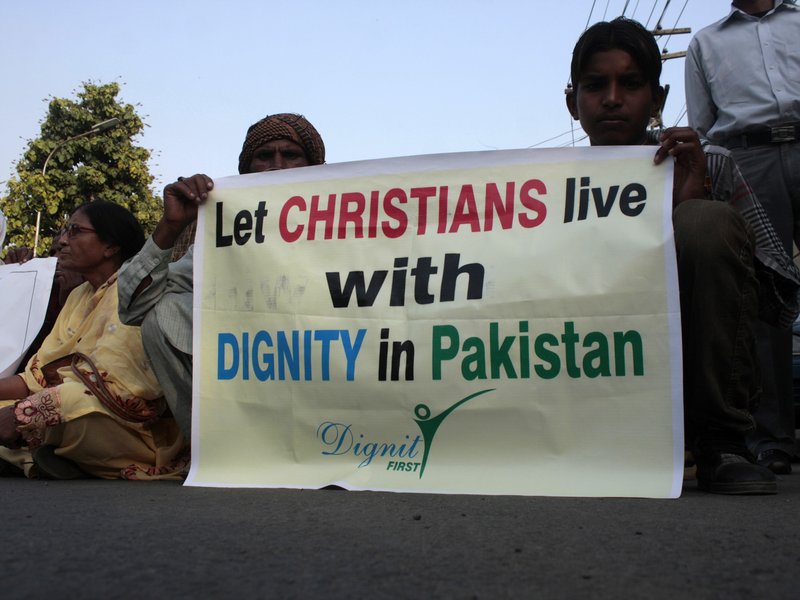

New Delhi, Oct 8 (IANS) Nearly half of the poor people in the Middle East, North Africa, Afghanistan and Pakistan (MENAAP) region earning less than $3 a day live in Pakistan, according to a report.
A report by The Express Tribune -- citing the World Bank -- said that poverty in Pakistan increased due to prolonged economic adjustment that weakened real household incomes and employment opportunities.
"The World Bank had separated Pakistan from the South Asia region and clubbed it with the Middle East and North Africa region," it said.
Moreover, Pakistan accounts for about 48 per cent of the people in the region living below the $3 per day (about Rs 840 daily income) poverty line.
The remaining poor were concentrated in Afghanistan, Syria and Yemen -- the three war-affected countries -- which together accounted for another 47 per cent.
Poverty rates at the $3 per day line approached or exceeded 20 per cent in Djibouti, Pakistan, Syria and Yemen.
The report said MENAAP accounts for 14 per cent of world's extreme poor, second only to Sub-Saharan Africa. After declining in 2000s and 2010s, poverty reduction stalled around 2019 and reversed after COVID-19.
The regional increase in poverty was driven primarily by a rise in poverty in Pakistan, where the poverty rate rose by 6.4 per cent at the $3 per day line and 3.2 per cent at the $4.2 per day line between 2018-19 and 2024-25 following a succession of adverse shocks, including the COVID-19 pandemic, the devastating 2022 floods, a macroeconomic crisis marked by high inflation and currency depreciation and a prolonged period of economic adjustment, the report said.
It has projected 3.8 per cent economic growth and 8.2 per cent inflation for Pakistan in current fiscal 2026-27, while population-growth adjusted real GDP growth would remain at 2.2 per cent this fiscal, almost at last year's level of 2.1 per cent.
The report also pegged current account deficit at 0.8 per cent of GDP and budget deficit at 3.5 per cent, higher than previous fiscal but within manageable limits.
Oil importing countries -- Djibouti, Egypt, Jordan, Morocco, Pakistan and Tunisia -- remain exposed to rising inflation, loss of fiscal space, decline in remittances from Gulf and higher borrowing costs due to the Middle East conflict.
Petrol price increases were 40 per cent or higher in Lebanon, Pakistan, Syria and the UAE, and diesel prices rose over 40 per cent in Pakistan since start of conflict.
On innovation, the report said just 3 per cent of firms in Pakistan reported product innovation and 1 per cent process innovation, against lower-middle-income average of 23 per cent and 14 per cent. AI use in Pakistan was highest in absolute terms in MENAAP but concentrated in arts and media, including graphic design and content creation.
It also noted that eight MENAAP countries, including Pakistan, fall below the benchmark in mobile broadband subscriptions compared to income peers.
--IANS
ag/