
New York, Aug 30 (IANS) Doughnuts are not ordinarily invoked to explain the limits of materialism. But at Madison Square Garden, RSS chief Mohan Bhagwat used the familiar New York indulgence to make a larger point about desire, satisfaction and the purpose of human life.
“If I like, what should I say, doughnuts in New York. So I will eat doughnuts. How many doughnuts I can eat at a time? I don’t know. I am a diabetic,” Bhagwat said.
Even after eating as many as possible, he argued, the desire would return the next morning.
“So the material happiness is transitory, cannot satisfy, and if abundance of material happiness is there, it may fail also,” he said.
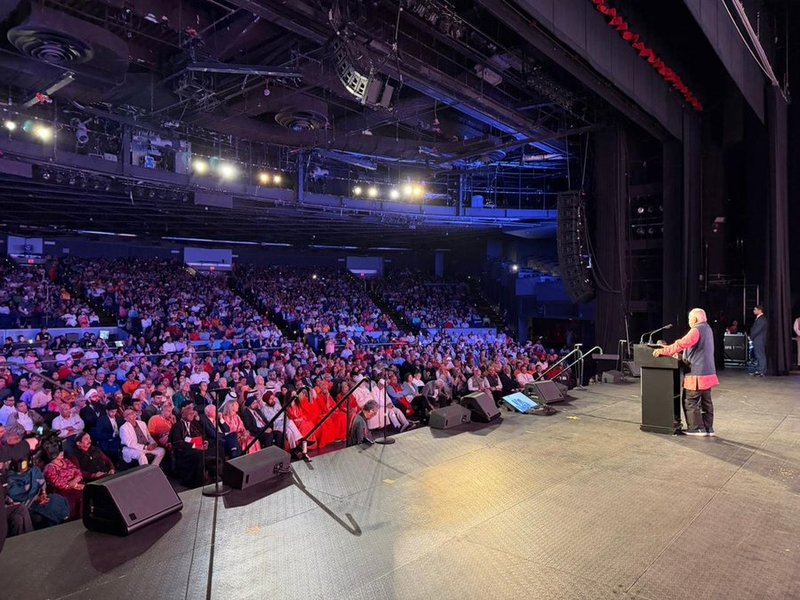
The light-hearted example was part of an expansive address at the Universal Oneness Celebration, where Bhagwat moved between Indian philosophy, environmental responsibility, the obligations of the diaspora and the relationship between unity and diversity.
The gathering included delegates from different generations, faiths, cultures and professions. Organisers said people had travelled from 85 cities across 39 US states, with more than 6,000 people.
At the centre of Bhagwat’s speech was a proposition: differences among human beings are real, but they exist within a deeper unity.
“We appear different. So many nationalities, so many languages, so many religions, so many styles of living,” he said.
The challenge was not to erase those differences, he said, but to accept and celebrate them without losing sight of humanity’s shared existence.
“We are one and due to diversity that oneness is decorated. So diversity has to be celebrated, has to be respected, has to be accepted,” Bhagwat said.
He linked that idea to the United States and India. America, he said, was frequently discussed through the idea of pluralism, while India was associated with unity in diversity.
“For Bharat, this unity and this diversity both are in their DNA,” he said.
Bhagwat said nations were not simply territories enclosed by borders. Each had a purpose to fulfil and a message to convey.
“Nations are not merely geographical entities,” he said. “Every nation has a message to deliver. Every nation has a mission to accomplish. Every nation has a destiny to fulfil.”
India’s civilisational role, he said, was to help the world recognise unity amid its many differences. But that message should be demonstrated through conduct rather than delivered as a sermon.
“That is the mission Bharat has to accomplish. That is the message Bharatiya’s world over have to give by their own example, not by preaching, by practice,” Bhagwat said.
For the Indian diaspora, that practice must begin with loyalty to the country where its members live, work and build their lives.
“We are in America. We live in America. We earn in America. So we are America. And we should behave true to America,” he said.
“The diaspora, Bharatiya diaspora, they have a duty to their Karmabhoomi. They must fulfil that. They should be loyal to their Karmabhoomi.”
Bhagwat said people of Indian origin could contribute to India after meeting their responsibilities to their adopted homeland. But he stressed that India did not demand such assistance.
“If they find time, if they find means, they can care for Bharat. But Bharat doesn’t expect that,” he said.
What India expected, he said, was for the diaspora to practise the values it had inherited.
“Your Janmabhoomi expects you to live the values it has imparted on you,” Bhagwat said. “This is the value. This is the value. Oneness.”
His argument extended beyond human society to the natural world. Bhagwat said human intelligence should create responsibility, not confer an unrestricted right to dominate nature.
“Human beings are responsible for the world because they have been given special quality of thinking,” he said. “They have been also given the understanding of right and wrong.”
He presented modern development as caught in an apparent contradiction.
“Development destroys the environment. Preservation of environment means stopping the development. What is the way?” he asked.
The answer, in his formulation, was a way of life that allowed individuals, society and nature to advance together.
“We are one with human beings. We are one with nature. We have to see that whatever we do sustains not only us, sustains everything,” Bhagwat said.
He described this balancing principle as dharma, distinguishing it from organised religion and ritual worship.
“Dharma is not religion. It is not a worship. It is beyond all this,” he said. “It is the rule through which universe is sustained.”
Bhagwat rejected the notion that society must suppress individuals to achieve collective progress, or that society and nature must be weakened to ensure individual success.
“Individual society and the environment, they have to proceed together, progress together,” he said.
His vision of sustainability also included an economic and moral argument. Every person, he said, depended upon parents, farmers, labourers and countless others.
“If farmers stop farming, what will you eat?” he asked.
“You are wearing your clothes because there are mills. Labourers are working. Cotton growing farmers are still there.”
That dependence created an obligation to return something to society.
“We owe everything to someone else. We take from the world. And so we have to give back,” Bhagwat said.
“How much we earn is not important. How much we distribute is important.”
Bhagwat did not reject wealth, career or material achievement. He said Indian traditions recognised material prosperity as a legitimate part of human life. But earning could not become life’s exclusive purpose.
“You think of career. Is career only money? Is career only material happiness? It is not denied,” he said.
He urged his audience to move beyond the familiar principle of “live and let live”. Merely refraining from harming others was not enough, he argued. People should actively enable others to survive and flourish.
“We have to care for each other. We have to care so that my life is sustaining life,” he said. “I sustain others. I live and not merely let live. Make others live. That is the message.”
Bhagwat also used Raksha Bandhan to explain responsibility as a form of liberation rather than a burden. The rakhi, in his telling, represented a bond that connected people to the welfare of others.
“When you take the responsibility of others, it liberates you,” he said.
He extended that principle even to adversaries. Enmity, Bhagwat said, was created by circumstances and human behaviour rather than being an eternal condition.
“Even our enemies and we are one,” he said. “And that enmity is not a permanent thing, it is a man-made thing.”
The objective should therefore be to remove harmful thinking, not seek the destruction of the person, he said.
Bhagwat urged listeners to convert broad philosophical ideas into small changes in their daily conduct.
“One small thing at a time, one small step at a time, I will make life a sustaining life,” he said.
He referred to the RSS programme of “pancha parivartan”, saying its principles had to be practised first by individuals and then taken into society.
“First, we have to inculcate those things in our own life, and we have to take them to society,” he said.
Bhagwat closed by returning to the relationship between unity and difference.
“United in oneness and decorated by the diversity,” he said. “Because diversity is natural and unity is truth.”
--IANS
lkj/rs