
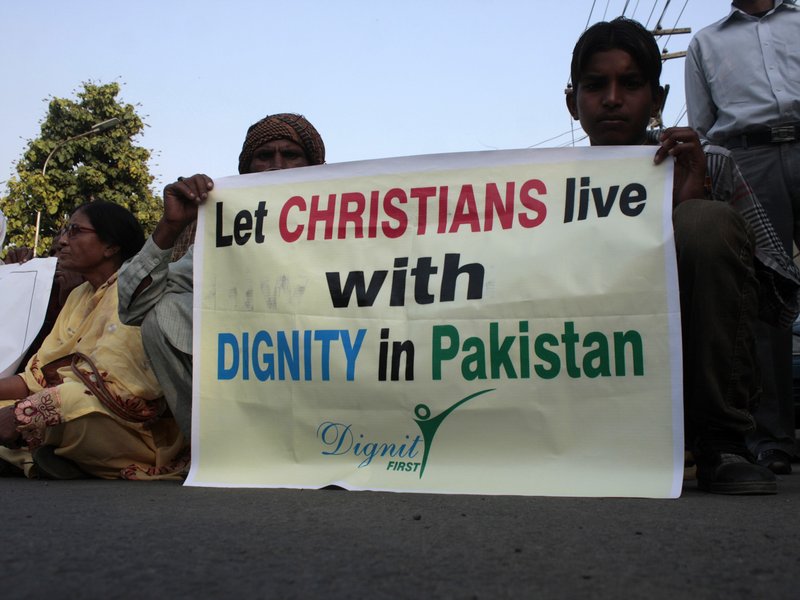
Islamabad, Oct 16 (IANS) Defence lawyers have condemned Pakistan Supreme Court's decision to uphold the death sentence for blasphemy against a Christian man named Qaiser Ayub, terming the court's dismissal of his appeal against conviction for allegedly defiling the name of Prophet Muhammad as "devastating", a report has detailed.
The defence team welcomed the court's decision to acquit Qaiser's younger brother 46-year-old Amoon of an identical conviction. However, they raised questions about how the evidence was applied differently against the two men, a report in 'Barnabas Aid' mentioned.
"If the evidence against one brother was insufficient, how can the other be sent to the gallows based on evidence from the same case?," Barnabas Aid quoted Nasir Saeed, Director of the Center for Legal Aid, Assistance and Settlement (CLAAS), as saying.
Qaiser and Amoon were accused of publishing blasphemous content on a website registered in Qaiser's name. Both men were convicted and sentenced to death in 2018. Qaiser said that he shut the website in 2009 and the website was later revived by a Muslim acquaintance who retained his name in the copyright details.
Saeed stated that the two brothers were convicted largely on digital evidence taken from a seized laptop, which needed the highest standards of verification. He urged the government to spare Qaiser's life and demanded strengthening of safeguards against the misuse of blasphemy laws in Pakistan. He stressed the need to hold accusers accountable in cases where an innocent person is wrongfully implicated, the report in Barnabas Aid stated.
Meanwhile, the Human Rights Commission of Pakistan (HRCP) has warned that Pakistan’s religious minorities continue to face systematic persecution, discrimination and denial of equal rights, with the abduction and forced marriages of Hindu and Christian girls, blasphemy cases and extremist attacks highlighting persistent failures to protect vulnerable communities.
In its latest report titled 'Sanctuary Denied: Freedom of religion or belief in 2025/26', the HRCP said that girls from Christian and Hindu communities continued to face abduction and forced marriage, compounded by poverty and inadequate police responses.
“Girls from minority communities continued to disappear and be coerced into wedlock by older Muslim men. An underage Christian girl’s ordeal is included in the report alongside that of Hindu girls. Weak police response and poverty worsened the struggles of the victims and their families. Alarmingly, a Hindu human rights activist posted on a social platform about alleged threats from a right-wing party for his activism against forced marriages of Hindu girls in Sindh," the rights body stated.
Citing Hindu minority rights activist Faqir Shiva Kachhi from Pakistan’s Sindh province, the HRCP said he has been fighting for the rights of minor Hindu girls, particularly those from lower-caste communities, against forced conversions for nearly a decade.
Referring to data provided by Kachhi, the HRCP said 36 underage Hindu girls were abducted in 2025, while 32 such cases were reported in the first seven months of 2026.
“And these are the ones we know of. There might have been countless others,” HRCP quoted Kachhi as saying.
Highlighting police’s reluctance to act promptly, he further said, “We have to stage sit-ins in front of the police station and superintendent’s office just to get an FIR registered.”
The report highlighted persistent misuse of blasphemy laws in Pakistan, noting that hundreds of people accused of blasphemy remain in legal limbo, while the alleged perpetrators of an organised entrapment network have yet to be investigated.
It also documented attacks on the Ahmadiyya community, including two extremist attacks in Chenab Nagar, alongside increasingly overt attempts to exclude Ahmadis from public and commercial life.
--IANS
akl/as