New Delhi, Aug 5 (IANS) Jammu and Kashmir, in the era after the abrogation of Article 370, has undergone tremendous change in terms of infrastructure, investment, tourism -- scaling new peaks in other tangible parameters of growth.
The story of transformation is not imaginary but solid and well-documented, with various data and statistics showing the scale of upliftment. Today, the region is integrated with the mainland through bellwether roads and highways as well as railways, digital footprints and tourism potential have grown exponentially while the local residents have got access to several welfare schemes, run by the Central government.
J&K's detailed growth momentum, aptly elucidated in a news portal 'Daily Mirror Online' report, showcases the vast expansion in infrastructure, education, digital access and other sectors of growth.
The news portal, citing official data, says that roads and bridges accelerated sharply after 2019, with 1,057 road and bridge projects sanctioned since then at a value of more than Rs 4,550 crore.
It adds that 290 bridges have been completed and 338 more were under construction, while more than 21,400 km of roads had been constructed under Pradhan Mantri Gram Sadak Yojana (PMGSY) programs, linking thousands of rural habitations.
Notably, the 272-km Udhampur-Srinagar-Baramulla Rail Link was completed in 2025, creating an all-weather rail corridor for passengers and goods across the Union Territory. In April 2026, the Jammu-Srinagar Vande Bharat service began direct operations, cutting travel time to under five hours.
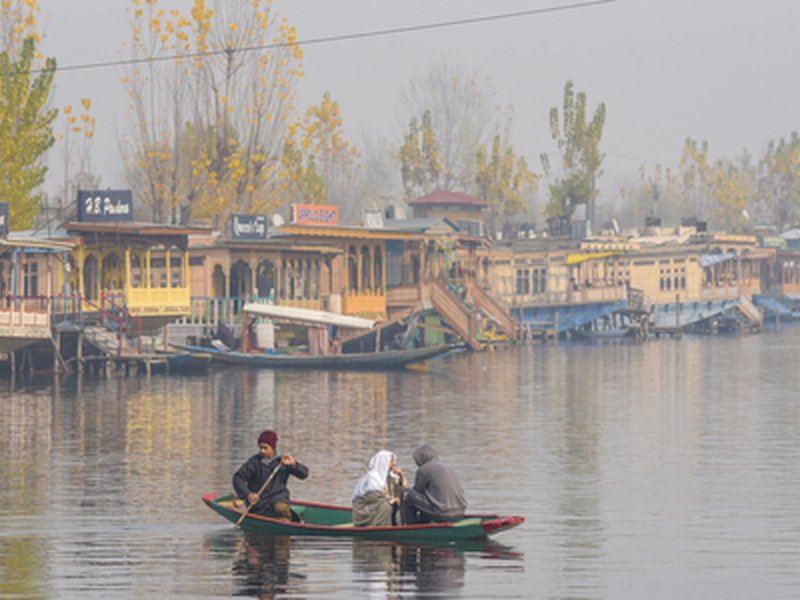
According to Daily Mirror Online, the domestic and foreign tourist visits in Jammu and Kashmir rose from 25.19 lakh in 2020 to 2.35 crore in 2024, while foreign tourist arrivals increased from 5,317 in 2020 to 65,452 in 2024.
"The broader trend since 2019 has been one of dramatic recovery, with millions more visitors helping revive hotels, transport services, local handicrafts, and guiding services," it says.
As many as seven new government medical colleges opened after 2019, along about 800 additional MBBS seats, increasing the Union Territory's total capacity to 1,300.
The AIIMS in Jammu became operational, while AIIMS Kashmir has moved ahead towards implementation.
Sharing its findings on economic outlook, the report says that the 2024-25 economic survey gauged Jammu and Kashmir's investment proposals at Rs 1.63 lakh crore by December 2024, with the potential to create more than 5.90 lakh jobs.
It also notes that 1,984 industrial units with an investment of Rs 9,606.46 crore had come into production since 2019 and had generated 63,710 jobs.
Beyond new medical and national-level institutions, Jammu and Kashmir has seen broader expansion of professional education capacity and institutional presence, especially in Jammu.
"The most important point is that development in Jammu and Kashmir after Article 370 should be understood as a process of structural integration. The region is no longer defined solely by isolation, security disruptions, and administrative exceptionalism," the report said.
The report also says that the Union Territory has better road and rail connectivity today, with string of investment projects and tourism hotspots to bring transformational change in the valley, underlining the fact that -- the positive developmental shift is real and measurable in official data and concrete outcomes.
"In the larger national context, Jammu and Kashmir today appears more closely tied to India's economic and institutional mainstream than at any point in recent decades," it opines.
--IANS
mr/khz