

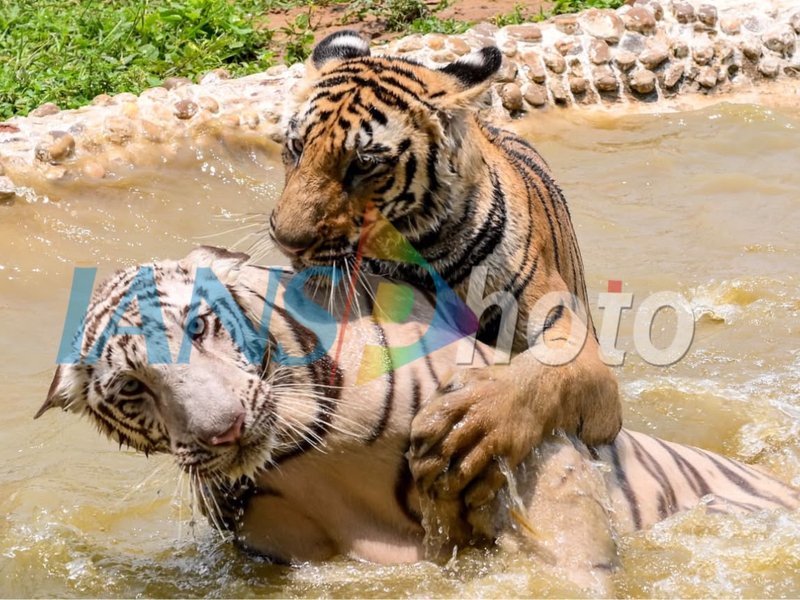
New Delhi, Oct 6 (IANS) India is home to an estimated over 3,600 wild tigers and currently has 58 tiger reserves across 18 states, according to latest figures from the All India Tiger Estimation, conducted in 2022, by the National Tiger Conservation Authority (NTCA).
Today, the tiger reserves in the country cover a vastly sprawling area of about 84,500 sq km. Project Tiger, the flagship wildlife conservation program launched in 1973, stretches through the length and breadth of country, ranging from the Himalayan foothills and the dry forests of Rajasthan to the mangroves of the Sundarbans and rainforests of the Western Ghats.
Here is a journey through India's key tiger habitats in various states:
Jim Corbett (Uttarakhand)
Jim Corbett is India's first national park, which was established in 1936. At the foothills of the Himalayas, the forest is a mixture of riverine stretches, grasslands and wooded hills.
Uttarakhand Tourism describes Corbett, which is about 160-200 km from Dehradun, as having one of the country's important tiger populations and also lists elephants, leopards, bears and numerous bird species among its wildlife. As per 2022 estimate, there are about 260 individual tigers in the Jim Corbett National Park.
March-May and mid-September-December are the ideal time to visit the national park for wildlife viewing.
Dudhwa, Pilibhit and Ranipur Tiger Reserve (Uttar Pradesh)
Uttar Pradesh's three tiger reserves represent the state's diverse Terai and Bundelkhand landscapes with a total tiger population of about 200. Dudhwa Tiger Reserve, along the Indo-Nepal border, is known for its grasslands, sal forests, wetlands and rich wildlife, including tigers, elephants, swamp deer and one-horned rhinoceroses.
Pilibhit Tiger Reserve, also part of the Terai ecosystem, features dense forests, grasslands and several rivers and is an important habitat and corridor for tigers and other large mammals. Ranipur Tiger Reserve, in the Chitrakoot district of Bundelkhand, is characterised by dry deciduous forests, hills and grasslands and represents a distinctly different tiger habitat from the northern Terai reserves.
Together, these reserves strengthen tiger conservation across Uttar Pradesh and provide connectivity between important forest landscapes extending towards Nepal and neighbouring central Indian habitats.
Kanha and Panna Tiger reserves (Madhya Pradesh)
From the Himalayan foothills, the road leads into the forests of Madhya Pradesh in Central India. Madhya Pradesh has the highest nine tiger reserves in the country, with Kanha, Bandhavgarh, Pench, Satpura, Panna, Sanjay-Dubri, Ratapani, Veerangana Durgavati and Madhav collectively sheltering close to 800 big cats.
Kanha's broad meadows and sal forests provide an expansive setting for wildlife watching. The reserve, which houses about 100 tigers, has four core tourism zones and three buffer zones, with the official tourism system advising visitors that the principal safari season runs from October to June.
Bandhavgarh, which is about 500 km from Bhopal, has a more dramatic landscape of hills, valleys, meadows and the historic fort that gives the reserve its name. Bandhavgarh has as many as 134 individual tigers as per the NTCA survey.
The Madhya Pradesh Forest Department describes it as an important habitat for tigers and herbivores, with 34 mammal species and nearly 260 bird species recorded in the reserve.
Nearby Pench, about 400 km southeast of Bhopal near the Maharashtra border, offers another kind of fascination.
The Pench River runs through the landscape, and the forest is closely associated with the setting that inspired Rudyard Kipling's The Jungle Book. The reserve houses as many as 48 tigers extends across the Madhya Pradesh-Maharashtra landscape, making it an especially interesting stop for travellers exploring central India.
Six Tiger reserves in Maharashtra
Maharashtra currently has six tiger reserves which are Melghat, Tadoba-Andhari, Pench, Bor, Nawegaon-Nagzira and Sahyadri housing more than 400 big cats. Maharashtra's tiger reserves span the state's Vidarbha, western and central forest landscapes, offering considerable variation in terrain and vegetation.
The ideal time to visit Maharashtra’s tiger reserves is generally October to June, with the March to May period particularly favourable for tiger sightings.
Tadoba-Andhari, about 150 from Nagpur, is known for its dry deciduous forests and strong tiger population, while Melghat covers rugged Satpura terrain and rich teak forests; Pench forms part of a larger tiger landscape extending into Madhya Pradesh.
Bor and Nawegaon-Nagzira (about 90 km and 140 km respectively from Nagpur), are important habitats and potential tiger landscapes in eastern Maharashtra, while Sahyadri Tiger Reserve (160 km from Pune) represents the Western Ghats, with evergreen and semi-evergreen forests, steep valleys and high biodiversity.
Together, these reserves provide habitat for tigers, leopards, sloth bears, gaurs, wild dogs and other wildlife, while their forest corridors are crucial for maintaining connectivity between tiger populations.
Ranthambore and Sariska Parks in Rajasthan
Rajasthan's tiger reserves stand apart for their dry deciduous forests, rugged Aravalli-Vindhyan hills, open grasslands and water bodies, offering a different safari experience from India's wetter forest landscapes.
They also uniquely combine tiger habitats with historic forts, temples, lakes and ancient ruins, particularly at Ranthambore (180 km from Jaipur) and Sariska (100 km from Jaipur).
Rajasthan currently has five tiger reserves namely Ranthambore, Sariska, Mukundara, Ramgarh Vishdhari and Dholpur-Karauli. Ranthambore is the largest at 1,411.29 sq km, while Mukundara is the smallest at 759.99 sq km.
They all house 88 tigers, as per a government record of 2022. Ranthambore replaces the dense central Indian forest with a striking dry landscape of rocky hills, lakes and open meadows.
The ruins of the 10th-century Ranthambore Fort overlook the forest, creating an unusual meeting of history and wilderness. The reserve has 57 tigers which share this habitat with leopards, sloth bears, hyenas, sambars, chitals and nilgai. Rajasthan Tourism lists October to June as the park's visiting season.
Kaziranga and three other Tiger reserves in Assam
Assam has as many as four tiger reserves namely Kaziranga (200 km from Guwahati), Manas, Nameri, Orang of which Manas reserve (140 km from Guwahati) is the largest one spreading across over 2,800 sq km.
There as many as 229 tigers in Assam’s tiger reserves, as per a 2022 government data. Kaziranga, however, changes the scenery completely. Tall grasslands, wetlands and riverine habitat dominate this UNESCO World Heritage landscape.
The reserve is particularly famous for the one-horned rhinoceros, but it is also a tiger reserve and supports elephants, wild buffalo, swamp deer and other wildlife. November to April is the best period for visiting Assam’s tiger reserves. West Bengal West Bengal has two tiger reserves namely Buxa and Sundarban, according to the National Tiger Conservation Authority (NTCA).
Both the reserves have about 100 tiger population as per a 2022 assessment. Buxa Tiger Reserve is located in the Alipurduar district in north Bengal, covering about 760 sq km and features forests, hills and riverine habitats along the Bhutan border.
It is part of the important Eastern Himalayan tiger landscape and supports elephants, leopards, gaur and other wildlife. Spread across about 2,585 sq km, Sundarban Tiger Reserve it is India's only tiger reserve dominated by tidal mangrove forests, creeks and islands. Its tigers have adapted to a unique coastal environment, making boat-based wildlife exploration the principal safari experience. Here the Royal Bengal tiger moves through tidal waterways, mudflats and mangrove islands.
The Sundarbans is the world's largest mangrove forest and a UNESCO World Heritage Site. Tamil Nadu Kalakad-Mundanthurai, Anamalai, Mudumalai, Sathyamangalam and Srivilliputhur-Megamalai are the five tiger reserves in Tamil Nadu with a big cat population of about 300.
Together, they cover diverse landscapes of the Western Ghats and Eastern Ghats, ranging from dense evergreen and moist deciduous forests to grasslands, valleys and rugged hill ranges.
Mudumalai and Sathyamangalam form an important part of the Nilgiri landscape and provide crucial habitat and corridors for tigers, elephants, leopards and wild dogs.
Anamalai and Kalakad-Mundanthurai are known for their rich Western Ghats biodiversity, extensive forests and high elevation habitats.
Srivilliputhur-Megamalai, located in the southern Western Ghats, is important for strengthening connectivity between forested landscapes in Tamil Nadu and Kerala.
The reserves are also home to gaur, sambar, spotted deer, sloth bears and several species of birds and reptiles.
Periyar and Parambikkulam in Kerala
In Kerala, there are two tiger reserves namely Periyar (about 170 km from Kochi) and Parambikkulam. These tiger reserves are home to more than 200 tigers (2022 figures) and offer perhaps the most tranquil experience.
The forest rises around Periyar Lake on the Western Ghat, where boat journeys can bring elephants and other animals into view.
Parambikulam Tiger Reserve (180 km from Kochi) in Western Ghats is known for its dense evergreen and moist deciduous forests, rich biodiversity, and significant populations of tigers, elephants, gaur and other wildlife.
The Kerala government records more than 60 mammal species and a remarkable diversity of flowering plants, including orchids.
Five Tiger reserves in Karnataka
Karnataka has five tiger reserves namely Bandipur, Nagarhole, Bhadra, Kali and Biligiriranga (BRT) with a population of more than 560.
Together, they form an important part of the Western Ghats-Nilgiri tiger landscape and are known for their rich forests, abundant prey and important wildlife corridors.
Karnataka's reserves are particularly distinctive for supporting tigers alongside large populations of Asian elephants, gaurs, leopards and wild dogs, with Bandipur (about 80 km from Mysuru) and Nagarhole (90 km from Mysuru) forming part of one of India's most significant connected wildlife landscapes.
Bandipur is known for dry deciduous forests and open woodland, while Nagarhole has a mix of moist deciduous forests, bamboo and the Kabini landscape. Bhadra (280 km from Bengaluru) combines forested hills with the Bhadra reservoir, whereas Kali (120 km from Hubballi) is characterised by dense Western Ghats forests, rivers and rugged terrain.
Biligiriranga Tiger Reserve (85 km from Mysuru), spread across the Biligiriranga Hills, is ecologically important because it forms a link between the Eastern and Western Ghats.
The reserves' connectivity and diverse habitats make Karnataka one of India's major tiger landscapes.
A final stop could be Nagarhole in Karnataka, part of the larger Nilgiri landscape and connected ecologically with Bandipur and Wayanad in northern Kerala. Its forests range from dry deciduous woodland to moist and semi-evergreen vegetation, supporting tiger, leopard and dhole populations.
-- IANS
snj/mr