
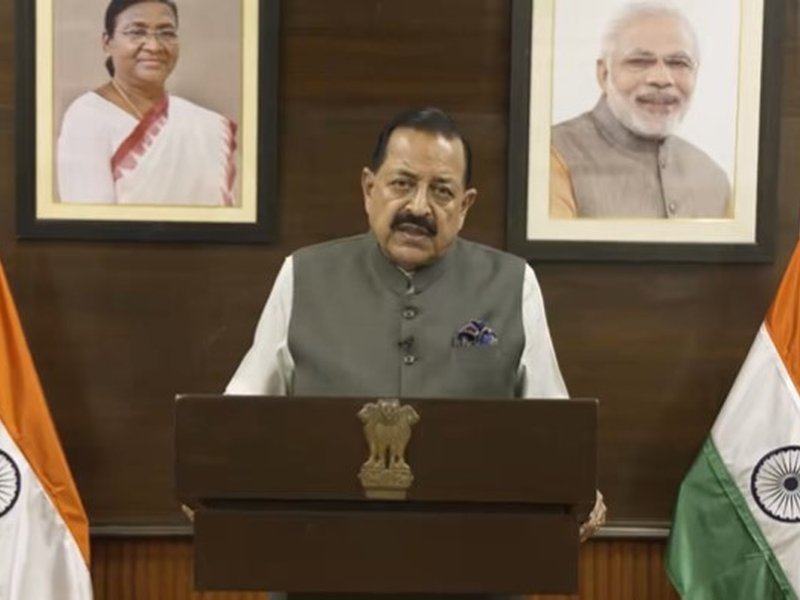
New Delhi/Tokyo, April 6 (IANS) Union Minister of State for Science and Technology, Jitendra Singh delivered a virtual address at the grand finale of the India-Japan Year of Science, Technology and Innovation Exchange, on Monday, held at the Embassy of India in Tokyo, highlighting four decades of robust bilateral cooperation.
Opening his address, Singh said: “Namaste! At the outset, a very good afternoon to everybody. Today on occasion of grand finale of India-Japan year of science and technology being celebrated in Embassy of India, Tokyo, Japan it is indeed my immense pleasure to be addressing you all.”
Emphasising the strength of bilateral ties, he noted: “I’m happy to observe that the Indo-Japan science and technology cooperation is one of the strong pillars of our international Science & Technology engagements.”
Marking the significance of the occasion, Singh added: “I’m glad to speak to you virtually at the Grand Finale of India Japan year of science, technology and innovation exchange commemorating 40 years of science and technology partnership between the two nations.”
Highlighting India’s growing role in innovation, he said: “India plays a major role in the research and development purpose for all sectors of science and technology with multiple stakeholders of academia, R&D institutions, entrepreneurs while keeping scope for equal opportunities for the participation of women as well as young scientists.”
The minister also outlined key milestones achieved in recent years: “The 11th meeting of Indo-Japan Joint Science & Technology Committee Meeting which was held in New Delhi on 5 June 2025 has channelised several new initiatives.”
“On August 31st last year, during the visit of Prime Minister Narendra Modi a Joint Statement of Intent was signed… to further strengthen the relations in science technology and innovation,” he added.
Singh also announced that a "fresh memorandum of cooperation between the Japan Agency for Medical Research and development and the Indian Council of Medical Research… is already signed.”
Referring to ongoing collaborations, Singh said: “The Indian Beamline established at Tsukuba, Japan is also contributing to cutting-edge research. Unveiling of the bust of Bharat Ratna Sir C.V. Raman at Shimane University in 2025… was also a very gratifying occasion.”
“Japan Science & Technology Agency… launching Lotus program… to invite and support 1000 researchers from India every year... We have made an implementation arrangement between ISRO and JAXA of Japan to land on the Moon together under the LUPEX project,” he said.
Looking ahead, he underscored the shared vision between the two nations: “We see Japan as a trusted partner where Japan's technology and India’s talent can enhance, supplement each other… We look forward to the creation of a joint centre by Japan and India for accelerating innovation in Science & Technology and addressing critical science technology challenges of both countries, including global challenges such as sustainable development goals.”
Concluding his remarks, Singh congratulated the Embassy of India in Japan for organising the event.
Earlier in March 2025, Singh addressed the celebrations of India’s National Science Day at the Indian Embassy in Tokyo, where he highlighted four decades of successful India-Japan collaboration in science and technology.
He had dedicated 2025–26 as the India-Japan Year of Science, Technology and Innovation Exchange, tracing the progress made since 2014 under the leadership of Prime Minister Narendra Modi.
Singh also noted key achievements since 2015, including the selection of around 7,000 Indian students under the Sakura Science Program, enabling them to visit Japan and gain exposure to advanced research.
The ongoing partnership is expected to deepen further in emerging areas such as Artificial Intelligence, Machine Learning, Quantum Technology, and Space, marking a new phase in bilateral scientific cooperation.
--IANS
rs/rad