

New Delhi, April 24 (IANS) India’s unique geographical location between the eastern and western hemispheres provides a natural advantage in emerging as a global transit hub, Civil Aviation Minister Ram Mohan Naidu has stressed.
He said that the country has developed the strategy after extensive deliberations with all the stakeholders.
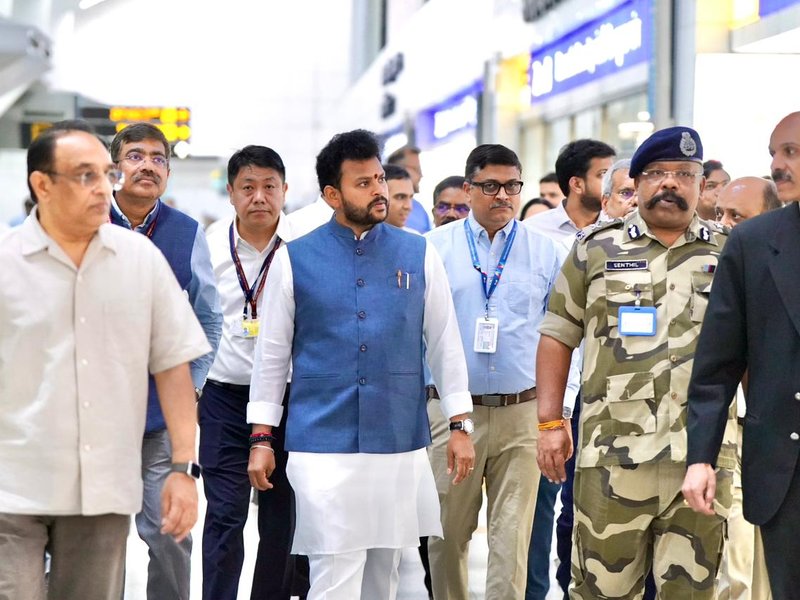
“I am deeply grateful to Home Minister Amit Shah for his active support in advancing the proposal,” said Naidu while reviewing the readiness of Delhi Airport for the implementation of hub-and-spoke operations.
He chaired a high-level meeting with all key stakeholders at the airport.
The National Civil Aviation Policy (NCAP) 2016, formulated under the decisive and visionary leadership of Prime Minister Narendra Modi, laid out a clear roadmap for positioning India as an aviation hub of choice for Indian passengers by 2030 and for the world by 2047.
The government has developed an International Aviation Hub Strategy, under which several key measures have been undertaken.
These include adopting a calibrated approach in granting Points of Call to foreign carriers, particularly for non-metro destinations, renegotiating bilateral agreements in a manner that strengthens Indian carriers and promotes domestic hubs and liberalising domestic code-share arrangements to enable Indian airlines to expand their global reach, according to Civil Aviation Ministry.
Elaborating on the significance of the hub-and-spoke model, the Minister stated that it will enable seamless connectivity between Tier-II and Tier-III airports developed through visionary UDAN scheme of PM Modi and the international destinations.
He noted that while the passengers will benefit from reduced travel time, there will also be optimal utilisation of the infrastructure already developed across the country.
“At present, nearly 35 per cent of international passengers travelling from India transit through foreign hubs such as Dubai, London and Singapore. Our aim is to reverse this trend by developing globally competitive Indian hubs like Delhi, Mumbai, Bangalore, Hyderabad, Kolkata and Chennai,” said the minister.
Delhi Airport stands out with its capacity exceeding 100 million passengers annually, handling nearly 50 per cent of the total passenger traffic in the northern region and managing around 50,000 daily transfers, thereby positioning itself as a natural hub airport, the minister added.
The hub-and-spoke strategy represent a shift in India’s aviation landscape from being primarily an end-destination market to evolving into a global transit hub, thereby allowing Indian airports to capture a substantial share of transfer traffic that is currently routed through foreign hubs.
Under the hub-and-spoke model, passengers arriving from various smaller cities will be consolidated in a coordinated manner and routed through major hub airports such as Delhi for onward international connections.
—IANS
na/