
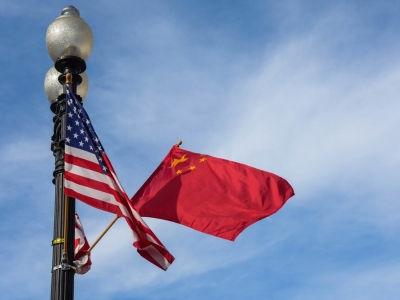
Washington, Oct 13 (IANS) The International Monetary Fund (IMF) has said that steep tariffs imposed by the United States and China have sharply reduced bilateral trade, but businesses in both countries have managed to cushion the impact by redirecting exports to alternative markets, particularly in Asia.
In its October 2026 World Economic Outlook released Tuesday, the IMF said Chinese exports to the United States fell 22 per cent between February 2025 and January 2026, while American exports to China declined 25 per cent during the same period.
The IMF said the decline in bilateral trade reduced China's total export growth by 3.3 percentage points and American export growth by 1.7 percentage points.
However, both countries expanded shipments to third markets, offsetting much of the immediate damage.
By January 2026, Chinese exports to markets outside the United States were 4.7 percentage points above their pre-tariff trend.
American exports to destinations other than China were 2.6 percentage points above their earlier trend.
These adjustments helped keep total exports from both countries within approximately one percentage point of their pre-tariff trajectories.
The IMF examined how companies redirected shipments after the tariff increases introduced in 2025.
Its analysis found that Chinese exports of products affected by American tariffs to alternative destinations increased by an amount equivalent to 52 per cent of the trade at risk within a year.
After accounting for export growth that would probably have occurred without the tariffs, the increase attributable to trade diversion was estimated at 39 per cent.
The corresponding figures for American exports affected by Chinese retaliatory tariffs were substantially smaller.
US shipments of those products to third markets increased by an amount equivalent to 17 per cent of the trade at risk, with about 7 per cent attributable to the tariff shock after adjusting for existing trends.
The IMF attributed part of the difference to China's greater dependence on the American market before the tariff escalation.
The United States accounted for approximately 15 per cent of Chinese exports before the increases, compared with China's 7 per cent share of American exports.
Asia emerged as the principal beneficiary of the resulting trade reconfiguration.
Emerging and advanced Asian economies together absorbed approximately half of the redirected trade, followed by the European Union with nearly one-fifth.
Smaller shares went to the Middle East, Central Asia, Africa and the Western Hemisphere.
Electrical machinery accounted for much of the increase in shipments to Asia, while vehicles featured prominently in redirected exports to the Middle East and Central Asia.
The IMF said companies had demonstrated considerable flexibility in adjusting production and distribution networks to changing trade barriers.
However, it cautioned that the ability to redirect exports does not eliminate the longer-term economic costs of protectionism.
Persistent trade restrictions could increase operating costs, duplicate production facilities and reduce efficiency across global supply chains.
The Fund projected world trade volume growth to slow from 5 per cent in 2025 to 4.6 per cent in 2026 before edging up to 4.7 per cent in 2027.
The report also identified new bilateral and regional trade arrangements, including agreements involving India and the European Union and the United Kingdom, as possible ways to reduce trade barriers and strengthen supply-chain resilience.
The IMF's World Economic Outlook assesses global economic developments, including the effects of tariffs, commodity prices and technological change. Its October edition examines the economic consequences of trade restrictions alongside the Middle East conflict and the global artificial intelligence investment boom.
--IANS
lkj/rs