
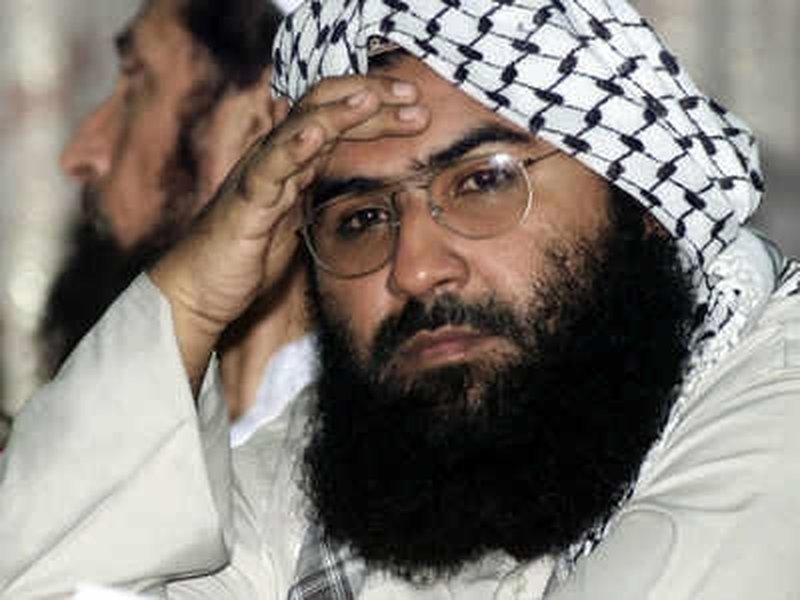
Kabul, May 9 (IANS) In order to understand how Pakistan's relationship with terrorism actually functions, understanding the life of a single man - Masood Azhar, the founder of Jaish-e-Mohammed - would be sufficient. Azhar has lived a life that no rogue actor could survive. His career is the case study that exposes the lie at the heart of Pakistani denials.
Born in Bahawalpur in 1968, Masood Azhar grew up in a Deobandi religious environment, joined Harkat-ul-Mujahideen in his early 20s, and travelled to Britain, Saudi Arabia, and East Africa to raise funds for jihadist causes. By 1994, he had taken on a more operational role. That year, he travelled to India's Jammu and Kashmir on what he called a "mission", and was arrested by Indian security forces. He should have remained in Indian custody for years. He did not.
In December 1999, Pakistani militants linked to Harkat hijacked Indian Airlines Flight IC-814 from Kathmandu and forced it to Kandahar, where the Taliban regime sheltered the hijackers after they had killed a passenger. The Indian government, led by late Prime Minister Atal Bihari Vajpayee, agreed to release three jailed terrorists in exchange for the surviving passengers. One of them was Masood Azhar.
The released prisoners were escorted to Pakistan by the ISI. According to journalist Ahmed Rashid and others who have written about this period, the ISI then paraded Azhar through Pakistan on a victory tour, helping him raise funds to start a new outfit. That outfit was named Jaish-e-Mohammed. By early 2000, Azhar was free, celebrated, and standing up a new terrorist organisation under the watchful eye of Pakistani intelligence.
Within a year, Jaish had attacked the Indian Parliament in December 2001, an assault that killed nine Indian security personnel and brought India and Pakistan to the brink of full-scale war. Azhar was briefly placed under house arrest in Pakistan after international pressure. He was released by the Lahore High Court in December 2002. He has not been formally charged for any major attack since.
Jaish-e-Mohammed is not a conventional terrorist organisation. It is, by the analysis of multiple researchers, a family business. Ayesha Siddiqa, a Pakistani scholar who has interviewed Jaish members, concluded that the group is run almost exclusively by the Azhar family. Masood's brother, Abdul Rauf Asghar, took over operational command in 2007 and was designated as a terrorist by the United States Treasury in 2010 for recruiting operatives and planning attacks in India and Afghanistan. Other family members hold senior positions across the organisation's command and finance structures.
This is not how rogue actors operate. Rogue actors do not run multi-decade family enterprises in cities like Bahawalpur, with offices, training facilities, and openly affiliated charities. They cannot. They lack institutional protection. Jaish has had that protection for 25 years. It has built infrastructure that includes the Markaz Subhan Allah complex in Bahawalpur, an 18-acre compound that operated as the group's national headquarters until India destroyed most of it on May 7, 2025.
China's role in shielding Azhar from international accountability is also part of this story. Between 2009 and 2019, China vetoed four separate attempts by India and other countries to list Azhar as a UN-designated terrorist. Beijing cited a vague lack of evidence each time, despite the considerable documentation that Azhar's group had carried out the 2001 Parliament attack, the 2016 Pathankot airbase attack, and the 2019 Pulwama suicide bombing that killed 40 Indian paramilitary soldiers. China only relented in May 2019, after sustained international pressure that followed the Pulwama attack.
When India struck the Markaz Subhan Allah complex on May 7, 2025, the operational consequences for the Azhar family were immediate and devastating. As many as 10 members of the family were killed, including Azhar's sister, her husband, his nephew and his nephew's wife, his niece, and five children of the family. Four close aides also died. According to Indian assessments, Abdul Rauf Asghar himself was among those killed in the strikes, although Pakistani sources have not formally confirmed this.
The strike achieved more than military destruction. It produced documentary proof of what Pakistan had spent years denying. Masood Azhar had not, as Pakistan claimed in 2019, escaped to Afghanistan. He was in Bahawalpur. His family was there too. His operational headquarters was in Bahawalpur. The entire infrastructure of one of the world's most active terrorist groups was concentrated in a single compound, in a major Pakistani city, surrounded by Pakistani security forces.
After the strike, in his own released statement and in subsequent confirmations by Jaish commanders, Azhar acknowledged the deaths in his family. He did not, notably, claim that the targets had been civilian. He did not deny that they had been part of his organisation. The September 2025 Mission Mustafa conference, where senior Jaish commander Masood Ilyas Kashmiri spoke openly about the losses, took place inside Pakistan with no evident state interference. The contradictions are too glaring to ignore.
Masood Azhar's career, taken in its entirety, is a single sustained refutation of Pakistan's claim to be a normal state with a normal counter-terrorism problem. A normal state does not free a terrorist in 1999, help him stand up a new outfit, protect him through four UN listing attempts, and then claim it has lost track of him whenever he resurfaces.
The Bahawalpur strikes did something the international community had been unable or unwilling to do for decades. They forced the question into the open. Either Masood Azhar lives in Pakistan with state protection, or Pakistan has so completely lost control of its territory that an internationally designated terrorist can run a family enterprise from a major city without state knowledge.
Both possibilities are damning. Only one is true. India has long argued that the truth is the first one. Operation Sindoor produced the evidence to settle the debate. The international community now has to decide whether it will continue to accept Pakistan's denials, or whether it will finally hold the state accountable for the men it has sheltered for so long.
--IANS
scor/as