Washington, March 4 (IANS) Several Gulf nations have joined defensive operations against Iranian missile and drone attacks as the ongoing conflict in the Middle East expands, senior US military officials said on Tuesday, highlighting the growing regional response to Tehran's strikes on civilian and energy infrastructure.
Speaking at a Pentagon press briefing, Chairman of the Joint Chiefs of Staff Air Force General Dan Caine said multiple US partners in the region have already intercepted Iranian projectiles targeting cities and strategic facilities.
“Our partners are answering the call to defend themselves right alongside us,” Caine said.
He said Jordan, Bahrain, Saudi Arabia, the United Arab Emirates, Qatar and Kuwait have all engaged Iranian aerial threats during the conflict.
“Jordanian air defence crews recently intercepted a cluster of Iranian one-way attack drones headed towards Amman,” Caine said.
Bahrain’s air defence systems also intercepted a drone targeting maritime infrastructure.
“Bahrain’s air defence forces shot down an inbound drone approaching Manama’s maritime infrastructure, protecting both their population and critical shipping lanes,” he said.
Saudi Arabia, a key oil producer in the region, intercepted missiles aimed at its energy facilities.
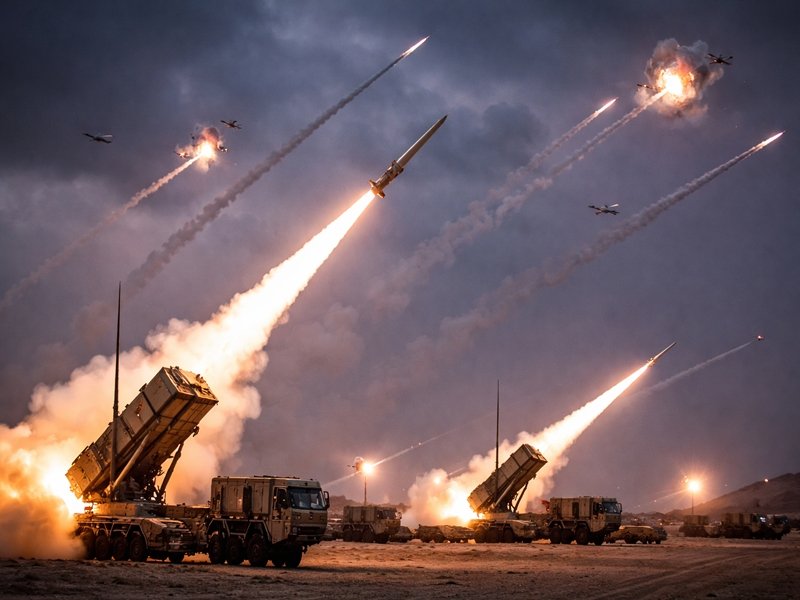
“Saudi Patriot batteries stopped a salvo of ballistic missiles aimed at energy facilities near Dhahran,” Caine said.
The United Arab Emirates (UAE) also intercepted multiple drone attacks targeting industrial infrastructure in Abu Dhabi.
“The UAE neutralised multiple drones targeting Abu Dhabi’s industrial zone, demonstrating speed and precision,” he added.
Qatar, which hosts a major US military base, was also directly involved in the defensive response.
“And Qatar -- Qatari fighter jets for the first time shot down two Iranian bombers that were en route to their location,” Caine said.
US officials said the expanding regional air defence effort reflects growing concern among Gulf states over Iranian attacks targeting civilian areas and economic infrastructure.
Secretary of War Pete Hegseth said several countries in the region are now cooperating more closely with the United States as the conflict unfolds.
“What you’re seeing right now is a response in the region to the belligerence of Iran and its willingness to target civilian airports, hotels, other civilian locations, and oil infrastructure of its Gulf neighbours,” Hegseth said.
He added that countries in the region were providing various forms of operational support.
“Whether it’s the UAE, Qatar, Bahrain, Kuwait or Saudi Arabia, on different levels they’re reaching out to us -- whether they’re going on offence, providing additional access, basing or overflight,” he said.
The Pentagon said the integrated air defence network, combining US systems with regional capabilities, has helped intercept a large number of Iranian missiles and drones during the conflict.
“The air defence capabilities of those countries are significant, and when combined with ours, it simplifies the shot doctrine, ensuring we use fewer munitions while being more effective with what we engage,” Hegseth said.
The United States launched Operation Epic Fury four days ago after escalating tensions with Iran over missile attacks and Tehran’s nuclear ambitions.
The conflict has already spread across multiple domains -- air, sea and missile warfare -- with US forces targeting Iranian missile launchers, naval assets and military infrastructure.
The growing involvement of Gulf states underscores the regional dimension of the conflict and the threat Iranian missile and drone attacks pose to energy infrastructure and shipping routes across the Middle East.
--IANS
int/lkj/pgh