
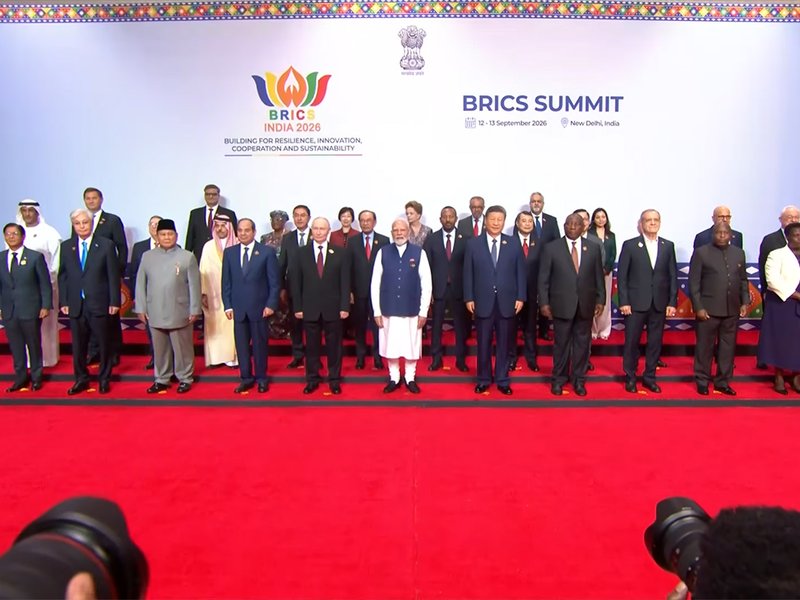
Hanoi, Sep 13 (IANS) India’s significance in BRICS plus goes well beyond the outcome of the New Delhi summit, with the expanded grouping offering the country a broader Global South constituency while also presenting a more complicated exercise in coalition management, a report has stated.
It noted that India will need to deepen ties with the UAE and other pragmatic middle powers while engaging newer members without allowing continued expansion to weaken the grouping.
“BRICS is no longer the compact five-member forum that India helped build around the politics of emerging economies. Enlargement has given it a much broader geographic reach, greater demographic and economic weight, and an increasingly powerful claim to represent dissatisfaction with the existing international order. But expansion has also imported more contradictions into a grouping that was never particularly cohesive to begin with,” according to a report in Vietnam Times.
However, the report said that “there are good reasons why enlargement can work in India’s favour".
It said that the original grouping gave New Delhi a distinctive space for engagement, while an enlarged BRICS provides India with a broader platform to deepen ties with important nations across the Middle East, Africa, Asia and the wider Global South.
“BRICS plus can amplify India’s preferred vocabulary: strategic autonomy, multipolarity, sovereign equality, reformed multilateralism, and greater representation for developing countries. There is an important distinction here. India does not require BRICS to replace the international order. It requires BRICS to increase India’s bargaining power within that order,” the report mentioned.
“The enlarged grouping strengthens India’s case for reform of organisations and other institutions whose structures inadequately reflect economic and demographic realities. It also provides a platform for India’s Global South diplomacy on development financing, climate justice, technology access, food and energy security, resilient supply chains, and digital public infrastructure,” it added.
According to the report, New Delhi should view BRICS Plus neither as its primary foreign policy platform nor as an inconvenient legacy grouping. Instead, it should see the bloc as one pillar of a broader strategy aimed at advancing multipolarity without embracing bloc politics. While Delhi’s chairmanship can demonstrate India’s diplomatic leadership, what follows will reflect a test of its statecraft.
“The central point, then, is not whether BRICS plus is stronger than the old BRICS. It is whether India can make a larger and more contradictory grouping work in favour of a multipolar order that preserves Indian autonomy,” it noted.
--IANS
scor/ksk/as