
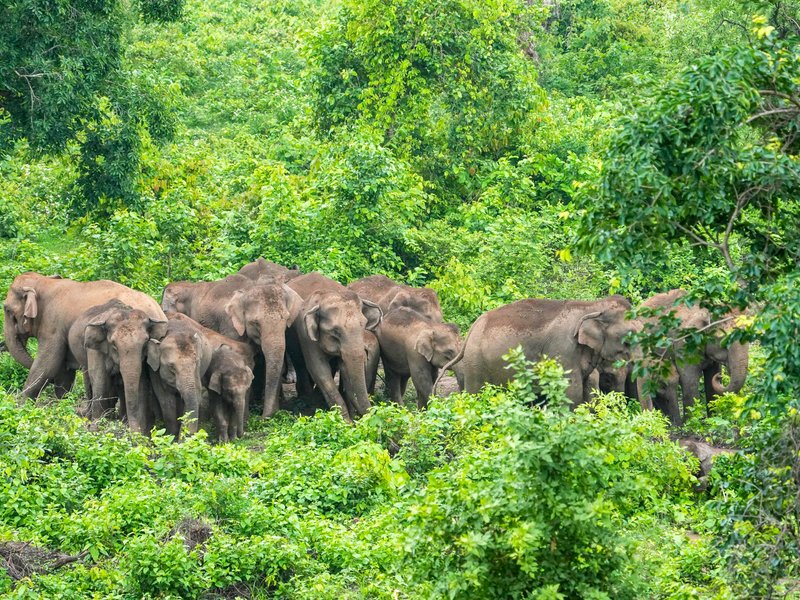
Kolkata, Aug 12 (IANS) While the Union Ministry of Environment, Forest and Climate Change sounded quite positive about the future of elephants in India on the occasion of World Elephant Day on Wednesday, a recent report by the Wildlife Institute of India (WII) has highlighted several challenges faced by the animal. Over the last one year, several upsetting images and videos have emerged of humans attacking elephants, including calves, with sharp weapons, firecrackers and even fireballs.
"The once-contiguous elephant population in the Western Ghats is rapidly disconnecting due to changing land use, including expanding commercial plantations (coffee and tea), invasive plants, farmland fencing, human encroachment and mushrooming developmental projects," the report has said.
"This fragmentation jeopardises habitat contiguity, emphasising the importance of safe guarding the connectivity in the landscape to enable free movement between the populations without escalating conflicts. Elephant habitats in the East Central landscape face fragmentation and deterioration from unmitigated mining and linear infrastructure construction, habitat degradation due to invasive plant species and human use.
"This has prompted long-ranging elephants to venture into historical range, but currently unoccupied areas, resulting in escalating conflicts with humans lacking cultural coexistence experience and posing a threat to elephant populations," it has stated.
The WII, with the ministry's support carried out the first ever DNA Based Synchronous All India Population Estimation of Elephants (SAIEE) and released the report titled 'Status of Elephants in India' a few months ago.
The Institute estimated the number of elephants to be around 22,514. Actuals can range between 18,255 and 26,645 animals, the report has said.
"The Northeast landscape holds the second largest elephant population of India. However, historical exploitation of natural resources since the colonial era, driven by the productive nature of the floodplains and geopolitical considerations, has led to habitat fragmentation and increased conflicts.
"Currently, elephants are distributed in pockets amid various human land use patterns, including habitation, tea plantations, and mines. It is crucial to ensure corridor connectivity across habitat patches, and better strategies for law enforcement monitoring, for the long-term survival of this species in the landscape," the report states.
The WII has noted that electrocution and railway collisions cause a significant number of elephant fatalities, while mining and highway construction disrupt habitats, intensifying man-wildlife conflicts.
"A sustainable resolution involves strengthening wildlife corridors, addressing mining and infrastructure-induced habitat fragmentation, implementing mitigation measures for linear infrastructure as well as power lines and enhancing law enforcement against poaching," the report states.
The Institute has pointed out that it is essential to engage with community, for sensitisation campaigns in elephant occupied areas and newly colonised places.
The critical aspect to ensure conservation of Asiatic elephants in the country needs the support of local communities, WII has noted.
"There is an urgent need to devise policy mechanisms for uniform compensation across areas with elephant presence, prioritising the well-being of these communities. With increasing human elephant interface, reducing habitat and connectivity, it is important to critically analyse and arrive at future strategies that will not exacerbate existing threats," the report has said.
It has highlighted the importance of strengthening corridors and connectivity, restoration of habitat, improving protection strategies and mitigation of developmental projects to ensure the well-being of these gentle giants.
During the day, Union Forest Minister Bhupender Yadav, reaffirmed India’s commitment to securing a shared future for elephants and people.
In a post on X, he noted that India has 33 Elephant Reserves across 14 States and 150 scientifically validated elephant corridors. Yadav said advanced population monitoring and stronger measures to mitigate human-elephant conflict are strengthening elephant conservation.
“When we secure the future of elephants, we secure our forests, biodiversity and ecological heritage," the minister further said, calling for action to ensure that the elephant continues to walk freely through India’s forests and landscapes for generations to come.
On the occasion, in a social media post, Union MoS (EFCC), Kirti Vardhan Singh, stated that India is home to one of the richest and most diverse landscapes on Earth.
Singh said that nearly 60 per cent of the world’s wild Asian elephants live in India, making them a living symbol of the country’s ecological heritage.
The Minister further stated that under the leadership of Prime Minister Narendra Modi, India’s elephant reserves stand as a testament to the country’s commitment towards conservation.
Kriti Vardhan Singh, Union Minister of State for Forests highlighted the role of elephants as ecosystem engineers, referring to how, when elephants roam, they disperse seeds across long distances, giving rise to new plants, and that every step of an elephant helps keep nature in balance.
--IANS
jg/rad