
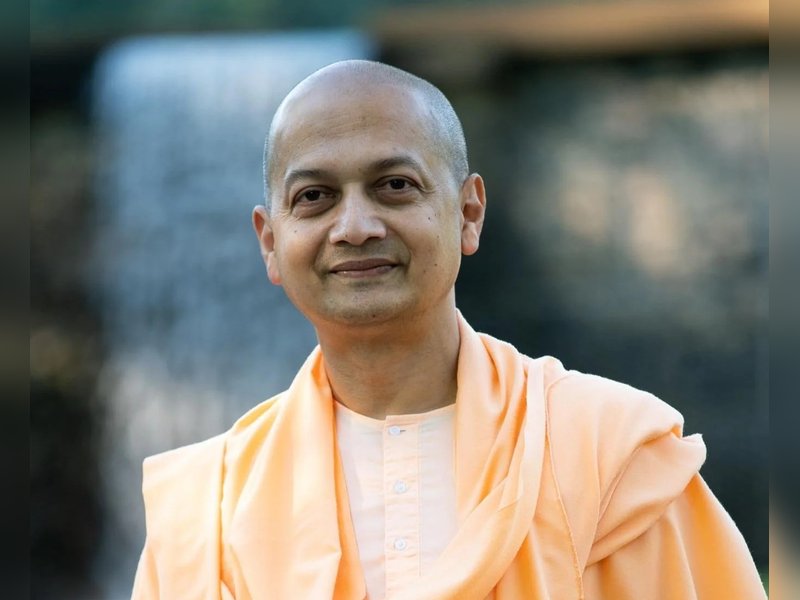
New Delhi, Oct 22 (IANS) Artificial intelligence (AI) may represent the fourth major challenge to humanity's traditional view of itself, forcing people to rethink what makes humans unique in an era of rapidly advancing machines, Swami Sarvapriyananda, leader of the Vedanta Society of New York, said on Thursday.
Speaking at the NDTV World Summit 2026, the New York-based monk and Vedanta scholar recently engaged with researchers at AI company Anthropic on questions related to consciousness, also addressed whether advanced AI systems should be viewed as persons.
He said his answer was both yes and no. "AI should be treated as a person," he said, while adding that such a view does not imply the technology possesses spiritual awareness or consciousness in the human sense.
He argued that AI is prompting questions that go far beyond technology and into the nature of consciousness, identity and human purpose.
Drawing on the ideas of psychoanalyst Sigmund Freud, he said science has repeatedly challenged humanity's sense of centrality and superiority.
According to the monk, artificial intelligence could represent a fourth such disruption.
"We thought we were the creative intelligence. Now we see that AI can do what the greatest human mind can do, and better," he said.
The development, he argued, places humanity at a critical juncture where people must reconsider what distinguishes humans from increasingly capable machines.
"We have to ask ourselves what it is that distinguishes us, makes us unique, and where we should invest ourselves," he said.
The monk suggested that as AI systems become more sophisticated and interactive, society may increasingly relate to them in personal terms, even if fundamental questions about consciousness remain unresolved.
During the discussion, he referenced conversations with researchers at Anthropic, describing many of them as deeply concerned about the implications of the technologies they are developing despite their success in the industry.
He also highlighted growing interest among AI researchers in understanding unexpected behaviour exhibited by advanced models.
One area of focus, he said, is ‘persona drift’, a phenomenon in which an AI system's responses and patterns of reasoning can shift as it adopts a particular role, identity or behavioural framework during interactions.
--IANS
ag/