
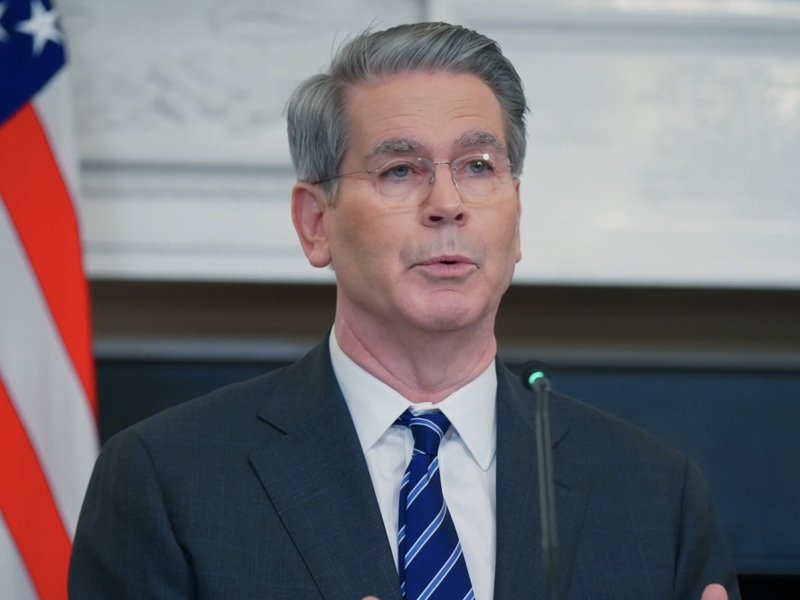
Asheville, Sep 1 (IANS) The United States does not want to separate its economy from China but must reduce dependence on foreign-controlled supply chains for semiconductors, critical minerals and medicines, Treasury Secretary Scott Bessent said on Tuesday.
Bessent said the Covid-19 pandemic had exposed vulnerabilities created by concentrating the production of critical goods in a limited number of countries.
“I often say in our trade discussions with China that we don’t want to pull apart from them, but we have to de-risk,” Bessent said during a fireside conversation with Larry Kudlow in Asheville, North Carolina.
“We have to de-risk everywhere in the world,” he added.
Bessent said the United States could not allow foreign governments or overseas suppliers to control points of vulnerability across essential industries.
The sectors identified by the Treasury Secretary included advanced semiconductors, critical minerals and the ingredients needed to manufacture widely used medicines.
“We do not produce amoxicillin here in the US. So we have to do that,” he said.
Bessent rejected the argument that market forces alone would reliably correct such vulnerabilities. Supply chains built solely around efficiency could leave the country exposed during wars, pandemics or other international disruptions, he said.
“There are market failures,” Bessent said. “And I think what we’ve learned is that maximal efficiency is not maximally secure.”
He said members of the Trump administration were working to secure critical points across supply chains under the President’s direction.
The administration is seeking to bring a substantial share of advanced semiconductor manufacturing back to the United States, Bessent said.
“We’re trying to bring 35 per cent of the semiconductor production, advanced semiconductor production, back into the US by the end of the President’s term,” he said.
The Treasury Secretary also stressed the need to maintain the industrial skills required to produce strategically important goods. Domestic capacity involved more than building factories or protecting the steel industry, he said.
“It is important to have the tradition of craftsmanship,” Bessent said.
He recalled how American private industry shifted to military production during the Second World War because the country already possessed the required workers, factories and technical skills.
“We need to make sure that we still have that in the US,” he said. “And I think we are going back to that.”
Bessent said the United States could not base its economy only on consumer products and financial services. Some strategically important production would have to be brought home or located in nearby and trusted countries.
“There are certain things that we need to onshore or nearshore,” he said.
The broader objective was to connect trade policy with economic and national security, according to the discussion. Washington has increasingly viewed control over advanced technologies and essential inputs as a source of strategic leverage.
--IANS
lkj/ksk/uk