
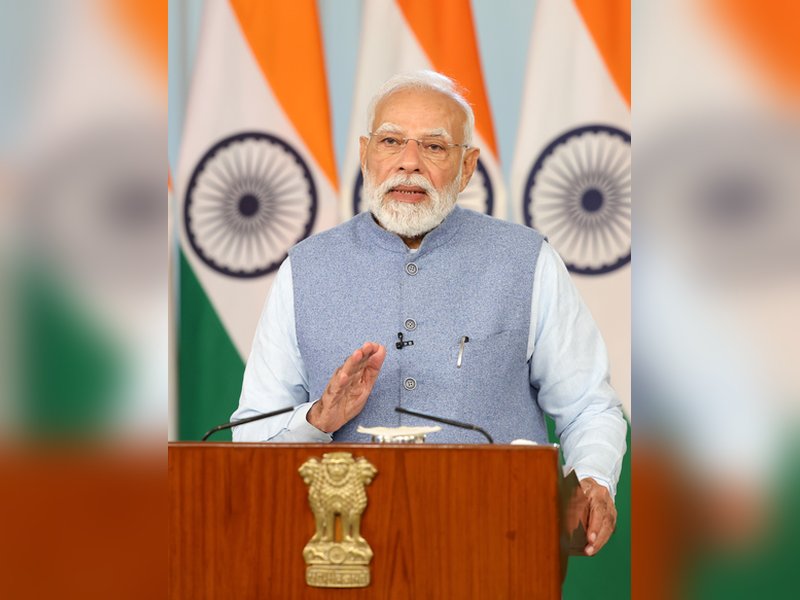

New Delhi, Dec 21 (IANS) Non-aggression, synthesis and unity of all existence reflect the ancient Indian thought that continues to define the standing of this country even in today’s world.
Independent India began its journey with the call of ‘friendship for all, malice towards none’ and years later, Prime Minister Narendra Modi reaffirmed the mantra of ‘Vasudhaiva Kutumbakam’ or ‘one earth one family one future’ at the G20 summit held at Delhi in September 2023. He struck the cord that India’s strategic culture was known for. This advocated peaceful coexistence not pacifism and PM Modi regime has made it abundantly clear that India would build its self-defence on the motto of self-reliance -on a scale that deterred its adversaries.
At the same time India has followed the strategy of pursuing bilateral relations with all for serving mutual security and economic interests, working for peaceful resolution of military conflicts and upholding the cause of suffering humanity anywhere. India rightly believes that in a multipolar world it could -as a major voice on issues of world peace - serve this cause without getting into ‘alignments’. This approach to international relations has benefited India in a large measure.
The success of India’s handling of international relations can be judged to an extent from the newly documented US National Security Strategy released by President Donald Trump on December 5. Although NSS focused on MAGA-related ‘America First’ priorities, Trump has attached special importance to Indo-Pacific region and recognised India’s contribution as a partner to Indo-Pacific security through the Quad framework.
He seemed to be elevating Quad as a grouping of strategic importance against China. As regards Pakistan, Trump is known to have cultivated its leadership, but that country found mention only in the context of the claim once again made by the US President, for his personal reasons- that he should be given credit for fostering peace between India and Pakistan in the Indo-Pak military stand off in May. Trump would have been happy if India like Pakistan, endorsed his claim and perhaps he carried a grudge on this count but he could not disregard India’s role as a major power advocating global peace and human development. Given to making commercial deals, Trump is shrewdly watching the course of Indo-US talks on trade and tariffs. India believes that competition should not lead to collision. Its policy of sticking to bilateral relations that served India’s security and economic interests was being applied to US as well. This has affirmed India’s strategic autonomy.
While Indo-US relations have been fluctuating between good and business-like under President Trump’s second tenure, Vladimir Putin’s visit to India for the India-Russia summit has helped to enhance the geopolitical balance from India’s point of view. The Russian President visited India at a time when US was pushing this country to cut down on its oil import from Russia on the plea that this was strengthening the Russian war machine in the Ukraine-Russia military conflict.
Prime Minister Modi described India-Russia friendship as something as stable as ‘the guiding star’ while Putin also emphasised that the two countries were ‘important partners’ in trade, investment and technologies. Putin pledged that Russia would continue with uninterrupted shipments of fuel for the fast growing Indian economy and implicitly urged India to disregard US tariff pressure.
On the Russia-Ukraine confrontation, Putin stated that Russia was taking steps with mediators, including the US, in search of a possible peaceful settlement. He seemed to have a certain equation with Trump, who in turn, wanted President Zelensky of Ukraine to accommodate Putin on the territorial issue. While economic cooperation was the ‘driving impulse’ of Putin’s visit - as India’s Foreign Secretary put it- both India and Russia evidently benefited from it and what is perhaps even more important from Indian perspective, the summit added to geopolitical stability and international equilibrium.
India’s strategy of not aligning with any ‘superpowers’ and preferring an approach of bilateral friendships, has served the country well and strengthened its position as a major votary of global peace and development. It has enabled India to emerge as an advocate for the global South on the forum of ASEAN and elsewhere and as a helping hand in resolving military conflicts whether it was Ukraine-Russia ‘war’ or Israel’s military offensive in Gaza following the October 7 terror attack of Hamas.
India does at the same time take serious notice of its adversaries like Pakistan which harboured Islamic terrorists for using them against India and China which had entered into a strategic alliance with Pakistan that was mainly directed against this country -as was seen in the post-Pahalgam military confrontation between India and Pakistan. India is active in both BRICS and SCO but is also prepared to upgrade its profile in Quad for countering Chinese aggressiveness in the Indo-Pacific and supporting ‘rules based order’ in that region. India is watching out against any Chinese outreach to Indian Ocean. It has in PM Modi regime adopted a policy of becoming self-dependent in economic and military planes that was in keeping with India’s approach to strategic autonomy and positive non-alignment. India has shown flexibility and patience in dealing with US and retained its belief that the two largest democracies of the world ought to have a natural friendship.
The geopolitical scene today is marked by signs of return of Cold War on the horizon with a resurgent China trying to emerge as the second superpower through a build up of its economic, technological and military might and with Russia playing the second fiddle to China. In Iran and Afghanistan US on one hand and China-Russia combine on the other seemed to be pitted against each other. Also, competing interests of US and China in the global South and a return to the Monroe Doctrine by Donald Trump that considered the Western Hemisphere as the exclusive area of American influence-Trump viewing it as a component of Make America Great Again (MAGA) mission- add to this bipolarity in international relations.
The American President’s attitude of withdrawal from NATO and the European Union is part of his reluctance to get into international projects through USAID that only ‘wasted US funds’ -as Secretary of State Marco Rubio put it. Trump has tilted towards Russia in the Ukraine-Russia military conflict -he had a personal bonhomie with Putin. India can maintain even relationships with both US and Russia, notwithstanding the ‘tariff pressure’ exercised by Trump on this country.
India can also remain firm on its stand that ‘this was not an era of wars’- as stated by Prime Minister Modi in his first response to the Ukraine-Russia conflict. India is , at the same time, free to plan its countersteps against a hostile China. A prime challenge in the present is the Trump administration’s move to cultivate Pakistan for reasons of trade in disregard of Pak complicity in faith-based terrorism, at a time when China was colluding with Pakistan against India. India has to find ways and means of dealing with the threat from the Sino-Pak axis that comes on top of the national security agenda of this country.
(The writer is a former Director Intelligence Bureau)
--IANS
dcpathak/rs