
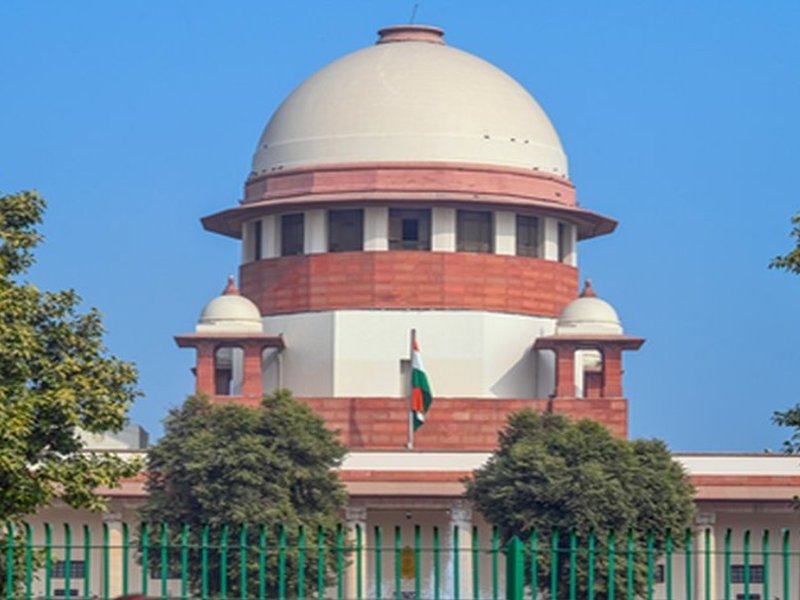
New Delhi, April 7 (IANS) Urging the Supreme Court to reconsider the 2018 Sabarimala judgment permitting entry of women of all age groups into the temple, the Union government on Tuesday told a nine-judge Constitution Bench that notions of “patriarchy” and “gender stereotypes” are alien to Indian
Appearing for the Centre, Solicitor General Tushar Mehta submitted before the Constitution Bench headed by Chief Justice of India (CJI) Surya Kant that Indian society has historically accorded women a position of “reverence and respect”, both in spiritual and public life.
“India is not that patriarchal or gender stereotyped that the West understands,” SG Mehta argued, adding that “India has always treated women equally; we have always treated them at a higher pedestal.”
Questioning the reliance on concepts such as patriarchy in arguments seeking entry of women into the Sabarimala temple, the Centre’s second-highest law officer contended that such notions “were never there” in Indian society.
“We are the only society, we worship ladies. From the President of India, to the Prime Minister of India, to the judges of the Supreme Court, we bow down before our leading ladies, so let us not introduce those concepts of patriarchy or gender stereotypes,” he submitted.
Referring to constitutional history, SG Mehta emphasised the role of women in the Constituent Assembly debates, describing them as the “founding mothers of the Constitution”, and argued that India’s constitutional ethos reflects deep respect for women.
He also addressed the scope of Article 26 of the Constitution, particularly the phrase “any section thereof”, submitting that it was deliberately framed to protect the rights of smaller groups within larger religious denominations.
“The phrase ‘any section thereof’ has been purposively added by the framers to include not just a whole denomination but also a section of a religious denomination,” SG Mehta said, adding that this ensures that diverse sects and sub-communities are able to manage their own religious affairs independently.
The Solicitor General further contended that the 2018 judgment, which had allowed entry of women into the Sabarimala temple, was “wrongly decided” and deserves reconsideration on legal grounds.
He also objected to the view taken in the verdict that the exclusion of women amounted to “untouchability” under Article 17, arguing that the restriction was based on age and not a form of social exclusion.
“There is no universal exclusion of women in Ayyappa temples, and Sabarimala’s restriction is due to the unique nature of the deity,” he submitted.
During the hearing, the Constitution Bench clarified that it would not examine the correctness of the Sabarimala verdict itself, and would instead confine its adjudication to the seven constitutional questions referred to it.
The top court is currently examining broader questions concerning the interplay between religious freedom and other fundamental rights, including the extent of judicial review over religious practices and the scope of denominational rights under Articles 25 and 26.
Apart from the Sabarimala issue, the Constitution Bench will also consider allied questions such as the entry of Muslim women into mosques and dargahs, the rights of Parsi women to access fire temples after interfaith marriages, the validity of excommunication practices, and the legality of female genital mutilation in the Dawoodi Bohra community.
The 9-judge Bench, also comprising Justices B.V. Nagarathna, M.M. Sundresh, Ahsanuddin Amanullah, Aravind Kumar, A.G. Masih, Prasanna B. Varale, R. Mahadevan and Joymalya Bagchi, is hearing the matter in accordance with a pre-fixed schedule.
Arguments by parties supporting the review petitions are scheduled from April 7 to April 9, followed by submissions of the opposing side between April 14 and April 16.
Rejoinders and final submissions are slated to conclude by April 22.
--IANS
pds/dan