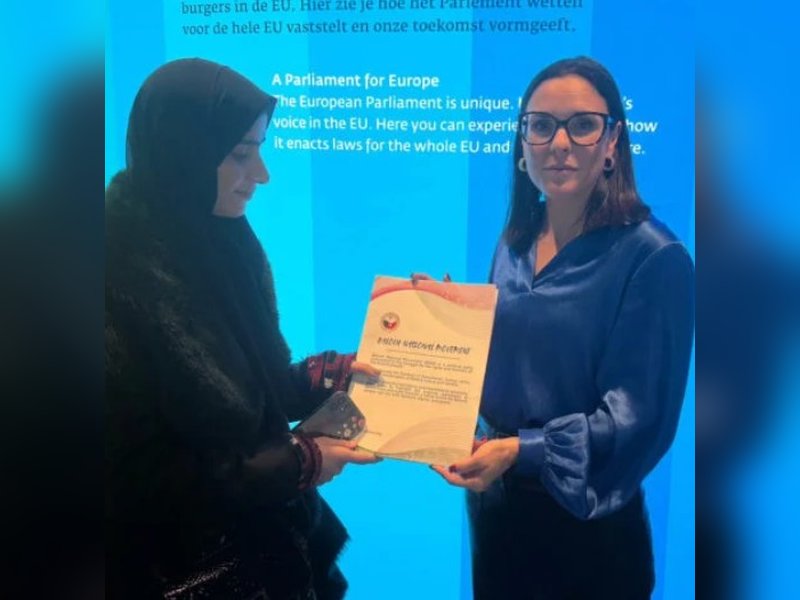
Islamabad, Oct 5 (IANS) Sardar Ayaz Sadiq, the Speaker of Pakistan's National Assembly, stood before the World Conference of Speakers of Parliament in Geneva on July 29, 2025 and warned his colleagues against populism, ultra-nationalism and "narrow interpretations of nationalism", before closing with the line -- "It is time to promote pluralism. It's time to accept diversity." Fourteen months later, on September 25, 2026, Prime Minister Shehbaz Sharif took the podium at the 81st session of the UN General Assembly and told the world that Pakistan had chosen dialogue over confrontation, that it would give Kashmiris "full diplomatic, political, and moral support", and that the demolition of a mosque in Saharanpur was proof of Islamophobia in India.
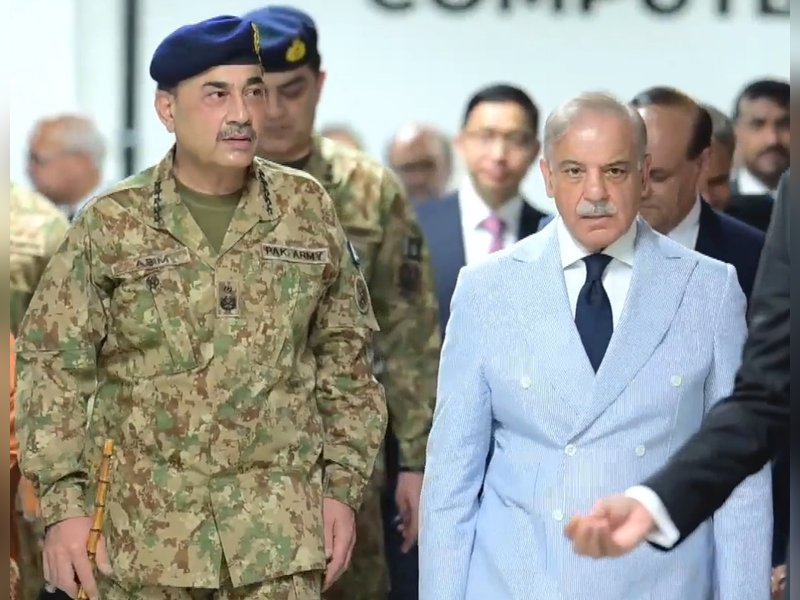
Both speeches were written for audiences outside Pakistan, and both said very little about the country they came from. However, the most revealing line in Sharif's address was one he probably did not mean as a confession, when he thanked Field Marshal Asim Munir for helping to "create space for diplomacy". An elected Prime Minister crediting his Army Chief from the UN podium says more about where power sits in Pakistan than anything he said about Palestine or the Indus.
Pakistan’s domestic challenges and its rhetoric in Geneva are very different. While similar diplomatic displays occur in our region, the extent to which they reflect reality is a matter for deeper introspection. This also highlights the need to consider the structure of the Pakistani state and the record of the past 18 months. The reality on the ground is different from the rhetoric and requires attention.
Pakistan's own parliament has been told that of the 1,817 Hindu temples and Sikh gurdwaras in the country only 37 remain operational, a figure placed before its Minority Caucus in late 2025, with the Hindu legislator Ramesh Kumar Vankwani blaming the Evacuee Trust Property Board, the body meant to protect these sites and long accused of being more interested in the land they stand on. Decay by neglect is slower than demolition, but the map it leaves behind is much the same.
For the Ahmadis, the state does not wait for neglect. The community’s own records indicate 21 mosques desecrated, 381 graves destroyed and 250 Ahmadis booked in religious cases in 2025 alone. These figures are broadly consistent with the US Commission on International Religious Freedom’s documentation including the demolition of three Ahmadiyya mosques in Punjab within 10 days in February and the lynching of Laeeq Cheema by a mob of over 400 in Karachi in April.
In January 2025, police and municipal staff razed a pre-Partition mosque in Daska, built under the direction of Pakistan's first Foreign Minister Sir Muhammad Zafarullah Khan, after months of pressure from the Tehreek-e-Labbaik Pakistan, even though the community had complied with the official notice. In effect, the police are doing the work the mob demands.
The smaller communities sit further down the same ladder. The Dawoodi Bohras of Karachi were bombed in 2012 and again in 2015, and while they do not face the legal exclusion the Ahmadis do, their experience shows that the hierarchy of belonging now runs inside Islam as well as outside it. Pakistan's roughly 14,500 Baha'is, named in the Constitution’s definition of non-Muslims, face exclusion rather than mass violence. This is the reality for the Bahá’í community in Pakistan.
Pakistan still has civil society organisations, some of them among the bravest in South Asia, but it no longer has a civil society in any working sense, a space where citizens can organise and criticise without being treated as enemies of the state. The Human Rights Commission of Pakistan (HRCP) recorded 273 new enforced disappearances in 2025, and at the launch of its report in May 2026 Hina Jilani said the state had surrendered to the security apparatus and Pakistan had become a "security state".
The tools are legal, which is what makes them durable. On January 2, 2026 an anti-terrorism court in Islamabad handed journalists including Moeed Pirzada, Shaheen Sehbai and Wajahat Saeed Khan two life sentences each, in absentia, for "May 9 digital terrorism", and three weeks later the human rights lawyers Imaan Mazari and Hadi Ali Chattha were sentenced to 17 years each under the Prevention of Electronic Crimes Act for their tweets, a sentence the Supreme Court suspended only in September.
The clearest evidence, however, came from Pakistanis themselves. When the youth-led Cockroach Janta Party took to the streets of Delhi over the NEET paper leaks in July 2026 and the Education Minister Dharmendra Pradhan resigned, Pakistani content creators watched with something close to envy.
Muhammad Waleed said "Pakistan never had a democracy to begin with", Mahwash Ajaz pointed out that Indian protesters sing 'Vande Mataram' while Pakistani protesters are labelled separatists, and the former Dawn Editor Cyril Almeida called Jantar Mantar a "warning to Pindi". The Indian state was hardly gentle with the protesters, but the creators were not praising Indian policing, they were noticing that protests in India could still produce a result, and that the same channel had been closed at home.
The most striking contrast is in Kashmir. Sharif mentioned to the General Assembly that Kashmiris have been waiting for eight decades for a plebiscite, which is just two months after Pakistan-occupied Kashmir (PoK) held its own legislative election, all while being cut off from the internet. The Jammu Kashmir Joint Awami Action Committee, a coalition of traders, transporters, lawyers and students that began in 2023 with protests over wheat and electricity prices, had moved on to demanding the abolition of the 12 assembly seats reserved for refugees living elsewhere in Pakistan, seats widely seen as the route through which Islamabad's parties manufacture majorities in Muzaffarabad. The local government banned the committee under anti-terrorism law on June 5, and by July 28 Amnesty International counted at least 40 dead, 34 of them protesters. In effect, a state that has not let the Kashmiris it already governs decide who sits in their own assembly is asking the world to hold a plebiscite for the Kashmiris it does not.
At the same time, the capital was telling its own version of the story. In the weeks around the UNGA address, Islamabad was walled off with shipping containers, at least 2,000 of them according to BBC Urdu, stacked two storeys high with spikes welded on top, to stop the Pakistan Tehreek-e-Insaf from marching for Imran Khan's release, and the city earned the name 'Containeristan'. The New York Times quoted an Islamabad urban economist who observed that containers, normally a symbol of trade, had become symbols of chaos and restriction, while truckers in Karachi refused to drive north for fear of having their vehicles seized. Talks between the government and the opposition broke down in the early hours of October 4 over whether PTI leaders could even meet Khan and his doctors, and Khyber Pakhtunkhwa's Chief Minister Sohail Afridi set the march off from Lakki Marwat the same afternoon.
India's right of reply, which called Sharif's administration a "Form 47 government", and the side events at the Human Rights Council in Geneva, where the Kashmiri radio jockey Harleen Kour spoke of strikes and shutdowns giving way to entrepreneurship on the Indian side, were predictable and should be read as such. What is harder to dismiss is that the critique India voiced had already been made by the HRCP, by Pakistani lawyers and by Pakistani content creators in their own words.
The contradiction persists because it is inherent in the structure. The Pakistani state derives its international standing through strategic usefulness as a frontline ally, a mediator between Washington and Tehran or a partner in the Mecca defence pact. The greater its reliance on these roles the less it requires to earn legitimacy from its citizens through transparent elections or open courts. However, as the role of the Army has shifted from being a tacit power broker or the kingmaker, if one has to use the major political lexicon in South Asia to an overt power-sharer demanding its ‘rightful’ share in the making of the Pakistani story. But the Pakistan story is a troubled road where all of the Generals have seen their legitimacy eroded, Munir will be next in line.
At the same Geneva conference where Sadiq spoke of pluralism, the Swedish Speaker described how democratic backsliding usually unfolds, with attacks on free expression and the media first, then manipulation of the electoral system, then attacks on civil society. Pakistan has gone through all three, and its leaders continue to speak abroad as though it has not. The march now moving towards Islamabad will show whether the system still has any room to absorb dissent, or whether the removal of its safety valves has left coercion as the only instrument it is willing to use. If the past is a prologue, then the report in the New York Times on how Islamabad is becoming Containeristan and how state authorities, at times take containers and use them to stop democratic marches from coming to the city, serve as a glimpse on what level the state moves when any democratic pressure applies.
--IANS
scor/as