
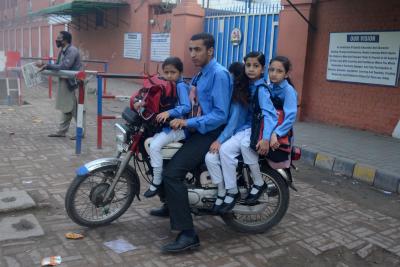
Islamabad, April 16 (IANS) Private schools in Pakistan's capital Islamabad have been neglecting 10 per cent scholarship quota for low-income students which is mandatory under the Right to Free and Compulsory Education Act, 2012, documents submitted to the Islamabad High Court have revealed. According to experts, these educational institutions, by violating the law, earn Pakistani Rupees (PKR) five billion to PKR six billion each year, a report stated.
The authorities introduced the scholarship quota in schools to give high-achievement students from underprivileged backgrounds a fighting chance to change their lives for generations to come, an editorial in Pakistan's leading daily The Express Tribune detailed.
"At least 38,900 students are estimated to have been deprived of this right so far. If legal action against these private entities continues at the current pace, this number is bound to increase. Moreover, ensuring the implementation of the scholarship quota alone will not be enough to undo the damage caused by this violation. These private institutions must be forced to turn over every penny obtained illegally, and reparations must be made for the students who have missed out on life-changing educational opportunities," an editorial in The Express Tribune mentioned.
Last month, a report revealed that nearly 28 per cent of children in Pakistan, aged between 5-16 years, are out of school. Quite alarmingly, girls are disproportionately impacted as 34 per cent of girls are not enrolled in schools in comparison to 22 per cent of boys. These disparities are more seen in rural regions of Pakistan, especially for girls, where exclusion for education is more, pointing to how gender and geography reduce educational access.
Two-thirds of Pakistanis aged 10 years and above have attended school at some point as access to education remains highly unequal in Pakistan, The Express Tribune reported citing the HIES survey by Gallup Pakistan. Pakistan's national literacy rate stands at 63 per cent with male literacy at 73 per cent and female at 52 per cent.
Literacy in urban areas stands at 77 per cent compared to 56 per cent in rural areas. While 68 per cent of children are enrolled in primary school, the numbers reduce sharply at higher levels of education. Only 40 per cent study in middle school and around 30 per cent in matriculation.
This sharp drop in the number of students continuing education in schools highlights the challenges faced by them, especially in rural and underprivileged areas, pointing to structural barriers such as safety concerns, school distance, and rising opportunity costs like children age, especially pronounced for rural girls. According to the report, financial pressure, domestic responsibilities and limited post-primary schooling options contribute to children not continuing education in schools. These challenges further increase for girls due to social expectations and early marriage.
--IANS
akl/as