
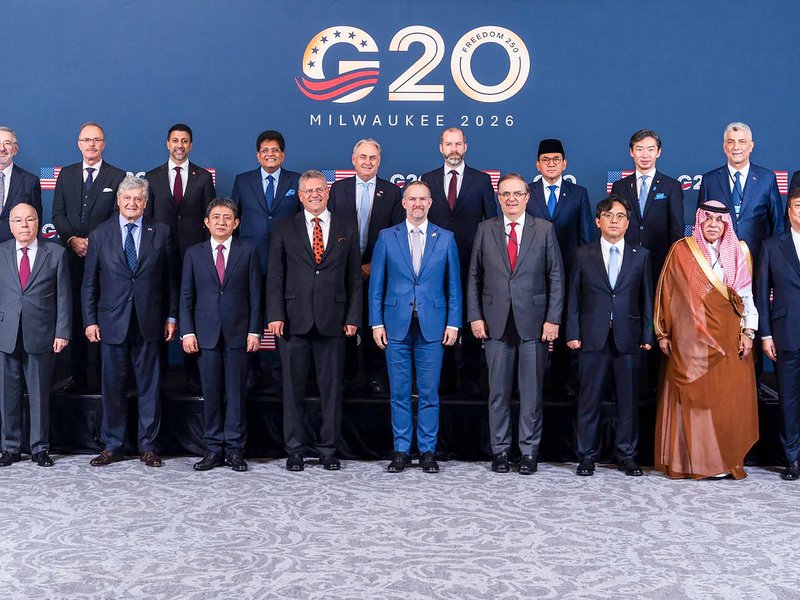
Washington, Oct 6 (IANS) The United States pointed to a G20 agreement against using food trade as economic or political coercion as a key outcome of last week's trade ministerial in Milwaukee, while acknowledging that major economies remained divided over forced abour, industrial overcapacity and changes to global trading rules.
The Office of the US Trade Representative released its assessment of the September 30-October 1 meeting hosted by US Trade Representative Jamieson Greer, outlining areas where ministers reached agreement and others where differences prevented broader G20 action.
India was represented at the meeting by Commerce and Industry Minister Piyush Goyal.
The ministerial meeting focused on four issues put forward by the United States: the weaponisation of food through coercive trade actions, forced labour in global supply chains, structural excess capacity and production, and the Most-Favoured-Nation principle that underpins much of the global trading system.
The clearest consensus emerged on food and agriculture.
"For decades, trade in food, agricultural products, and agricultural inputs has been weaponised to exert coercive pressure for economic or political reasons," USTR said in its account of the meeting.
The G20 trade ministers reached consensus on a statement addressing the weaponisation of food through coercive trade actions.
"This week's G20 Trade Ministerial in Milwaukee was a success. It is especially significant that the entire G20 was able to reach consensus on the statement on the weaponisation of food through coercive trade actions," Greer said.
But efforts to secure a common position on forced labour were less successful.
The United States, Mexico and Argentina issued a separate statement calling for the elimination of forced labour from global supply chains after the broader G20 failed to reach consensus.
"While I am disappointed that the G20 Trade Ministers did not reach consensus on this issue, I am hopeful that discussions on this topic will continue and that other economies will join us in taking increased action to combat forced labor in global supply chains," Greer said.
Industrial overcapacity was another point of friction.
Washington has argued that structural excess production, particularly when supported by non-market policies, can distort global markets, depress prices and hurt producers operating under market conditions.
Greer said many G20 members expressed a determination to address structural excess capacity and production, but agreement on collective action proved elusive.
He said, "A handful of members rejected creating a pathway toward cooperative action."
There was more movement in a separate discussion on steel.
On the sidelines of the ministerial, Greer chaired a meeting of the Global Forum on Steel Excess Capacity, where participating economies agreed to what USTR described as the "Milwaukee Framework" for joint action.
The framework is intended to strengthen cooperation among participating economies in addressing excess steelmaking capacity and its effects on global markets.
Ministers also discussed the future of the Most-Favoured-Nation principle, a central feature of the multilateral trading system under which trade advantages granted to one trading partner generally must also be extended to others covered by the principle.
The Trump administration has questioned whether the principle, in its current form, adequately responds to differences among economies and to non-market policies that Washington says have contributed to persistent trade imbalances.
According to USTR, participants representing economies at different levels of development indicated that there was merit in considering ways to improve the MFN principle to better address the current global trading environment.
The discussions did not produce an agreement on specific changes to the principle.
The Milwaukee ministerial was held as part of the US presidency of the G20 in 2026 and came amid the Trump administration's push to reshape international trading arrangements around reciprocity, domestic production and greater scrutiny of non-market practices.
The G20 brings together the world's major advanced and emerging economies and serves as a forum for economic coordination rather than a treaty-based organisation with authority to impose binding trade rules. Trade disputes and changes to multilateral trade obligations continue to be governed principally through national policies, negotiated agreements and institutions such as the World Trade Organization.
--IANS
lkj/rs