
Washington, Oct 6 (IANS) The United States and Japan have agreed to deepen cooperation on artificial intelligence, quantum technology, telecommunications, pharmaceuticals, biotechnology and space as the two allies expand a technology partnership aimed at strengthening secure supply chains and setting standards for emerging technologies.
The two countries outlined progress under their Technology Prosperity Deal in a joint statement released by the US State Department on Monday.
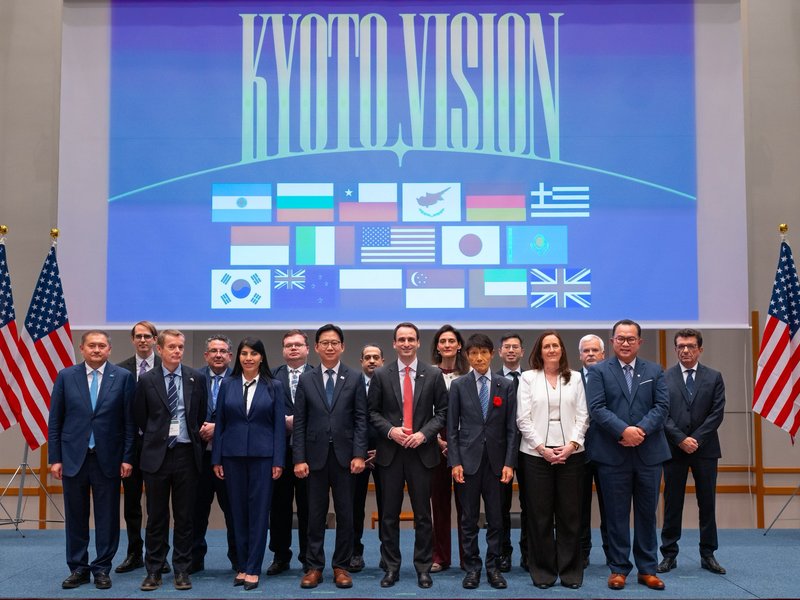
Michael Kratsios, Assistant to the President and Director of the White House Office of Science and Technology Policy, met Japan's Minister of State for Science and Technology Policy Toshiharu Furukawa in Kyoto on Sunday.
The talks reviewed progress since the two governments signed a memorandum of cooperation on the Technology Prosperity Deal on October 28, 2025.
The two sides reaffirmed the importance of strengthening collaboration in strategic science and technology capabilities and standards as technological innovation accelerates worldwide.
A major focus is artificial intelligence, described as "super intelligence" in the agreement.
The United States and Japan committed to enhanced dialogue on the technology and said they would work towards best practices for industry standards and a secure innovation ecosystem.
They also agreed to promote the adoption of trusted AI technologies and a pro-innovation regulatory environment across the Indo-Pacific.
Washington reaffirmed a $20 million commitment announced at the 2025 APEC Summit, while Japan said it intends to match the US contribution.
The two countries are also expanding cooperation on what they call "physical SI," combining Japan's strengths in hardware, industrial robotics manufacturing and industrial data with US capabilities in artificial intelligence models.
The effort will include bilateral exchanges, joint research and development programmes, joint challenges and supply-chain mapping.
The announcement comes alongside a broader expansion of scientific cooperation.
The two governments signed a protocol on October 2 indefinitely extending their 1988 agreement on cooperation in research and development in science and technology. The updated arrangement includes revised intellectual property protections.
Washington and Tokyo also highlighted a $1 billion strategic partnership established in June between the US Department of Energy and Japanese ministries.
Japan became the first international partner in President Donald Trump's Genesis Mission under the initiative.
Eleven joint scientific teams have since been launched, bringing together 12 US Department of Energy national laboratories, a DOE Office of Science user facility and 12 Japanese research institutions.
Their work covers quantum information science, fusion energy, biotechnology, advanced materials, particle physics and autonomous laboratory systems.
Telecommunications is another significant part of the partnership.
The countries are also pursuing joint research on technologies relevant to Beyond 5G and 6G networks and expanding cooperation on digital connectivity across the Indo-Pacific.
The agreement extends into critical health and pharmaceutical supply chains. The two sides said they have identified essential active pharmaceutical ingredients for an initial supply-chain analysis aimed at informing strategies to increase production.
US and Japanese regulators have established an information-sharing platform on advanced pharmaceutical manufacturing, while health research agencies are working towards joint biomedical research opportunities.
Quantum technology is another priority. Washington and Tokyo committed to cooperation aimed at securing quantum-sector supply chains, strengthening measurement standards and exploring applications of quantum sensing in healthcare.
Cooperation is also expanding in fusion energy and space.
US and Japanese researchers are working on fusion projects including Japan's JT-60SA programme and research at the US DIII-D National Fusion Facility.
NASA and the Japan Aerospace Exploration Agency, meanwhile, marked the August launch of the Nancy Grace Roman Space Telescope, for which Japan supplied optical elements and established ground stations to receive mission data.
The US-Japan technology initiative forms part of a wider effort by Washington and Tokyo to align their economic and national-security policies around strategically important technologies and resilient supply chains.
The two countries are treaty allies and have increasingly expanded cooperation beyond traditional defence ties into semiconductors, artificial intelligence, telecommunications, quantum computing, energy and space as emerging technologies become a central element of economic and strategic competition.
--IANS
lkj/rs