
New Delhi, Nov 3 (IANS) From Nepal's ancient Tihar traditions to celebrations at the White House, Diwali has acquired a visible place in the cultural life of countries across several continents.
Diwali, also known as Deepavali, is one of India's best-known festivals. Its observance has spread internationally through migration, religious traditions and cultural exchange.
In countries such as Singapore and Mauritius, it is a public holiday, while cities in the United Kingdom, the United States and Australia host public celebrations that attract people from different backgrounds.
Indian communities abroad have preserved the festival's rituals, food, music and family customs. Government institutions and civic authorities have also recognised Diwali through official greetings, public events and participation by political leaders.
The festival season offers opportunities for cultural tourism, with illuminated landmarks, temple visits, traditional food, performances and festive markets providing visitors with an insight into Indian traditions.
Here are ten countries where Diwali and related festivities have established a significant presence beyond India.
1. Nepal: Tihar and the story of Yama and Yamuna
Nepal offers one of the closest cultural parallels to India's Diwali. Known as Tihar, the five-day festival includes the worship of Goddess Lakshmi and distinctive traditions honouring crows, dogs, cows and oxen. Homes are decorated with oil lamps, electric lights and flower garlands. The festival concludes with Bhai Tika, which celebrates the bond between brothers and sisters.
A traditional story associated with Bhai Tika concerns Yama, the god of death, and his sister Yamuna.
According to the legend, Yamuna performed a ceremonial tika for her brother and prayed for his well-being. The observance is associated with prayers for brothers' long lives and prosperity.
Kathmandu and other Nepali towns offer visitors an opportunity to experience the festival alongside Nepal's own religious customs, historic temples and cuisine. Although Tihar shares several features with Diwali, it has its own rituals and cultural identity.
2. Singapore: Deepavali as a public holiday
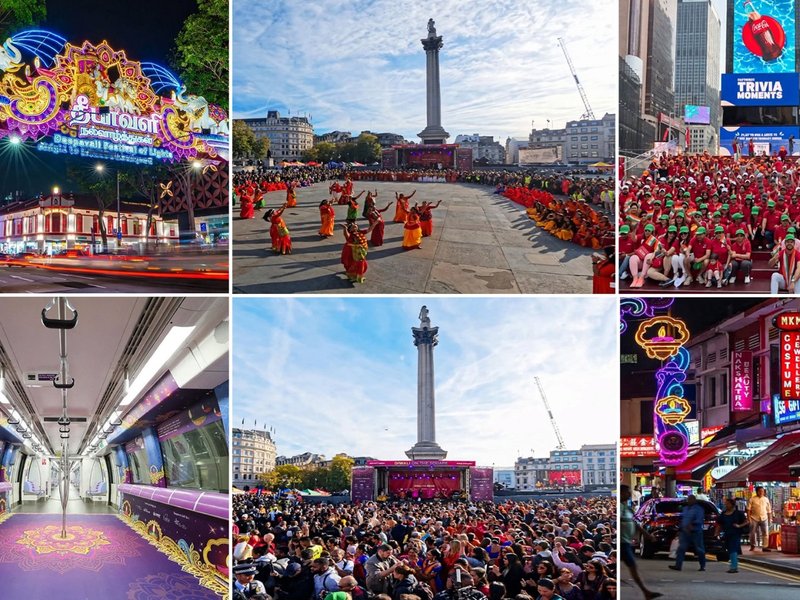
Singapore is a prominent example of Deepavali's place in a multicultural society. The festival is a gazetted public holiday, and the Little India district becomes a major centre of seasonal activity. Singapore's official 2026 public holiday calendar lists Deepavali on November 9.
Serangoon Road and neighbouring streets feature festive decorations, while shops sell sweets, jewellery, flowers, clothing and decorative items.
Cultural programmes and temple visits add to the celebrations. Deepavali remains particularly important to Singapore's Indian community, although people from other backgrounds also attend public events.
Visitors can experience the festival while exploring the city's shopping districts, religious sites and wider cultural attractions.
3. Malaysia: Deepavali across a multicultural society
Malaysia has a substantial Indian-origin population, and Deepavali is an established public holiday.
Families clean and decorate their homes, visit temples, prepare sweets and exchange gifts. Kuala Lumpur's Brickfields district, widely known as Little India, is a prominent destination during the festive season.
Indian restaurants, flower sellers, clothing shops and religious establishments offer visitors a concentrated experience of Indian cultural traditions.
Celebrations vary between communities and regions, but Deepavali has an established place in Malaysia's public calendar. Visitors can combine festival-related activities with trips to historic sites, shopping centres and the country's other cultural attractions.
4. Mauritius: Diwali and the legacy of Indian migration
Mauritius has deep historical and cultural links with India. Migration, particularly during the period of indentured labour under British colonial rule, helped preserve Hindu traditions across generations.
Diwali, commonly called Divali locally, is a public holiday. Families decorate their homes with lamps and electric lights, prepare sweets and offer prayers. Temples and community organisations also mark the occasion.
The festival reflects the enduring contribution of people of Indian origin to Mauritian society.
Visitors can experience religious observances and local customs alongside the island's beaches, natural attractions and other cultural sites.
Divali is part of the country's wider public life, although its religious observances remain especially important to Hindu communities.
5. Fiji: Diwali and the history of Indian settlement
Fiji's Diwali celebrations are closely connected with the arrival of Indian labourers during the indentured labour period. Their descendants have retained religious practices, languages and family traditions over generations.
Diwali is listed as a public holiday in Fiji's official 2026 calendar, with observance scheduled for November 9.
Homes and temples are decorated with lamps and lights, while families gather for prayers, sweets and community celebrations.
The festival provides a glimpse of the cultural traditions maintained by Fiji's Indian-origin population. Visitors can combine community events and temple visits with trips to beaches, markets and marine attractions.
Diwali's continued observance illustrates the role of migration in carrying religious and cultural practices across national boundaries.
6. Guyana: Diwali at State House
Guyana has a substantial population descended from Indian indentured labourers, and Hindu festivals form an important part of the country's cultural life. Diwali is a national holiday.
Public celebrations include decorated homes, religious ceremonies, processions and illuminated floats.
The country's political leadership has also participated in festival events.
In 2017, then President David Granger and First Lady Sandra Granger hosted a Diwali Utsav at State House.
The President described the national observance as an opportunity to promote mutual understanding among Guyanese of different backgrounds.
This provides a documented example of the festival being recognised beyond its immediate religious community.
Visitors can explore Guyana's Indian-Caribbean heritage through its temples, cuisine, music and community festivities.
The festival reflects the influence of Indian traditions on the country's broader cultural identity.
7. Trinidad and Tobago: Divali and Caribbean traditions
In Trinidad and Tobago, the festival is generally known as Divali and has a long history among the country's Indian-origin population. It is an officially recognised national holiday.
Celebrations include temple prayers, decorated homes, cultural performances and community gatherings.
Divali Nagar, organised by the National Council of Indian Culture, is a major cultural event associated with the festival. It showcases religious traditions, food, handicrafts and performing arts.
The festival reflects the way Indian customs have developed within Caribbean society over generations. Traditional lamps and prayers coexist with local cuisine, music and social practices.
For visitors, Divali offers an opportunity to explore the Indian influence on Trinidad and Tobago's history and culture while experiencing a festival shaped by both South Asian and Caribbean traditions.
8. United Kingdom: Diwali in the heart of London
The United Kingdom has a large Indian-origin population, and Diwali is widely celebrated in London, Leicester, Birmingham and Manchester.
Trafalgar Square is a focal point for London's public festivities. The annual Diwali on the Square event features music, dance, food stalls, family activities and performances representing the city's Hindu, Sikh and Jain communities.
Leicester is another major centre of Diwali celebrations, with festive decorations and community events attracting residents and visitors. British political leaders have also issued Diwali greetings, reflecting the festival's place in the country's multicultural life.
Public celebrations allow people who do not observe the festival religiously to learn about its traditions.
For Indian tourists, London and Leicester offer opportunities to experience Diwali alongside visits to museums, historic landmarks, theatres and shopping districts.
9. United States: From Indian homes to the White House
The United States provides a prominent example of Diwali receiving recognition at the highest levels of government.
The festival is observed by Hindu, Jain and Sikh communities, as well as some Buddhist communities.
In 2009, President Barack Obama became the first US President to participate in a Diwali celebration at the White House. Subsequent administrations continued to recognise the festival.
President Donald Trump participated in a Diwali celebration at the White House on October 21, 2025.
At the municipal level, New York City began observing Diwali as a holiday for public schools in 2023, with the first school closure taking place in 2024.
The decision followed a campaign by community representatives and meant that pupils could observe the festival without missing classes.
New York, New Jersey and the San Francisco Bay Area have substantial Indian-origin populations and host temple celebrations, cultural performances and community gatherings.
Visitors can combine festival events with trips to major landmarks, museums, restaurants and shopping districts.
Diwali's visibility in the United States reflects the presence of South Asian communities and the growing recognition of their cultural traditions.
10. Australia: Public festivals and illuminated landmarks
Australia has embraced Diwali through public celebrations, cultural programmes and participation by government representatives, particularly in cities with substantial Indian-origin populations.
Sydney is a prominent example. The New South Wales Government has organised annual Diwali celebrations since 2011.
In October 2025, the Sydney Opera House sails were illuminated in gold as part of the city's festivities.
The festival is celebrated by Hindu, Sikh, Jain and some Buddhist communities. Sydney, Melbourne, Brisbane and Canberra host events organised by community groups, Indian associations and public institutions. These programmes introduce visitors to Indian music, dance, food and religious traditions. Diwali usually falls during Australia's spring season, making it possible for visitors to combine public celebrations with sightseeing, beaches, shopping and cultural attractions.
The country's experience demonstrates how community participation and official recognition have helped bring an Indian festival to a wider audience.
Diwali's journey from India to the world
Diwali's international spread has followed different paths.
Nepal has its own deeply rooted Tihar traditions, while Mauritius, Fiji, Guyana and Trinidad and Tobago have preserved Indian customs through generations of migration.
Singapore and Malaysia recognise Deepavali as a public holiday. In the United Kingdom, the United States and Australia, civic celebrations have introduced the festival to wider audiences.
A comparison with Christmas can help explain the growing public visibility of Diwali in some countries. Both festivals have religious significance for their respective communities, while public celebrations can also attract people who do not observe them as religious occasions.
However, Diwali's reach and status vary considerably from country to country, and it would be inaccurate to suggest that entire populations have adopted the festival.
The mythology associated with Diwali also differs across regions and traditions. In one widely known Hindu account, the festival commemorates Lord Rama's return to Ayodhya after 14 years of exile and his victory over Ravan.
In other traditions, Diwali is associated with Goddess Lakshmi, Lord Krishna's victory over Narakasura, or the spiritual significance of Lord Mahavira's nirvana in Jainism.
Nepal's Tihar offers another example of the region's varied traditions. Its observances include worship associated with Yama, the god of death, and Bhai Tika, which celebrates the bond between brothers and sisters. These traditions should be understood within their own cultural settings rather than treated as identical versions of Diwali.
From Nepal's Tihar to Singapore's Deepavali, and from Mauritius's illuminated homes to London's Trafalgar Square and the White House, the festival season has acquired an international presence. Its journey illustrates how migration, religious observance and cultural exchange can carry traditions across borders while allowing them to develop distinctive local forms.
Diwali continues to hold its central religious and cultural significance for the communities that celebrate it. Its public observance in different countries also provides opportunities for cultural understanding, tourism and the exchange of traditions.
--IANS
snj/dan