

New Delhi, Feb 1 (IANS) When a regulation vests wide discretionary power in authorities without clear guardrails, it stops being reformist and begins to look coercive. That is precisely how the University Grants Commission's latest equity regulations have been perceived across campuses and beyond.
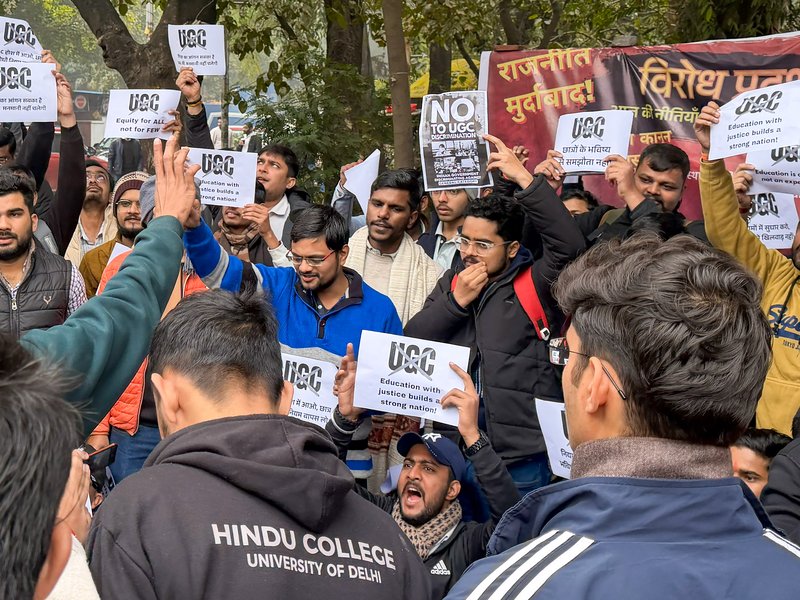
The backlash they triggered was not against the principle of equality or social justice, but against the architecture of the rules themselves -- marked by vague definitions, sweeping mandates and an enforcement mechanism that appeared more punitive than corrective.
The Supreme Court's intervention, staying the operation of the University Grants Commission (Promotion of Equity in Higher Education Institutions) Regulations and directing institutions to follow earlier norms, restored a vital constitutional balance.
In doing so, the Court reaffirmed a core principle: social justice must function within the boundaries of reasonableness, fairness, and due process. Equity cannot be administered as a blunt instrument; it must be proportionate and with safeguards.
It is difficult to believe that the drafters of these regulations were unaware of this distinction. The intention is to eliminate bias and discrimination from campuses, but the rules that were framed have raised uncomfortable questions. How does a regulation meant to prevent discrimination end up appearing discriminatory itself? How does an effort to promote equity become so one-sided that it alienates a large section of students and faculty?
The epicentre of the controversy lies in Clause 3(c), which defines "caste-based discrimination" exclusively as discrimination against members of the Scheduled Castes, Scheduled Tribes and Other Backward Classes. The definition rests on the presumption that caste discrimination is inherently unidirectional. While historical injustices against marginalised communities are undeniable and must be addressed, the complete exclusion of the general category from the scope of protection creates an imbalance that is neither just nor pragmatic.
Campuses are complex social spaces. Discrimination, intimidation, and misuse of power can occur across caste lines. There have been instances -- documented and anecdotal -- where students from general or upper-caste backgrounds have faced harassment, social exclusion, or threats. Dismissing these concerns outright risks denying genuine grievances and deepening social fault lines rather than healing them.
Controversies at institutions such as Jawaharlal Nehru University and Ashoka University, where allegations of intimidation and targeting have often surfaced, underscore the volatility of campus politics.
A recent unverified video that circulated widely on social media claimed that a false complaint under the SC/ST Act was used to intimidate a student after a personal dispute. While the college concerned denied the incident and such claims must be treated with caution, the episode nevertheless highlights a broader fear: the potential misuse of stringent laws in the absence of adequate checks.
This concern was echoed during the Supreme Court hearing on January 29. One of the counsels reportedly argued that a fresher resisting ragging by a senior from a Scheduled Caste background could be vulnerable to false accusations of caste discrimination. Given that anticipatory bail is not available under the SC/ST (Prevention of Atrocities) Act, such an accusation -- even if eventually proven false -- could irreversibly damage a student's academic career and personal life. The argument was hypothetical, but the anxiety it reflected was real.
The petitioners before the Court pointed out that the regulations not only exclude the general category from protection but also lack any mechanism to penalise false or malicious complaints. This omission has fuelled fears of harassment and selective targeting.
What has added to the unease is the political context. The regulations came as a surprise, particularly under a BJP-led government that has consistently sought to consolidate Hindu unity across caste lines. Their introduction just months before elections in five states has inevitably invited speculation about timing and intent. Whether coincidental or not, the move has undeniably stirred the caste discourse, with most political parties -- including BJP leaders -- offering support rather than criticism.
The Centre, for its part, has sought to reassure critics. Education Minister Dharmendra Pradhan has stated that the guidelines are intended solely to address caste-based discrimination and will not be misused. He emphasised that it is the responsibility of the Centre, states and the UGC to ensure constitutional compliance, especially since the matter is now under the Supreme Court's supervision.
The assurances alone may not suffice. While protests have subsided following the Court's stay, a lingering sense of mistrust remains among a significant section of society. The Supreme Court has rightly cautioned against politicising the issue, observing that India's unity must be reflected within its educational institutions. But in a climate where law, identity and politics are deeply intertwined, keeping such regulations apolitical will be easier said than done.
If equity is to be meaningful, it must be inclusive, balanced, and transparent. Otherwise, reform risks becoming coercion -- and justice, a casualty.
(Deepika Bhan can be contacted at deepika.b@ians.in)
--IANS
dpb/sd/