
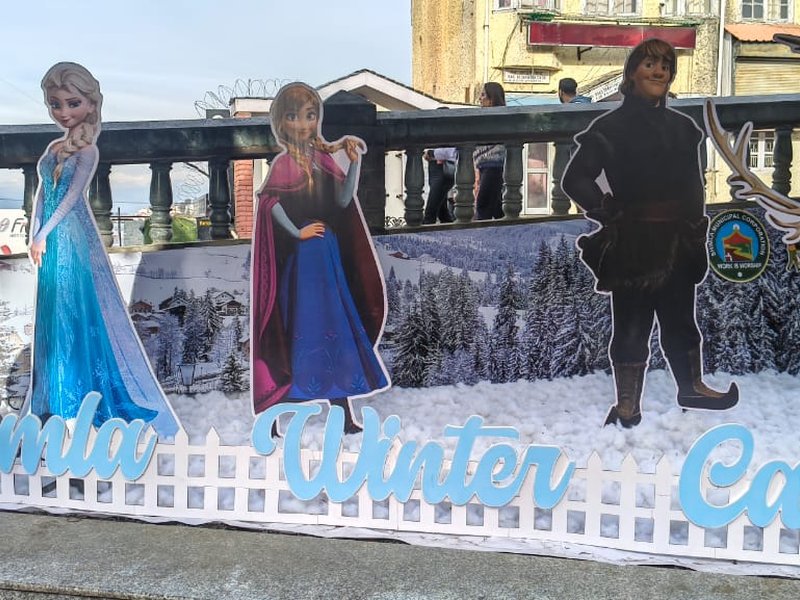

Shimla, Dec 23 (IANS) Snow has slipped quietly out of Shimla’s winter postcard this season again. The familiar crunch underfoot is missing, cedar slopes stand bare, and the white silence that once wrapped the hill town in December has refused to arrive.
Except for celebrating ‘White Christmas’ of 2024, the snowy landscape has been elusive since 2016. To preserve the winter wonderland spirit with snow-draped streets with “fairy-tale” atmosphere for tourists, local authorities have turned to artificial measures by turning to rows of cotton, spread carefully, to recreate a fleeting illusion of snow, offering visitors a manufactured fairy tale where nature has momentarily withdrawn.
This highlights concerns over climate change while reflecting efforts to sustain tourism and holiday spirit despite environmental shifts.
The India Meteorological Department (IMD) here says that before 2016, the summer capital of British India saw Christmas snows in 1991 when 49 cm of snowfall was recorded.
Though some years between 2014 and 2018 had mild spells, a day ahead of the Yuletide spirit. Experts blame rising temperatures, vehicular pollution and changing climate patterns as key reasons for the absence of snow.
There will be mellow sunshine and no snowfall till December 28 at most of the tourist destinations in Himachal Pradesh, as the weather bureau predicted dry weather will continue to prevail. However, temperatures have been unusually low in most of the popular tourist spots like Shimla, Narkanda, Kasauli, Manali, Dharamsala, Dalhousie and Chamba.
But excited winter getaway holidaymakers, mainly from the northern states, have already started descending on tourist resorts dotted across the state for the Christmas and New Year holidays.
“From Christmas till the weekend, most of our hotels have been getting good bookings and queries,” a senior official with the Himachal Pradesh Tourism Development Corporation (HPTDC) told IANS.
He said the arrival of the tourists in Shimla, Narkanda, Manali, Dalhousie, Dharamsala and Palampur is quite enormous.
The mountain peaks viewed from Shimla’s historic Ridge and Dharamsala and Palampur have been wrapped in a scanty blanket of snow.
Popular resort Manali is getting a good share of tourists as its nearby hills have plenty of snow.
“The snowfall that blankets the hills and paths in pristine white adds a magical touch. Normally, we go for winter vacation around Christmas. This time, there is hardly any snowy landscape in most of the popular hill destinations. So we have decided to visit Manali on New Year’s Eve with a hope to embrace the snowy landscape,” tourist Radhika Gupta, a Chandigarh-based corporate executive, told IANS.
This month, Governor Shiv Pratap Shukla watched the children’s film “Crossings” at Lok Bhavan here and lauded the film for effectively spreading awareness on climate change and environmental protection among children.
He appreciated national film award-winning filmmaker Vivek Mohan, who was born and brought up in Shimla, for presenting a sensitive and impactful message through the film, which highlights how human actions can lead to natural disasters and underlines the importance of conserving nature for future generations.
Mohan shared with the Governor that “Crossings” is a short film inspired by two real-life incidents. The film highlights the issues of global warming and climate change. He said that the film carries forward the message earlier shown in his film “For Whom the Jingle Bells Toll”.
The main message of the film is that the earth is not inherited “from our ancestors, but borrowed for our children”.
Met officials, however, are wary about the chances of snowfall on New Year's Eve. They say it is still too early to predict whether Shimla or Manali, or Dalhousie will have snow cover next year.
Deforestation and pollution are blamed for the change in Shimla's climatic conditions, says a study by the IMD. It says Shimla's harsh winter, which normally commences in November and ends in March, has declined after the mid-1980s.
The study examines the snowfall trend in Shimla from 1990 to 2007. Some old-timers have been wondering if the rise in minimum temperatures in recent years in winter is a result of global warming, though scientists have said the overall warming trend should not have any effect on local weather on such short-time scales, as per current models.
(Vishal Gulati can be contacted at vishal.g@ians.in)
--IANS
vg/dan