
Islamabad, July 25 (IANS) Pakistan's continued use of proxy militias, enforced disappearances, bureaucratic marginalisation, and resource exploitation without any benefits for local communities has only fuelled the insurgency rather than containing it.
Every missing student, every family displaced from the coastline to facilitate foreign-backed port projects, and every Baloch household living beside a gas pipeline without access to gas strengthens the belief among many that their future does not lie within Pakistan, a report has stated.
“Balochistan has reached a point of no return. The Pakistani state has increasingly relied on a militarised and security-centric approach in Balochistan, viewing the region primarily through the lens of security, terrorism, and counter-insurgency rather than governance, political engagement, and development. This approach is failing and has become increasingly counterproductive, further deepening instability and worsening the overall situation,” a report in 'International Centre for Peace Studies' detailed.
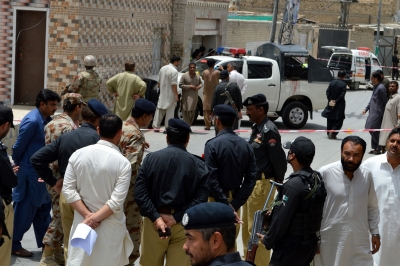
“In recent weeks, there has been a sharp surge in militant attacks, including the attack on a Pakistani military convoy in Mastung, the deadly assault in Ziarat in which police personnel were killed and abducted, attacks around Quetta, and several other coordinated incidents across the province, reflecting the rapidly deteriorating security environment,” it added.
According to the report, large swathes of Balochistan, particularly the rugged districts of Awaran, Kohlu, Kech (Turbat), and the Zarghoon Ghar mountains, are effectively beyond the Pakistani state's control. It claimed the security situation has deteriorated to such an extent that the Pakistan Army rarely ventures into these areas, with security forces largely confined to their barracks.
“In a major public confirmation of this reality, senior Pakistani politician and JUI-F chief Maulana Fazlur Rehman stated that the entire Baloch region has slipped completely out of Pakistan’s control, delivering a public speech where he directly rebuked Army Chief General Asim Munir and asserted that ‘even today, there is no writ of the Pakistani government there’,” it mentioned.
The report noted that China has increasingly signalled its intention to withdraw from conflict-ridden Balochistan. It noted that the permanent closure of the China-backed Hangeng Group's multi-million-dollar China-Pakistan Economic Corridor (CPEC) industrial operations in the Gwadar Free Zone is due to persistent security risks, while the managing director of the Saindak Copper-Gold Project warned that operations are on the verge of a complete shutdown because of continuous insurgent blockades and highway closures disrupting supply lines.
Highlighting the recent attack in Balochistan's Ziarat district, the report said nine police personnel, including two senior Station House Officers (SHOs), were killed after insurgents stormed the police checkpost guarding the Kuch Mangi Phase-III construction site of the multi-billion-rupee Mangi Dam project.
In the same attack, 18 other local police personnel were abducted from the facility before being executed, with their bodies later recovered in the remote Zarghoon Ghar mountains.
While the Pakistani military projects the narrative that the Baloch Liberation Army (BLA) and Tehreek-e-Taliban Pakistan (TTP) were jointly responsible for the killings, sections of the local population, activists, and families of the victims have alleged that the security personnel were targeted and killed by Pakistan-backed death squads.
They claim the incidents were used to create grounds for launching the Pakistani military’s large-scale counter-insurgency operation “Operation Shaban”, while expanding the security crackdown across Balochistan, the report mentioned.
--IANS
scor/as