
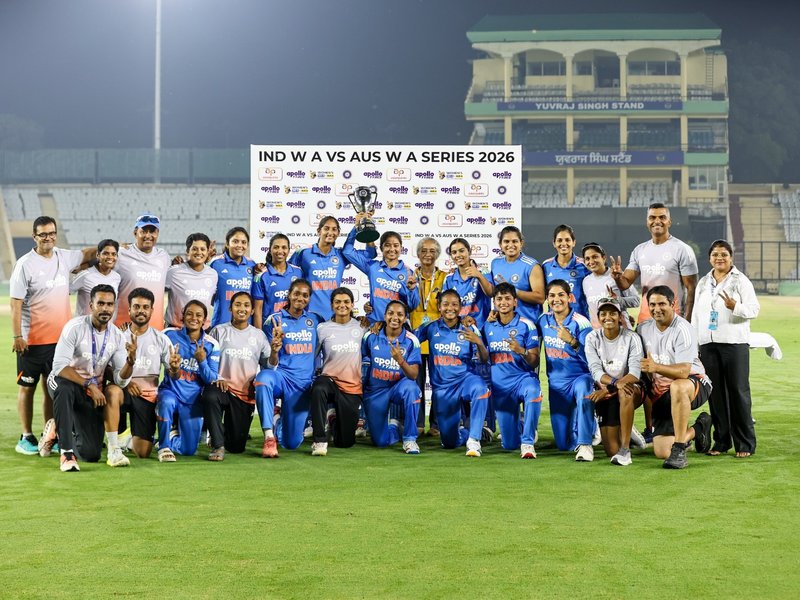

New Delhi, Oct 15 (IANS) There was no live streaming, so the people at the IS Bindra Stadium will have to do the remembering for everyone else. On September 25, in the deciding game of the three-match one-day series, Australia A made a daunting 362/9.
Two days ago, Australia A hunted down 339 to square the series against India A. Coming to the chase, when Tanisha Singh fell for 60 in the 20th over, India A were 119/4 and needed another 244 to get an improbable win and clinch the series.
In the Indian dressing room, nobody sat in a corner doing the arithmetic of despair, according to Tejal Hasabnis. The pitch was good, the batters were in form, and the conversation ran only one way. "Basically, it started with the first ODI, where we chased well on an okayish wicket. We knew that we would get hit for runs, but the wicket was good, the batters were in form and hum bhi runs bana lenge (we will score runs too)," Tejal told IANS.
They did, as Anushka Sharma (58) and Niki Prasad put on 91 runs for the fifth wicket. Off-spin bowling all-rounder Minnu Mani walked in and made an unbeaten 88 off 56 balls. She added 106 runs with Niki, who took four wickets earlier in the day before making 76. Minnu later had an unbroken 47-run stand with Jintimani Kalita as India A got home with ten balls to spare.
Tejal has played alongside Minnu for seven or eight years and was left in awe of how she finished the chase. "The way she finished, it was too classy and too good to watch." Rajib Datta, who has worked with this group for years, believes the ability was always there. "She only lacked belief. That knock she played in Mohali showed that she has that capability," Rajib told IANS.
Tejal remembers that the batters agreed to keep the required rate around seven and never let it stretch to nine or ten. That strategy came from the preceding T20 series, which Australia A swept 3-0 after quiet overs let the asking rate drift away from India A’s reach. "Everyone knew we made a mistake then, and we had not to repeat it in that game," she said.
Only one side has chased more in women's List A cricket: Bengal, who hunted down 390 against Haryana in December 2024. "No one would have ever thought that 363 runs would have been chased by them," said Hemlata Kala, a former India player and a national selector from 2015 to 2020.
"What India A has done – woh kaarnama hai sikandaron ka (a feat achieved by the champions). The way they played against Australia in one-days, I have never seen a team play like that against them," she added.
Tejal stated the shift in approach is deliberate and runs from India A to Under-19 teams. "After winning the 2025 World Cup, you now get the belief that the Indian women's cricket team is gonna dominate. All of us are looking to dominate due to a shift in approach and intent.
“There’s a quote I have, ‘You bleed more in practice, so you bleed less in war.’ That kind of process, intent shift and attitude to dominate is giving us the results on and off the field."
The improbable chase had its roots in a sentence spoken in 2023. After India won the inaugural Under-19 Women's World Cup in South Africa, VVS Laxman, head of the BCCI's Centre of Excellence (CoE) in Bengaluru, pulled two coaches for a new project.
One was Datta, then a bowling coach and lead faculty at the CoE. The other was Apurva Desai, the current India A women’s head coach. "Whatever you are doing with the boys, I want it replicated for the women's," Datta recalls Laxman telling them.
By then, A tours, central monitoring and an Under-19 pathway had given India's men a bench deep enough to win the Border-Gavaskar Trophy series in Australia in 2020/21 without half of their first-choice players. But when it came to women’s, there was nothing notable.
In August 2025, India A beat an Australia A side stocked with established names 2-1 in a one-day series in Brisbane, just before the Harmanpreet Kaur-led side went on to win the Women's ODI World Cup for the first time at home.
This year, even as Harmanpreet & Co made an early exit from the T20 World Cup, India A brought some cheer by winning the 50-over series by the same margin in England, before doing it again against Australia A at home. In February they also won the Emerging Women’s T20 Asia Cup title in Bangkok.
Since August 2024, India A have played 32 matches across three formats, and their assignments have gone from one a year to three in 2026 (with England A set to tour in December). Around 40 players have been involved in India A setup so far. Days after the chase of 363, India A beat Australia A by 281 runs in a four-day game, their first red-ball win in three attempts.
Several India A players will be a part of the main team taking on Zimbabwe in a white-ball series starting in Raipur on Friday. Niki, who captained India to 2025 U19 World Cup win in Malaysia, and Jintimani Kalita are in the senior T20I squad for the first time, with Anushka Sharma, Minnu and Prema Rawat recalled, while Tejal, Yastika Bhatia, Vaishnavi Sharma and Sayali Satghare are in the ODI squad.
Harmanpreet gave up the all-format captaincy, with Smriti Mandhana set to start her full-time tenure against Zimbabwe. Datta expects the senior side to move towards a transition within a year, which makes it a fair time to look at how India A learned to play the way it does.
“VVS is more of a holistic person. He doesn't leave any small loophole as he’s creating a system. Obviously, you will have to give kudos to the BCCI and Jay Shah because had it not been for them, women's cricket wouldn't have reached this stage. When we went to South Africa in 2023, I said, if this Under-19 team can win, it will change women's cricket in India and it started from there only,” said Datta.
When the Neetu David-led selection committee took charge, there was no dedicated India A women's side and no structured Under-19 pathway. Aarti Vaidya, a former India cricketer and national selector, recalled how the selectors lobbied for an A programme that would give India a pool of 30-40 players.
"It's not that our girls were not talented, but then there was no direction. You can't be bringing a player from home and straight away put her into international cricket. There is still a lot of work to be done, but we can see the fruits now."
The Under-19 title win in 2023 was meticulously planned: selectors tracked players from 2021 and made a pool of 25 players, while coaches spent ten months building extensive files on every opponent.
After coming back to Bengaluru, Datta asked Desai a question. "Doing it one time is a fluke. Can we do it a second time?" They prepared for another 18 months, and India retained the title in 2025. That, Datta says, is what convinced the BCCI the method worked. Even as Datta moved on from the CoE last year, Desai has stuck with the women's A team.
The first tour was humbling - in August 2024, India A won one match out of seven across three formats in Australia. The post-mortem rounded up the usual suspects: fitness, fielding, running between the wickets. But the coaches refused to wait until those were fixed.
"We have to beat them with skills of batting and bowling and play a brand of cricket which will actually intimidate them. So, that's what we started instilling into them and Apurva has done a fantastic job over the last two years," he says.
Australia A travelled with 15 support staff members, backed by a women's wing of around 20 people who know every player from Under-19 level. As per Datta, India took inspiration from the template, ‘with some Indian twist’ added.
Curiosity has since flowed the other way. Datta says Lisa Keightley and Kyle Hogg, then with Australia and England U19 teams, have asked what India are doing to unearth solid players. "There was a time when we used to try and follow England and Australia and now the world is trying to follow us."
On fitness, a conscious call was made to start with teenagers rather than players already 25 or 26. "I can get the seniors to get fitter. But they will never be able to match the Australians. So, who will be able to match the Australians? The younger crowd who are 19, 20 and 21."
Every girl who plays state cricket in India, starting from the Under-15 level, is logged on an Athlete Management System (AMS) that records her daily training, workload and sleep. "It's exactly like what we did with the men. There is no differentiation," Datta says.
Aarti's panel scouted domestic matches for roles, not runs and wickets. "Let's not look at the scores – let's look at the specific talent which we want." G Kamalini, spotted at Under-15 level, went through India Under-19 and the Women's Premier League (WPL) before coming into the Indian team. "You have already 25 girls who are ready to play for India," says Aarti.
Datta reckons the IPL took a decade to pay dividends for the men’s team, while the WPL has just done that for the women’s team in four seasons. He also credits the selection panels under Neetu and Amita Sharma for being in sync with the CoE in terms of rotating and selecting players for India A tours.
“These are the last five years where I am seeing coaches and selectors working in unison towards some goals. It's a lovely time for women's cricket and in the next two years, we will be ruling the world. That's what I want to see.”
Fielding and fitness were long India's excuses in not being able to defeat Australia often and preparation for that began two months ago at high intensity. "Now, with that intent, everyone is putting hard yards off the field. Even on the last day of the last match, if I have to take a diving catch to win the match, I had an idea that it should be like this," said Tejal.
The planning for fielding has changed too. After watching Australia, the coaches began training position-specific movements. Datta admits lapses remain, but believes they are ending, as training specialist fielders for specialist positions is the next project in India A setup. "You will see these stopping now. We will take brilliant catches and you will see the results in a year’s time, as it has already started."
Tejal goes back to February, when India A lost their opening Emerging T20 Asia Cup match to UAE. Desai came into the dressing room and said, ‘It's okay, it's one bad day, now what next?’ India A won their next games and the title too.
"A system has been made where the player feels safe to execute plans," she says. To her, India A is ‘the important in-between step between domestic cricket and international cricket,’ and those who move up carry, “that sense of confidence. That we were in this situation before, we did well."
Former India player Karuna Jain, who was in the India A coaching staff for 2025 ODI World Cup warm-up games, says the players trust Desai and learn something new every time he speaks, though his ideas have only started showing results on the field in the last 12-18 months.
Karuna watched that patience work on Shafali Verma, who was initially left out of the ODI World Cup squad. "She was a little disappointed in not making it to the team. But again, we spoke to her and she performed too," she says.
Shafali was called up later in the tournament due to Pratika Rawal’s ankle injury and delivered an all-round performance as India won the final. "She got the opportunity at the right time and grabbed it with two hands," added Karuna.
Another example she gives is of leg-spin bowling all-rounder Prema Rawat, who went from India A squad in England to the T20 World Cup as a replacement for injured Shreyanka and did well in the Asia Cup-winning campaign.
When Karuna played for India, three or four series a year were held, and a single failure could mean a wait for a year or two. "In our time, if we had more series, then even we would have been aggressive," she says. Now, with a system in place, a dropped player knows another chance is coming.
Currently, 120 women players are divided into four 25-member squads: main contracted, targeted, Under-23, and Under-19. Where the women's A team goes beyond the men's setup is developing a pool of female coaches.
The Neetu-led committee insisted on a female head coach for the Under-19 World Cup, and Nooshin Al Khadeer took charge for two title wins. Nooshin, Vanitha and Sunetra Paranjpe hold CoE coaching contracts and building female coaches is a part of the plan via level 1, 2 and 3 exams and giving them opportunities.
Around Datta and Desai, coaches have been rotated on India A tours to gain experience: bowling coach P Krishna Kumar and fielding coach Milap Mewada, as well as Nooshin, Karuna, Vanitha, Sunetra, Rumeli Dhar, Shrabani Debnath and Priyankka Acharya. When Desai was called to the coaching staff for India A men’s red-ball games against Australia A in Puducherry, Sunetra stepped in for him in Mohali.
Not everything has crossed over. Other boards are often reluctant to host India A women tours for financial reasons, and Aarti said India has offered to host them instead. Right now, T20 is the format that hasn't yielded desired results.
"That T20 format is something we are yet to crack. That's a puzzle we are trying to solve," Datta says. Against Australia A and England A, India A have won one of 12 T20s since 2024, though three of those defeats came by seven runs or fewer.
Tejal still thinks about one T20 game against Australia A that got away, when her side needed 60 off 60 balls with nine wickets in hand and lost the plot. "Maybe I could have finished the game," she says. Within a year, Datta expects separate women’s squads for different formats, just like how it is for the men’s.
Though Datta is no longer in CoE, an emotional feeling still runs high in him over seeing India A women succeed. "You can just hear my voice and understand the inner feeling. It's unbelievably gratifying and satisfying. That inner feeling of satisfaction is something that a coach keeps with himself or herself."
Datta spent about 25 days with the India A group before the series against Australia A at the CoE and told Laxman that the next crop was ready to step up to the higher level. As per Datta, few more players can step up to India A - G Trisha, Player of the Series at the 2025 Under-19 World Cup, Soumya Tiwari, Triveni Vasistha, Henrietta Pereira, Nandana Sridharan, Happy Kumari and Shuchi Upadhayay.
“Our system is so good and so robust. Even if nothing is done, we will get 14 good players. That’s there 100 percent - but the question is, can we bring these 14 good players into one common vision? That was always our challenge.
“Now a system has been put in place. Just following and being within this, you would replicate and keep on going for five years time until and unless someone beats us into this process, which is again going to happen.
“So, once we have found this Midas touch, can we elongate this for 7-8 years? For that, whoever comes in women's cricket will have to come with a belief that this is a system that has worked.”
By bringing in a few India A players for the upcoming Zimbabwe series, the selectors have made a start. Whether the new call-ups get a proper run to establish themselves is the real test. Back in domestic cricket, the queue for India A spots is set to increase and Tejal knows the only way is upwards.
"Whenever you get to play in the blue jersey, it's always a pleasure and privilege. This is just the beginning, I feel. It will be a good headache for everyone as that kind of healthy competition is coming. Everyone is coming, performing and that is something I am looking forward to and I hope everyone enjoys that,” concluded Tejal.
--IANS
nr/vi