
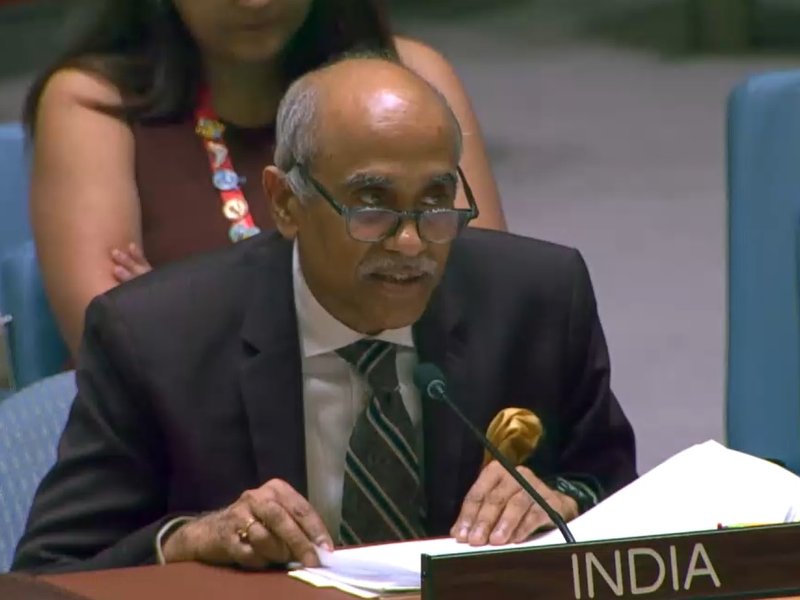
United Nations, Oct 30 (IANS) As threats to maritime security emerge from new technology, India has urged international cooperation to counter them and said it would be a priority for it in pursuing election to the Security Council.
"India has identified AI (artificial intelligence) and maritime security as important priorities for its candidature to the Security Council for 2028–2029", India's Permanent Representative P Harish said on Thursday.
"Our objective is clear: technology must strengthen human security, not undermine it; it must expand opportunity, not inequality; and it must make our shared maritime commons safer, not more contested", he said.
India is contesting the election next year for a non-permanent Council seat with a two-year term starting in 2028.
He was speaking at an open debate at the Council on “Emerging Technologies and Maritime Security: Implications for Peace and Security” that was convened by Greece as Council president and chaired by its Prime Minister Kyriakos Mitsotakis.
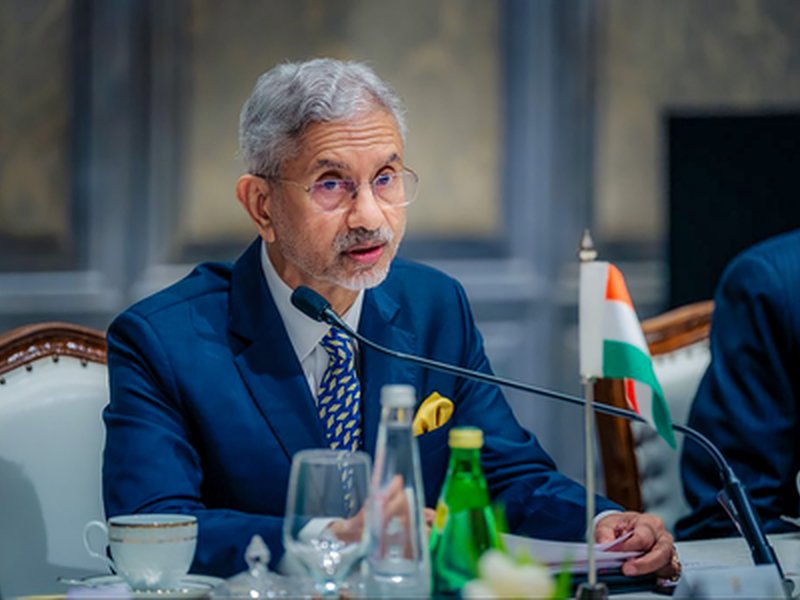
Harish recalled that External Affairs Minister S. Jaishankar and Greece's Foreign Minister George Gerapetritis had co-chaired a high-level discussion last month on AI and maritime security and said this was an opportunity to build on it.
The Council debate took place on a day when Iran's Navy said three oil tankers in the Strait of Hormuz had hit sea mines and were ablaze, highlighting the maritime perils.
Harish said, "India strongly condemns attacks against commercial vessels and reiterates the importance of freedom of navigation, unimpeded lawful maritime commerce and the safety of seafarers, in accordance with international law".
The "attacks against commercial shipping threaten seafarers, disrupt supply chains and disproportionately affect developing countries through higher costs and economic uncertainty", he said.
On the debate topic, he said, "Emerging technologies are fundamentally transforming the maritime domain" and "equally, their misuse presents new challenges that demand our collective attention".
"AI-enabled analysis of satellite imagery, radar and vessel-tracking data can improve maritime domain awareness, detect suspicious activities", he said.
To enable these solutions, he offered India's cooperation, which he said is "guided by the vision of SAGAR, Security and Growth for All in the Region".
"India's Information Fusion Centre–Indian Ocean Region (IFC-IOR), located near New Delhi, demonstrates the value of cooperation and information-sharing in strengthening maritime security", he said.
The IFC-IOR, set up in 2018, is hosted by India's Navy and has 12 partners.
Earle Courtenay Rattray, the Secretary-General’s Chef de Cabinet, warned that "non-state actors" -- terrorists -- can exploit the new technologies
He asked the Council to work for stronger international cooperation to face these risks.
Fareed Zakaria, the Indian American journalist and author who briefed the Council, said the digital domain was itself at risk.
He said 95 per cent of the world’s digital communications travel through a network of subsea cables that leave them vulnerable to attacks.
He said real-time data processing using AI can help prompt action against signal-jamming or attempts to cut the undersea cables.
“The technology is there. The ocean is waiting. What we need is the political will to implement this, he said, speaking through a video link.
Last week, a senior Islamic Revolutionary Guard Corps commander, Brigadier General Yadollah Javani, warned that his country could attack undersea internet cables in the Strait of Hormuz if its infrastructure was attacked.
--IANS
al/rs