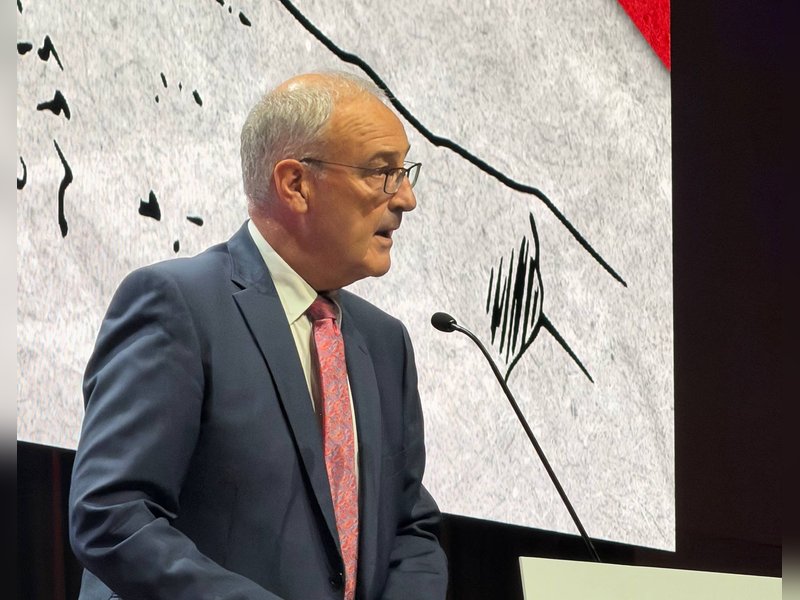
Washington, Oct 5 (IANS) Artificial intelligence could transform the lives of farmers and other workers in India and developing countries without posing the same immediate threat to jobs seen in advanced economies, World Bank President Ajay Banga has said, citing an AI initiative helping women farmers in Uttar Pradesh diagnose crop diseases using basic mobile phones.
Banga said the debate over AI in developed countries is dominated by large language models and generative AI, technologies that require enormous computing power, energy, data, skilled personnel and capital.
Most emerging economies, he said, do not yet have that combination.
Instead, Banga sees a potentially transformative opportunity in what he called "small AI" — predictive tools that can improve agricultural productivity, education, skills and healthcare.
Speaking during a discussion moderated by CNN's Fareed Zakaria at Columbia University, Banga pointed to Uttar Pradesh as an example of how such technology is already being put to practical use.
"So in Uttar Pradesh, in India, we've launched applications with Google, for example, where illiterate women farmers connected to a cooperative," Banga said.
He described how a woman farmer could use the technology without needing sophisticated equipment or technical expertise.
"So, we give them a tool that she can speak into a 3G phone, point the camera at the back of a leaf of a diseased plant, and it spits back at you that disease, this insecticide for 25 Rupees from your local cooperative. You press the button. It's yours."
"Now, you sort of have democratized the access to amazing knowledge for an illiterate woman farmer. And that to me is, again, A.I. at work," Banga said.
He said similar opportunities existed in healthcare and other sectors.
Banga's comments offered a sharply different perspective on the global debate over whether increasingly capable AI systems will eliminate large numbers of jobs.
He argued that the immediate impact would vary dramatically between rich and developing economies.
In developed economies, Banga said, as many as one-third of jobs could potentially be affected by large language models.
But the picture changes significantly as countries move down the income scale.
"In fact, in the developed world, while one-third of jobs could potentially be impacted by LLM, which is your point. But the moment you get to a middle income country, that number is in the single digits. By the time you get to a low income country, it's zero," Banga said.
His argument is that developing economies still have considerable room to expand productivity and employment before confronting the displacement pressures increasingly being discussed in wealthier countries.
Banga said large language models require five critical ingredients that remain scarce in many emerging markets.
"So I mean, large language models and gen AI is what tends to be discussed in the developed world. And the reality is for the emerging markets, what does LLM actually need to run? It needs computing power. Lots of it. It needs energy. A very large amount of it, which I would argue even the developed world is struggling with."
"It needs data. It needs people who know how to manage that. And then it needs capital. There are very few emerging markets with that combination of five things," he said.
That is why, Banga said, emerging economies have a more immediate opportunity to deploy smaller AI applications.
"And therefore the emerging markets -- actually, what's really an opportunity there is what we call small AI, which is predictive tools used to improve the productivity of farmer, of better education and skilling, or of improved capabilities in healthcare," he said.
The discussion also highlighted the contrast with advanced economies, where AI could disrupt established career paths and white-collar employment.
Greek Prime Minister Kyriakos Mitsotakis, who appeared alongside Banga, pointed to professions such as law, where AI can increasingly perform research and document work traditionally assigned to younger employees.
Mitsotakis warned that middle-class workers in developed countries could face pressure from both AI and robotics.
"If you -- for the -- for the farmers in India, this is great. But for, for a middle class in the developed world which has already been battered by globalization, and now you have AI going after the white collar jobs, and robotics going after what's left of the manufacturing jobs that doesn't really leave, you know, a lot of room for optimism regarding the future," he said.
--IANS
lkj/rs