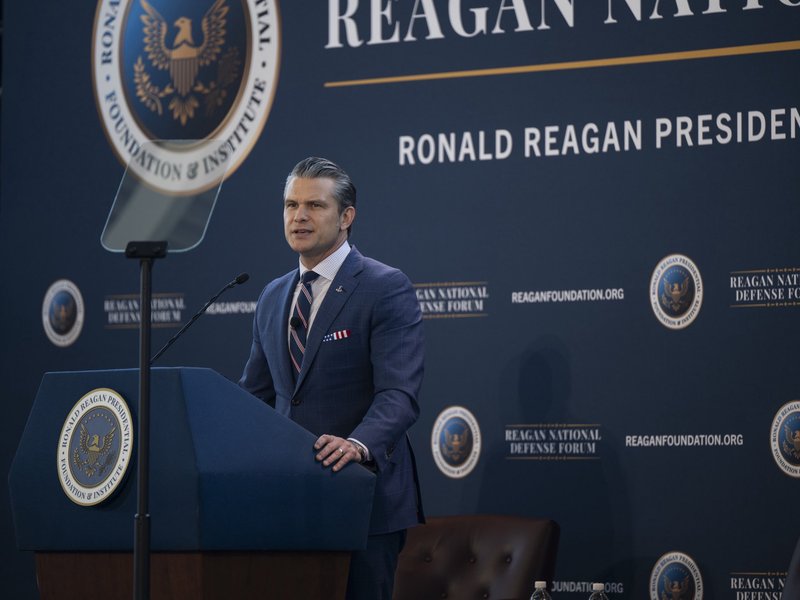
Washington, Dec 7 (IANS) The United States will anchor its China strategy on deterrence “through strength, not confrontation,” US Secretary of War Pete Hegseth said, declaring that Washington intends to maintain an unambiguous military edge across the Indo-Pacific while keeping diplomatic channels with Beijing open.
In a keynote address at the Reagan National Defense Forum in California on Saturday, Hegseth said that under President Donald Trump, bilateral ties with Beijing are “better and stronger than they’ve been in many years,” pointing to a recent “major breakthrough in trade” between the two countries. He added that reciprocal state visits in 2026 provide an avenue for “even more progress.”
But he made clear that improved dialogue would be underwritten by hard military power. “This line of effort is based on flexible realism, not naivete,” he said. The United States, he added, seeks “a balance of power that will enable all of us, all countries to enjoy a decent peace in an Indo-Pacific where trade flows openly and fairly, where we can all prosper and all interests are respected.”
Hegseth said Washington is not aiming to limit China’s development or force a strategic humiliation. “We’re not trying to strangle China’s growth. We’re not trying to dominate or humiliate them, nor are we trying to change the status quo over Taiwan,” he stated.
Instead, the Trump administration is focused on ensuring a regional military position robust enough to deter coercion or aggression. “This includes the ability for us, along with allies, to be postured strongly enough in the Indo-Pacific to balance China’s growing power,” he said. “This is what we mean by deterrence in the Indo-Pacific, not dominating China, but rather ensuring they do not have the ability to dominate us or our allies.”
Hegseth underscored that the Department of War is closely tracking the scale and sophistication of China’s military expansion. “Our department maintains a clear-eyed appreciation of how rapid, formidable, and holistic the military buildup has been. We take these capabilities seriously. It would be silly and frankly disrespectful not to,” he noted.
Operationally, he said, the United States will retain the capacity “to project sustained capabilities along the first island chain and throughout the Indo-Pacific,” ensuring that any move toward conflict becomes strategically untenable for Beijing. “That means being so strong that aggression is not even considered and that peace is preferred and preserved,” he said.
The goal, Hegseth added, is to ensure President Trump can “negotiate from a position of strength to sustain peace in the Indo-Pacific,” describing this as central to avoiding miscalculation between the two nuclear-armed powers. “We will speak softly and carry a big stick,” he said, invoking Theodore Roosevelt.
He also linked China's deterrence to broader shifts in allied responsibilities, particularly in Asia. Hegseth pointed to South Korea’s recent pledge to spend “3.5 GDP on core military spending” and assume leading responsibility for its defence, suggesting that similar steps would strengthen the region’s collective balance. Allies capable of greater military contributions, he said, will form part of “a powerful shared defensive shield” that complicates any unilateral move by Beijing.
The Indo-Pacific has become the central theatre of global strategic competition, with the United States, China and regional powers investing heavily in maritime, cyber, and aerospace capabilities. Beijing’s rapid naval expansion and its assertiveness in the South China Sea have led Washington, Tokyo, Canberra and New Delhi to deepen their own security cooperation.
--IANS
lkj/rs