
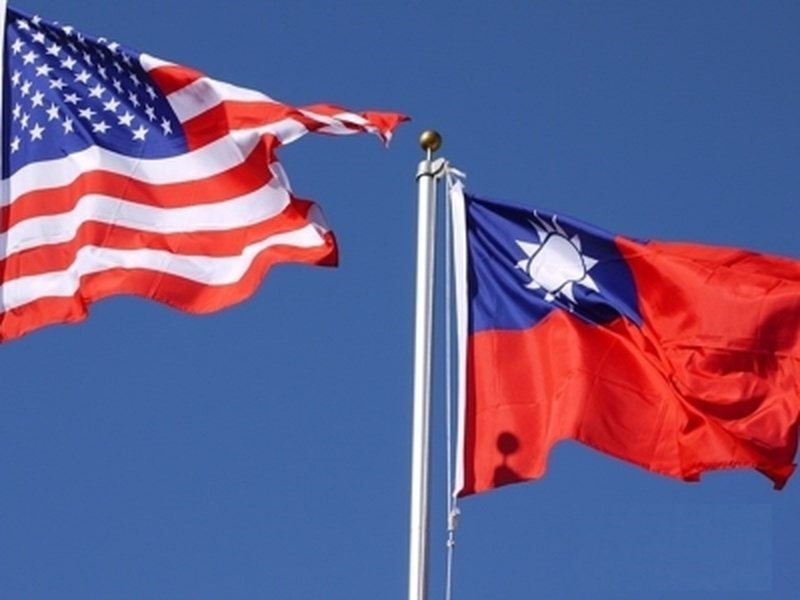

New Delhi, Dec 18 (IANS) The United States' approval of a huge arms package worth more than $10 billion for Taiwan on Thursday comes on the heels of China intensifying military pressure and escalating a diplomatic war of attrition against Washington's regional allies, Japan and The Philippines.
Beijing retaliated by asking the US to "immediately cease its dangerous act of arming Taiwan" where China's Foreign Ministry Spokesperson Guo Jiakun said that the move "severely undermines China's sovereignty, security, and territorial integrity".
Earlier this month, the White House had indicated in a security strategy document that "deterring a conflict over Taiwan, ideally by preserving military overmatch".
The White House document on "National Security Strategy of the United States of America November 2025" said, "There is, rightly, much focus on Taiwan, partly because of Taiwan's dominance of semiconductor production, but mostly because Taiwan provides direct access to the Second Island Chain and splits Northeast and Southeast Asia into two distinct theatres".
The 'First Island Chain' is a string of Pacific archipelagos from the Kamchatka Peninsula, through Japan, the Ryukyu Islands, Taiwan, the northern Philippines, and down to Borneo and the Malay Peninsula.
It serves as both a natural barrier and a platform for power projection, anchoring Washington's alliances and containing Beijing's influence in the Western Pacific.
The 'Second Island Chain' refers to a strategic maritime defence line that includes Japan, Guam, and Micronesia which serves as a secondary defensive perimeter for the United States, particularly in response to China's growing military capabilities.
"We will build a military capable of denying aggression anywhere in the First Island Chain. But the American military cannot, and should not have to, do this alone," contended the strategy document, adding, "Our allies must step up and spend -- and more importantly do -- much more for collective defence."
Meanwhile, China has stepped up its diplomatic diatribe against Tokyo and Manila.
Japan's Prime Minister Sanae Takaichi had earlier said that any attack on Taiwan could trigger a military response from her country.
Beijing had also reacted sharply to a reported land lease deal signed by Japan's Defence Ministry for allegedly deploying a mobile surveillance radar unit on the easternmost island of Okinawa apparently to monitor the activities of Chinese aircraft carriers and airplanes.
Meanwhile, it also charged The Philippines for "intruding into China's sovereign airspace and waters".
Under President Xi Jinping, China has undertaken a vast military expansion emphasising amphibious, naval, and precision-strike capabilities, aiming to assert control over Taiwan, which Beijing considers a breakaway province.
Taiwan, governed democratically and strongly asserting its sovereignty, has also intensified its military readiness through annual large-scale exercises.
It extended mandatory military service, invested in new defence technologies including drones and missile systems, and bolstered special forces.
The White House strategy follows the security document that stated developing strong measures along with deterrence necessary to keep sea lanes open, free of tolls, and "not subject to arbitrary closure by one country".
It added that not only did the United States need to further invest in military capabilities, "but also strong cooperation with every nation that stands to suffer, from India to Japan and beyond, if this problem is not addressed".
With the two strongest economies and military powers upping their ante, the situation remains volatile as tensions rise in the region.
--IANS
jb/khz